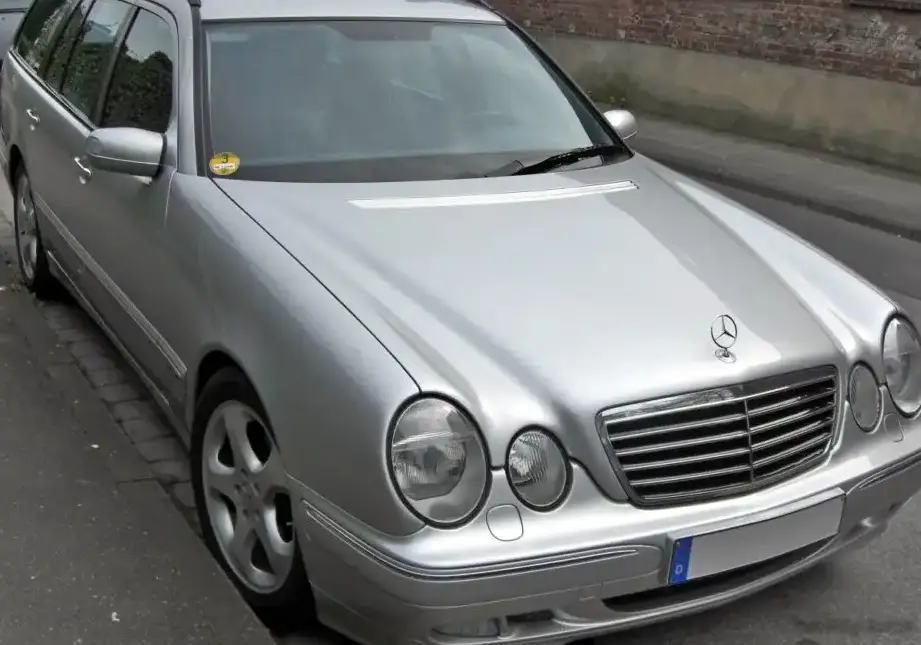
The Mercedes-Benz E-Class T-modell (S210) facelift E 200, produced from July 1999 to June 2000, represented a compelling entry point into the premium wagon segment. Positioned within the broader S210 series – the wagon variant of the W210 E-Class – the E 200 offered a balance of practicality, comfort, and the renowned Mercedes-Benz build quality. This facelift brought revised styling, improved equipment levels, and refinements to the engine range, solidifying the S210’s appeal as a sophisticated and versatile vehicle. The E 200 specifically targeted buyers seeking a spacious, comfortable estate car without the higher price tag associated with the more powerful six and eight-cylinder models.
Technical Specifications
| Brand | Mercedes-Benz |
| Model | E-Class |
| Generation | E-Class T-modell (S210, facelift 1999) |
| Type (Engine) | E 200 (136 Hp) |
| Start of production | July, 1999 |
| End of production | June, 2000 |
| Powertrain Architecture | Internal Combustion engine |
| Body type | Station wagon (estate) |
| Seats | 5 |
| Doors | 5 |
| Fuel consumption (urban) | 13.5 l/100 km (17.4 US mpg, 20.9 UK mpg, 7.4 km/l) |
| Fuel consumption (extra urban) | 7.3 l/100 km (32.2 US mpg, 38.7 UK mpg, 13.7 km/l) |
| Fuel consumption (combined) | 9.6 l/100 km (24.5 US mpg, 29.4 UK mpg, 10.4 km/l) |
| Fuel Type | Petrol (Gasoline) |
| Acceleration 0 – 100 km/h | 10.1 sec |
| Acceleration 0 – 62 mph | 10.1 sec |
| Acceleration 0 – 60 mph | 9.6 sec |
| Maximum speed | 198 km/h (123.03 mph) |
| Weight-to-power ratio | 11.8 kg/Hp, 84.5 Hp/tonne |
| Weight-to-torque ratio | 8.5 kg/Nm, 118 Nm/tonne |
| Power | 136 Hp @ 5500 rpm |
| Power per litre | 68.1 Hp/l |
| Torque | 190 Nm @ 3700-4500 rpm (140.14 lb.-ft. @ 3700-4500 rpm) |
| Engine layout | Front, Longitudinal |
| Engine Model/Code | M 111 E 20 / 111.945 |
| Engine displacement | 1998 cm3 (121.93 cu. in.) |
| Number of cylinders | 4 |
| Engine configuration | Inline |
| Cylinder Bore | 89.9 mm (3.54 in.) |
| Piston Stroke | 78.7 mm (3.1 in.) |
| Compression ratio | 10.4:1 |
| Number of valves per cylinder | 4 |
| Fuel injection system | Multi-port manifold injection |
| Engine aspiration | Supercharger, Intercooler |
| Valvetrain | DOHC |
| Engine oil capacity | 5.5 l (5.81 US qt | 4.84 UK qt) |
| Coolant | 8.5 l (8.98 US qt | 7.48 UK qt) |
| Kerb Weight | 1610 kg (3549.44 lbs.) |
| Max. weight | 2190 kg (4828.12 lbs.) |
| Max load | 580 kg (1278.68 lbs.) |
| Trunk (boot) space – minimum | 600 l (21.19 cu. ft.) |
| Trunk (boot) space – maximum | 1920 l (67.8 cu. ft.) |
| Fuel tank capacity | 70 l (18.49 US gal | 15.4 UK gal) |
| Length | 4839 mm (190.51 in.) |
| Width | 1799 mm (70.83 in.) |
| Height | 1504 mm (59.21 in.) |
| Wheelbase | 2833 mm (111.54 in.) |
| Front track | 1542 mm (60.71 in.) |
| Rear (Back) track | 1546 mm (60.87 in.) |
| Drivetrain Architecture | The Internal combustion engine (ICE) drives the rear wheels of the vehicle. |
| Drive wheel | Rear wheel drive |
| Number of gears and type of gearbox | 6 gears, manual transmission |
| Front suspension | Double wishbone |
| Rear suspension | Hydro-pneumatic element, Independent multi-link suspension |
| Front brakes | Ventilated discs |
| Rear brakes | Disc |
| Assisting systems | ABS (Anti-lock braking system) |
| Steering type | Steering rack and pinion |
| Power steering | Hydraulic Steering |
| Tires size | 205/65 R15 |
| Wheel rims size | 7J x 15 |
Powertrain & Engine Architecture
The E 200 T-modell was powered by the M111 E 20 engine, a 1.998-liter inline-four cylinder powerplant. This engine was notable for its Kompressor (supercharger) technology, a feature that significantly boosted low-end torque and improved responsiveness compared to naturally aspirated engines of similar displacement. The M111.945 engine code specifically denotes the supercharged variant. Fuel delivery was managed by a multi-port fuel injection system, ensuring precise fuel metering for optimal combustion. The engine featured a double overhead camshaft (DOHC) valvetrain with four valves per cylinder, contributing to its efficient breathing and power output. The supercharger, an Eaton-type unit, was intercooled to reduce intake air temperature and further enhance performance. The standard transmission for this model year was a 6-speed manual, although a 5-speed automatic transmission was also available as an option.
Driving Characteristics
The E 200 T-modell with the manual transmission offered a reasonably engaging driving experience. While not a sports car, the supercharger provided a noticeable surge of power, making overtaking and merging onto highways relatively effortless. The 136 horsepower and 190 Nm (140 lb-ft) of torque were adequate for everyday driving, but the car felt less energetic than its six-cylinder siblings. The automatic transmission, while providing convenience, did slightly diminish performance due to its inherent efficiency losses. Gear ratios were tuned for a balance of fuel economy and usability, with a relatively tall final drive. Compared to the E 280 or E 320 models, the E 200 felt less refined and had a more noticeable engine note. However, it offered a more economical and accessible entry point into the E-Class range.
Equipment & Trim Levels
The E 200 T-modell came standard with a respectable level of equipment, including automatic climate control, power windows, power mirrors, and a basic audio system. Upholstery was typically cloth, although leather was available as an option. The dashboard layout was typical of the W210 E-Class, characterized by a functional and understated design. Optional extras included a sunroof, upgraded audio systems, heated seats, and parking sensors. The wood trim was standard, adding a touch of luxury to the interior. Safety features such as ABS and airbags were standard equipment.
Chassis & Braking
The S210 chassis featured a double wishbone front suspension and an independent multi-link rear suspension, providing a comfortable and controlled ride. The rear suspension utilized a hydro-pneumatic element, further enhancing ride quality. Braking duties were handled by ventilated discs at the front and solid discs at the rear. ABS (Anti-lock Braking System) was standard, providing enhanced stopping power and stability. The steering was a rack and pinion system with hydraulic power assistance, offering precise and responsive steering feel.
Market Reception & Comparison
The E 200 T-modell was generally well-received by critics as a practical and well-built estate car. However, some reviewers noted that the engine lacked the refinement and power of the larger-displacement engines in the E-Class range. Fuel economy was considered good for a vehicle of its size and class. Compared to the E 280 T-modell, the E 200 offered significantly better fuel economy but at the expense of performance. The E 200 also represented a more affordable alternative to competitors such as the BMW 5 Series Touring and the Audi A6 Avant.
Legacy
The M111 engine, in general, is known for its reliability and durability. The supercharger component, while adding complexity, has proven to be relatively robust when properly maintained. The E 200 T-modell, while not as sought-after as its higher-powered siblings, remains a viable option in the used car market for buyers seeking a practical and affordable estate car. Common issues include wear and tear on suspension components and potential leaks from the supercharger system. However, with regular maintenance, these vehicles can provide many years of reliable service. Today, the S210 E-Class, including the E 200 variant, is appreciated by enthusiasts for its classic Mercedes-Benz styling and build quality.