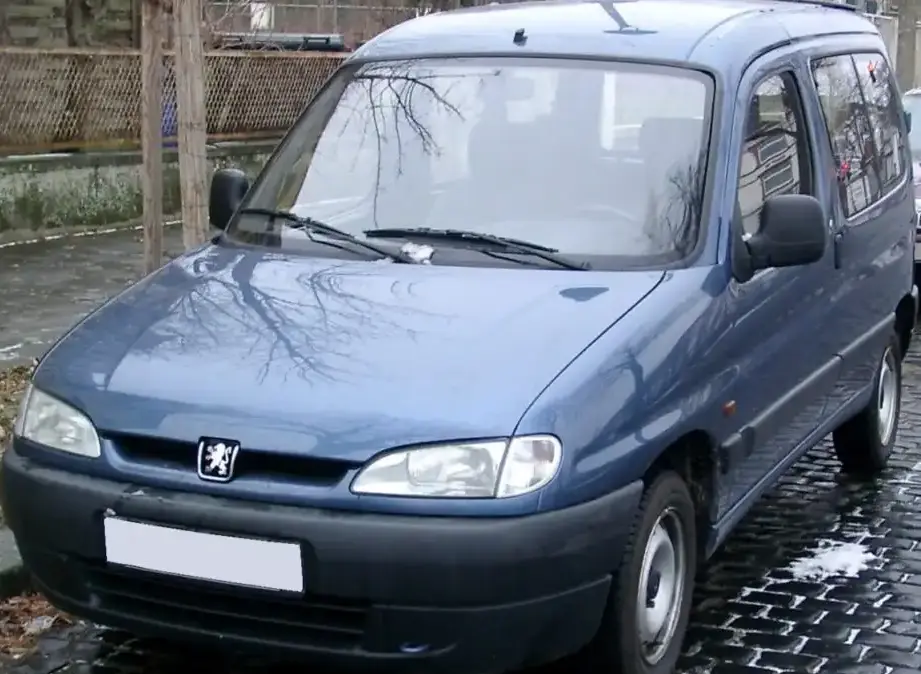
The Peugeot Partner I (Phase I) 1.4, producing 75 horsepower, was a key variant in the first generation of the Peugeot Partner, manufactured from 1996 to 2002. Positioned as an entry-level offering within the Partner range, it served as a practical and affordable light commercial vehicle and multi-purpose vehicle (MPV) aimed at small businesses, families, and those needing a versatile vehicle for both work and leisure. The Partner I, based on the Citroën Berlingo and sharing its platform (G9/G11), represented Peugeot’s entry into the increasingly popular compact van segment. This particular 1.4-liter engine and five-speed manual transmission combination was designed to balance affordability with reasonable usability, prioritizing fuel economy over outright performance.
Technical Specifications
| Brand | Peugeot |
| Model | Partner |
| Generation | Partner I (Phase I) |
| Type (Engine) | 1.4 (75 Hp) |
| Start of production | 1996 |
| End of production | 2002 |
| Powertrain Architecture | Internal Combustion engine |
| Body type | Minivan |
| Seats | 5 |
| Doors | 5 |
| Fuel consumption (urban) | 8.9 l/100 km (26.4 US mpg) |
| Fuel consumption (extra urban) | 6 l/100 km (39.2 US mpg) |
| Fuel consumption (combined) | 7.1 l/100 km (33.1 US mpg) |
| CO2 emissions | 168 g/km |
| Fuel Type | Petrol (Gasoline) |
| Acceleration 0 – 100 km/h | 17.5 sec |
| Acceleration 0 – 62 mph | 17.5 sec |
| Acceleration 0 – 60 mph | 16.6 sec |
| Maximum speed | 150 km/h (93.21 mph) |
| Weight-to-power ratio | 15.2 kg/Hp |
| Weight-to-torque ratio | 9.5 kg/Nm |
| Power | 75 Hp @ 5500 rpm |
| Power per litre | 55.1 Hp/l |
| Torque | 120 Nm @ 3400 rpm (88.51 lb.-ft. @ 3400 rpm) |
| Engine layout | Front, Transverse |
| Engine Model/Code | KFX TU3JP |
| Engine displacement | 1360 cm3 (82.99 cu. in.) |
| Number of cylinders | 4 |
| Engine configuration | Inline |
| Cylinder Bore | 75 mm (2.95 in.) |
| Piston Stroke | 77 mm (3.03 in.) |
| Number of valves per cylinder | 2 |
| Fuel injection system | Multi-port manifold injection |
| Engine aspiration | Naturally aspirated |
| Valvetrain | SOHC |
| Engine oil capacity | 3 l (3.17 US qt | 2.64 UK qt) |
| Coolant capacity | 8 l (8.45 US qt | 7.04 UK qt) |
| Kerb Weight | 1140 kg (2513.27 lbs.) |
| Max. weight | 1740 kg (3836.04 lbs.) |
| Max load | 600 kg (1322.77 lbs.) |
| Trunk (boot) space – minimum | 624 l (22.04 cu. ft.) |
| Trunk (boot) space – maximum | 2800 l (98.88 cu. ft.) |
| Fuel tank capacity | 55 l (14.53 US gal | 12.1 UK gal) |
| Max. roof load | 100 kg (220.46 lbs.) |
| Permitted trailer load (braked) | 900 kg (1984.16 lbs.) |
| Permitted trailer load (unbraked) | 500 kg (1102.31 lbs.) |
| Permitted towbar download | 70 kg (154.32 lbs.) |
| Length | 4110 mm (161.81 in.) |
| Width | 1720 mm (67.72 in.) |
| Width including mirrors | 1960 mm (77.17 in.) |
| Height | 1870 mm (73.62 in.) |
| Wheelbase | 2690 mm (105.91 in.) |
| Front track | 1420 mm (55.91 in.) |
| Rear track | 1440 mm (56.69 in.) |
| Front overhang | 820 mm (32.28 in.) |
| Rear overhang | 600 mm (23.62 in.) |
| Turning circle | 11.55 m (37.89 ft.) |
| Drivetrain | Front wheel drive |
| Number of gears | 5, manual transmission |
| Front suspension | Independent type McPherson |
| Rear suspension | Torsion |
| Front brakes | Disc |
| Rear brakes | Drum |
| Assisting systems | ABS |
| Steering type | Steering rack and pinion |
| Power steering | Hydraulic |
| Tires size | 175/65 R14; 175/70 R14; 185/65 R15 |
| Wheel rims size | 14; 15 |
Powertrain & Engine Architecture
The Peugeot Partner I 1.4 utilized the KFX (TU3JP) engine, a 1.4-liter inline-four cylinder petrol engine. This engine was a common choice in various Peugeot and Citroën models during the 1990s and early 2000s. It featured a single overhead camshaft (SOHC) valvetrain with two valves per cylinder. Fuel delivery was managed by a multi-port fuel injection system, providing a balance between efficiency and performance for its time. The engine’s relatively simple design contributed to its reliability and ease of maintenance. The five-speed manual transmission was the standard offering for this variant, providing adequate gear ratios for everyday driving and load-carrying. The transmission was a conventional setup, known for its durability and straightforward operation.
Driving Characteristics
The 1.4-liter engine in the Partner I delivered modest performance. Acceleration was not a strong point, with a 0-60 mph time of around 16.6 seconds. However, the engine provided sufficient power for typical urban and suburban driving, especially when unladen. The five-speed gearbox allowed drivers to keep the engine in its optimal power band, although frequent downshifts were often necessary when carrying a load or tackling inclines. Compared to higher-output versions of the Partner, such as those equipped with the 1.9-liter diesel engine, the 1.4 felt noticeably slower and less capable of handling heavy loads. However, it offered a smoother and quieter driving experience than the diesel, and its lighter weight contributed to slightly better handling.
Equipment & Trim Levels
The 1.4-liter Partner I was typically equipped with basic, functional trim levels. Standard features generally included power steering, a driver’s airbag, and a basic audio system. Interior upholstery was typically durable cloth. Optional extras included air conditioning, central locking, and electric windows. The Partner was designed with practicality in mind, so the interior focused on durability and ease of cleaning rather than luxury. The dashboard layout was simple and functional, with clearly labeled controls. The rear seats could be folded or removed to maximize cargo space, making the Partner a versatile vehicle for various needs.
Chassis & Braking
The Partner I featured a front-wheel-drive layout with an independent McPherson strut suspension at the front and a torsion beam suspension at the rear. This suspension setup provided a reasonable balance between ride comfort and handling. The front brakes were disc brakes, while the rear brakes were drum brakes. Anti-lock Braking System (ABS) was available as an option, enhancing safety by preventing wheel lockup during hard braking. The steering was a rack and pinion system with hydraulic power assistance, providing light and precise steering feel.
Market Reception & Comparison
The Peugeot Partner I 1.4 was generally well-received as an affordable and practical light commercial vehicle. Critics praised its versatility, fuel economy, and relatively low running costs. However, some reviewers noted its lack of power and refinement compared to more expensive rivals. Compared to the diesel-powered versions of the Partner, the 1.4 offered lower initial cost but higher fuel consumption and reduced performance. The 1.4 was often favored by buyers who prioritized affordability and simplicity over outright performance and load-carrying capacity.
Legacy
The Peugeot Partner I 1.4, while not the most powerful or refined version of the Partner, remains a popular choice in the used car market due to its affordability and reliability. The KFX (TU3JP) engine is known for its durability, and parts are readily available. However, potential buyers should be aware of potential issues such as oil leaks and corrosion. Overall, the Partner I 1.4 represents a practical and dependable option for those seeking a versatile and affordable light commercial vehicle or MPV.