Technical Specifications
| Brand | Peugeot |
| Model | Partner |
| Generation | Partner I (Phase I) |
| Type (Engine) | 1.9 D (70 Hp) |
| Start of production | 1997 |
| End of production | 2002 |
| Powertrain Architecture | Internal Combustion engine |
| Body type | Minivan |
| Seats | 5 |
| Doors | 5 |
| Fuel consumption (urban) | 8.7 l/100 km (27 US mpg, 32.5 UK mpg, 11.5 km/l) |
| Fuel consumption (extra urban) | 5.8 l/100 km (40.6 US mpg, 48.7 UK mpg, 17.2 km/l) |
| Fuel consumption (combined) | 6.9 l/100 km (34.1 US mpg, 40.9 UK mpg, 14.5 km/l) |
| CO2 emissions | 181 g/km |
| Fuel Type | Diesel |
| Acceleration 0 – 100 km/h | 19.9 sec |
| Acceleration 0 – 62 mph | 19.9 sec |
| Acceleration 0 – 60 mph | 18.9 sec |
| Maximum speed | 142 km/h (88.23 mph) |
| Weight-to-power ratio | 17.2 kg/Hp |
| Weight-to-torque ratio | 9.6 kg/Nm |
| Power | 70 Hp @ 4600 rpm |
| Power per litre | 37.5 Hp/l |
| Torque | 125 Nm @ 2500 rpm (92.2 lb.-ft. @ 2500 rpm) |
| Engine layout | Front, Transverse |
| Engine Model/Code | DW8 |
| Engine displacement | 1868 cm3 (113.99 cu. in.) |
| Number of cylinders | 4 |
| Engine configuration | Inline |
| Cylinder Bore | 82.2 mm (3.24 in.) |
| Piston Stroke | 88 mm (3.46 in.) |
| Number of valves per cylinder | 2 |
| Fuel injection system | Precombustion chamber injection |
| Engine aspiration | Naturally aspirated |
| Valvetrain | SOHC |
| Engine oil capacity | 4.75 l (5.02 US qt, 4.18 UK qt) |
| Coolant capacity | 8 l (8.45 US qt, 7.04 UK qt) |
| Kerb Weight | 1206 kg (2658.77 lbs.) |
| Max. weight | 1840 kg (4056.51 lbs.) |
| Max load | 634 kg (1397.73 lbs.) |
| Trunk (boot) space (min) | 624 l (22.04 cu. ft.) |
| Trunk (boot) space (max) | 2800 l (98.88 cu. ft.) |
| Fuel tank capacity | 60 l (15.85 US gal, 13.2 UK gal) |
| Max. roof load | 100 kg (220.46 lbs.) |
| Permitted trailer load (braked) | 1100 kg (2425.08 lbs.) |
| Permitted trailer load (unbraked) | 500 kg (1102.31 lbs.) |
| Permitted towbar download | 70 kg (154.32 lbs.) |
| Length | 4110 mm (161.81 in.) |
| Width | 1720 mm (67.72 in.) |
| Width (including mirrors) | 1960 mm (77.17 in.) |
| Height | 1870 mm (73.62 in.) |
| Wheelbase | 2690 mm (105.91 in.) |
| Front track | 1420 mm (55.91 in.) |
| Rear track | 1440 mm (56.69 in.) |
| Front overhang | 820 mm (32.28 in.) |
| Rear overhang | 600 mm (23.62 in.) |
| Turning circle | 11.55 m (37.89 ft.) |
| Drivetrain | Front wheel drive |
| Number of gears | 5 |
| Gearbox type | Manual transmission |
| Front suspension | Independent type McPherson |
| Rear suspension | Torsion |
| Front brakes | Disc |
| Rear brakes | Drum |
| Assisting systems | ABS |
| Steering type | Steering rack and pinion |
| Power steering | Hydraulic |
| Tires size | 175/65 R14, 175/70 R14, 185/65 R15 |
| Wheel rims size | 14, 15 |
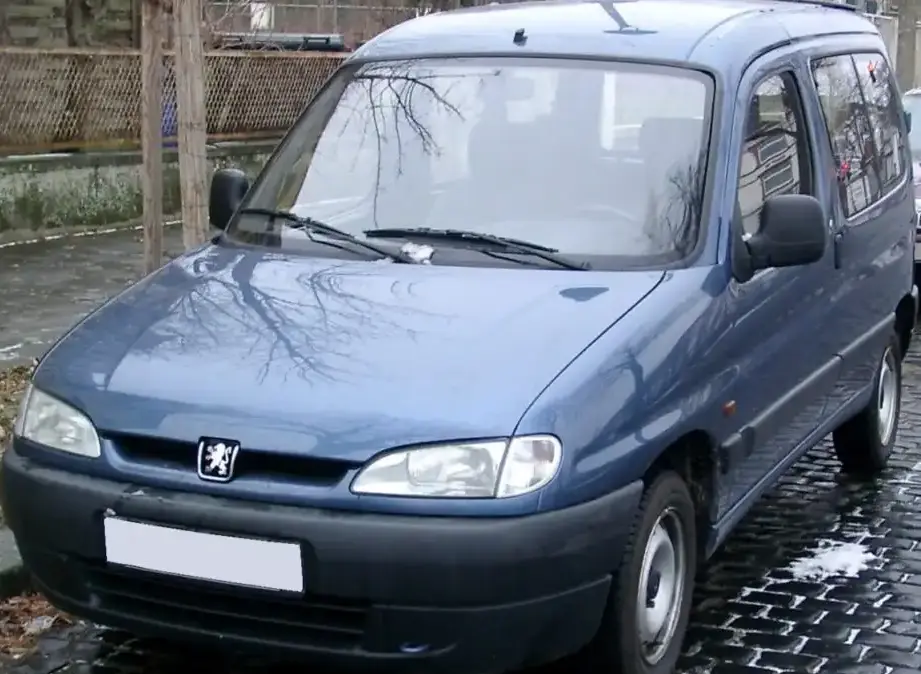
The Peugeot Partner I, launched in 1996, was a significant step for Peugeot into the compact van segment. The Phase I models, produced until 2002, established the Partner as a versatile vehicle suitable for both commercial and family use. The 1.9 D variant, equipped with the DW8 engine, was a mainstay of the lineup, offering a balance of affordability, fuel economy, and practicality. It was designed to appeal to small businesses, tradespeople, and families needing a spacious and reliable vehicle. This trim level typically served as the entry-level diesel option, providing a cost-effective alternative to the more powerful and expensive petrol or higher-output diesel versions.
Powertrain & Engine Architecture
The heart of the Partner 1.9 D is the DW8 engine, a 1.9-liter inline-four diesel engine. This engine, a product of Peugeot’s long-standing diesel expertise, utilizes precombustion chamber injection. This system, common in diesel engines of the era, involves injecting fuel into a precombustion chamber connected to the main cylinder, promoting more complete combustion. The DW8 features a single overhead camshaft (SOHC) valvetrain, operating two valves per cylinder. The engine produces 70 horsepower at 4600 rpm and 125 Nm (92.2 lb-ft) of torque at 2500 rpm. The Partner 1.9 D was typically paired with a five-speed manual transmission, although a four-speed automatic transmission was available as an option, albeit less common. The automatic transmission, while offering convenience, impacted fuel economy and performance.
Driving Characteristics
The driving experience in the Partner 1.9 D is characterized by its utilitarian nature. Acceleration is modest, taking approximately 19.9 seconds to reach 62 mph (100 km/h). The engine’s torque, however, provides adequate pulling power for everyday driving and carrying loads. The five-speed manual transmission allows drivers to optimize engine speed for fuel efficiency or to maintain momentum on inclines. The automatic transmission, when equipped, offers smoother shifts but at the expense of responsiveness. The suspension, tuned for comfort and load-carrying capacity, provides a reasonably compliant ride, even when the vehicle is fully loaded. Steering is light and easy, making it maneuverable in urban environments.
Equipment & Trim Levels
The Partner 1.9 D typically came with a basic level of equipment, reflecting its position as an entry-level model. Standard features generally included power steering, central locking, and a basic audio system. Interior upholstery was typically cloth, and the dashboard featured a functional, no-frills design. Optional extras included air conditioning, electric windows, and upgraded audio systems. Higher trim levels, such as the ‘Style’ or ‘GL’ variants, offered more comprehensive equipment lists, including features like alloy wheels, body-colored bumpers, and improved interior trim. The Partner’s strength lay in its configurable cargo space, with rear seats that could be folded or removed to maximize load capacity.
Chassis & Braking
The Partner I utilizes a front-wheel-drive layout with an independent McPherson strut suspension at the front and a torsion beam suspension at the rear. This configuration provides a good balance of ride comfort and handling. Braking duties are handled by disc brakes at the front and drum brakes at the rear. Anti-lock Braking System (ABS) was often included as standard equipment, enhancing safety. The chassis was designed to withstand the stresses of commercial use, with a robust construction and a relatively high payload capacity. The steering system employs a rack and pinion setup with hydraulic power assistance, providing precise and effortless steering control.
Market Reception & Comparison
The Peugeot Partner 1.9 D was well-received in the market for its practicality, fuel efficiency, and affordability. Critics praised its spacious interior, versatile cargo area, and robust construction. Compared to the petrol-powered versions, the 1.9 D offered significantly better fuel economy, making it a popular choice for high-mileage users. Compared to higher-output diesel variants, such as the 2.0 HDI, the 1.9 D offered a more economical purchase price but lacked the same level of performance. The Citroën Berlingo, its sister vehicle, offered a virtually identical driving experience and equipment levels, often coming down to brand preference.
Legacy
The Peugeot Partner I 1.9 D has proven to be a durable and reliable vehicle, with many examples still in use today. The DW8 engine, while not known for its refinement, is generally considered to be robust and long-lasting, provided it receives regular maintenance. Common issues include wear and tear on suspension components and potential fuel injection system problems. On the used car market, the 1.9 D variant remains an affordable option for those seeking a practical and economical van or MPV. Its simplicity and relatively low running costs continue to appeal to budget-conscious buyers. The Partner I laid the foundation for the continued success of the Partner range, establishing it as a leading player in the light commercial vehicle segment.