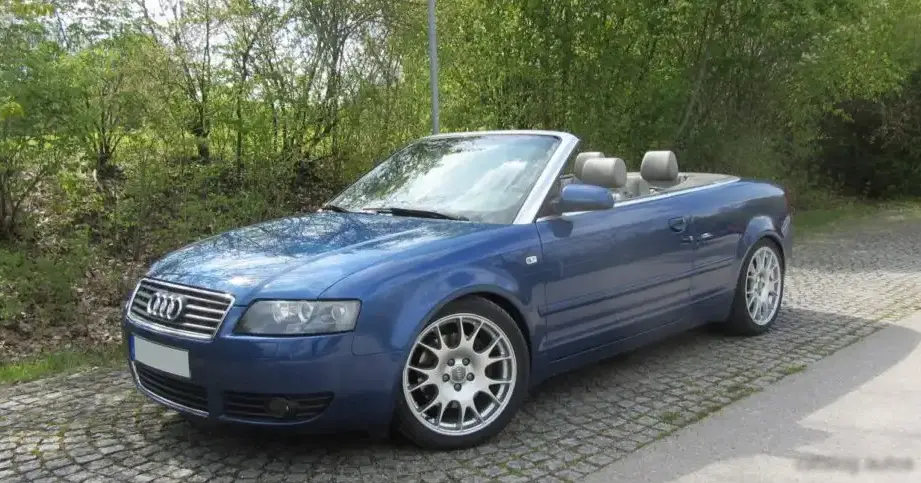
The Audi A4 Cabriolet (B6 8H) 1.8T, produced from July 2002 to 2005, represented Audi’s entry into the premium compact convertible market. Positioned as a more accessible alternative to the higher-performance and more expensive A4 Cabriolet variants, the 1.8T offered a blend of style, comfort, and reasonable performance. It was built on the Volkswagen Group’s B6 platform (internally designated 8H for the Cabriolet), shared with the Audi A4 sedan and Avant (wagon), as well as other models like the SEAT Toledo and Skoda Superb. This particular engine and transmission combination aimed to broaden the A4 Cabriolet’s appeal to buyers prioritizing affordability and ease of driving over outright speed.
Technical Specifications
| Brand | Audi |
| Model | A4 |
| Generation | A4 Cabriolet (B6 8H) |
| Type (Engine) | 1.8 T (163 Hp) |
| Start of production | July, 2002 |
| End of production | 2005 |
| Powertrain Architecture | Internal Combustion engine |
| Body type | Cabriolet |
| Seats | 4 |
| Doors | 2 |
| Fuel consumption (urban) | 11.6 l/100 km (20.3 US mpg, 24.4 UK mpg, 8.6 km/l) |
| Fuel consumption (extra urban) | 6.7 l/100 km (35.1 US mpg, 42.2 UK mpg, 14.9 km/l) |
| Fuel consumption (combined) | 8.5 l/100 km (27.7 US mpg, 33.2 UK mpg, 11.8 km/l) |
| CO2 emissions | 204 g/km |
| Fuel Type | Petrol (Gasoline) |
| Acceleration 0 – 100 km/h | 9.4 sec |
| Acceleration 0 – 62 mph | 9.4 sec |
| Acceleration 0 – 60 mph | 8.9 sec |
| Maximum speed | 226 km/h (140.43 mph) |
| Emission standard | Euro 4 |
| Weight-to-power ratio | 9.4 kg/Hp, 105.8 Hp/tonne |
| Weight-to-torque ratio | 6.8 kg/Nm, 146.1 Nm/tonne |
| Power | 163 Hp @ 5700 rpm |
| Power per litre | 91.5 Hp/l |
| Torque | 225 Nm @ 1950-4700 rpm (165.95 lb.-ft. @ 1950-4700 rpm) |
| Engine layout | Front, Longitudinal |
| Engine Model/Code | BFB |
| Engine displacement | 1781 cm3 (108.68 cu. in.) |
| Number of cylinders | 4 |
| Engine configuration | Inline |
| Cylinder Bore | 81 mm (3.19 in.) |
| Piston Stroke | 86.4 mm (3.4 in.) |
| Compression ratio | 9.3:1 |
| Number of valves per cylinder | 5 |
| Fuel injection system | Multi-port manifold injection |
| Engine aspiration | Turbocharger, Intercooler |
| Valvetrain | DOHC |
| Engine oil capacity | 4.1 l (4.33 US qt | 3.61 UK qt) |
| Coolant | 8 l (8.45 US qt | 7.04 UK qt) |
| Kerb Weight | 1540 kg (3395.12 lbs.) |
| Max. weight | 2020 kg (4453.34 lbs.) |
| Max load | 480 kg (1058.22 lbs.) |
| Trunk (boot) space – minimum | 246 l (8.69 cu. ft.) |
| Trunk (boot) space – maximum | 315 l (11.12 cu. ft.) |
| Fuel tank capacity | 70 l (18.49 US gal | 15.4 UK gal) |
| Permitted trailer load with brakes (8%) | 1600 kg (3527.4 lbs.) |
| Permitted trailer load with brakes (12%) | 1400 kg (3086.47 lbs.) |
| Permitted trailer load without brakes | 750 kg (1653.47 lbs.) |
| Permitted towbar download | 80 kg (176.37 lbs.) |
| Length | 4573 mm (180.04 in.) |
| Width | 1777 mm (69.96 in.) |
| Height | 1391 mm (54.76 in.) |
| Wheelbase | 2654 mm (104.49 in.) |
| Front track | 1523 mm (59.96 in.) |
| Rear (Back) track | 1523 mm (59.96 in.) |
| Drag coefficient (Cd) | 0.30 |
| Minimum turning circle (turning diameter) | 11.1 m (36.42 ft.) |
| Drivetrain Architecture | The Internal combustion engine (ICE) drives the front wheels of the vehicle. |
| Drive wheel | Front wheel drive |
| Number of gears and type of gearbox | 5 gears, manual transmission |
| Front suspension | Independent multi-link suspension |
| Rear suspension | Independent multi-link suspension |
| Front brakes | Ventilated discs |
| Rear brakes | Disc |
| Assisting systems | ABS (Anti-lock braking system) |
| Steering type | Steering rack and pinion |
| Power steering | Hydraulic Steering |
| Tires size | 205/55 R16 |
| Wheel rims size | 7J x 16 |
Powertrain & Engine Architecture
The heart of the A4 Cabriolet 1.8T was the BFB engine code, a 1.8-liter inline-four cylinder gasoline engine. This engine was a member of Audi/Volkswagen’s EA827 family, known for its robust construction and relatively simple design. It featured a cast iron block and an aluminum cylinder head, incorporating five valves per cylinder (three intake, two exhaust) operated by a double overhead camshaft (DOHC) valvetrain. The engine utilized Bosch Motronic fuel injection and a single turbocharger with an intercooler to boost power output. The turbocharger provided increased air intake, allowing for a higher compression ratio of 9.3:1. The 1.8T engine was paired with a 5-speed manual transmission, delivering power to the front wheels. This configuration was chosen for its balance of cost-effectiveness and driving enjoyment.
Driving Characteristics
The 163 horsepower and 165.95 lb-ft of torque produced by the 1.8T engine provided adequate, though not exhilarating, performance for the A4 Cabriolet. Acceleration from 0-60 mph took approximately 8.9 seconds, and top speed was around 140 mph. The turbocharger provided a noticeable boost in power at higher RPMs, but turbo lag was present, particularly at lower engine speeds. The 5-speed manual transmission offered precise shifts, but the gear ratios were geared towards fuel efficiency rather than outright acceleration. Compared to the more powerful 3.0-liter V6 models, the 1.8T felt less responsive and required more downshifting for overtaking maneuvers. However, it offered a more forgiving and manageable driving experience, especially for less experienced drivers.
Equipment & Trim Levels
The 1.8T Cabriolet typically came with a respectable level of standard equipment. This included power windows, power locks, air conditioning, a basic audio system, and alloy wheels. Interior upholstery was typically cloth, though leather options were available. Optional extras included a premium audio system, heated front seats, automatic climate control, and a wind deflector to reduce turbulence in the cabin with the top down. Trim levels varied slightly depending on the market, but generally, the 1.8T represented the entry-level Cabriolet offering, with the V6 models offering more luxurious appointments.
Chassis & Braking
The A4 Cabriolet’s chassis featured independent multi-link suspension at both the front and rear, providing a comfortable ride and good handling characteristics. The front suspension utilized coil springs and shock absorbers, while the rear suspension incorporated a more complex multi-link design to minimize body roll and improve stability. Brakes consisted of ventilated discs at the front and solid discs at the rear, with ABS (Anti-lock Braking System) as standard. The steering was a hydraulic power-assisted rack and pinion system, offering precise and responsive steering feel. The curb weight of approximately 3395 lbs was relatively moderate for a convertible, contributing to the car’s balanced handling.
Market Reception & Comparison
The Audi A4 Cabriolet 1.8T was generally well-received by automotive critics as a stylish and comfortable convertible. It was praised for its build quality, refined interior, and enjoyable driving experience. However, some critics noted that the 1.8T engine lacked the punch of the V6 models and that the turbo lag could be noticeable. Compared to rivals like the BMW 3 Series Convertible and Mercedes-Benz CLK Cabriolet, the A4 Cabriolet offered a compelling value proposition, particularly in terms of standard equipment and overall refinement. Fuel economy was respectable for a convertible, averaging around 27.7 US mpg in combined driving.
Legacy
The Audi A4 Cabriolet (B6 8H) 1.8T has proven to be a relatively reliable vehicle, with the BFB engine generally considered durable. Common issues include occasional turbocharger failures and oil leaks. However, with proper maintenance, these engines can easily exceed 150,000 miles. On the used car market today, the A4 Cabriolet 1.8T represents an affordable entry point into Audi ownership. Its combination of style, comfort, and reasonable running costs makes it a popular choice for buyers seeking a classic open-top experience. Parts availability is generally good, and the car’s relatively simple mechanical design makes it accessible to DIY mechanics.