Technical Specifications
| Brand | Audi |
| Model | Q5 |
| Generation | Q5 II (FY, facelift 2020) |
| Type (Engine) | 50 TFSI e (299 Hp) Plug-in Hybrid quattro S tronic |
| Start of production | February, 2021 |
| End of production | November, 2024 |
| Powertrain Architecture | PHEV (Plug-in Hybrid Electric Vehicle) |
| Body type | SUV |
| Seats | 5 |
| Doors | 5 |
| Combined fuel consumption (WLTP) | 1.5-1.8 l/100 km (156.8 – 130.7 US mpg, 188.3 – 156.9 UK mpg, 66.7 – 55.6 km/l) |
| CO2 emissions (WLTP) | 35-42 g/km |
| Fuel consumption (economy) – combined (NEDC) | 1.8-1.9 l/100 km (130.7 – 123.8 US mpg, 156.9 – 148.7 UK mpg, 55.6 – 52.6 km/l) |
| CO2 emissions (NEDC) | 41-44 g/km |
| Fuel Type | Petrol / electricity |
| Acceleration 0 – 100 km/h | 6.1 sec |
| Acceleration 0 – 62 mph | 6.1 sec |
| Acceleration 0 – 60 mph | 5.8 sec |
| Maximum speed | 239 km/h (148.51 mph) |
| Emission standard | Euro 6d-ISC-FCM |
| Weight-to-power ratio | 6.9 kg/Hp, 144.1 Hp/tonne |
| Weight-to-torque ratio | 4.6 kg/Nm, 216.9 Nm/tonne |
| Gross battery capacity | 17.9 kWh |
| Net (usable) battery capacity | 14.4 kWh |
| Battery voltage | 381 V |
| Battery technology | Lithium-ion (Li-Ion) |
| Battery location | Under the trunk |
| Recuperation output | 80 kW |
| All-electric range (WLTP) | 56-62 km (34.8 – 38.53 mi) |
| Average Energy consumption (NEDC) | 19.3-19.5 kWh/100 km (31.06 – 31.38 kWh/100 mi, 108 – 107 MPGe, 5.2 – 5.1 km/kWh, 3.2 – 3.2 mi/kWh) |
| Max speed (electric) | 135 km/h (83.89 mph) |
| Electric motor power | 143 Hp |
| Electric motor Torque | 350 Nm (258.15 lb.-ft.) |
| Electric motor location | Between the combustion engine and the transmission |
| System power | 299 Hp |
| System torque | 450 Nm (331.9 lb.-ft.) |
| Power | 265 Hp @ 5250-6500 rpm |
| Torque | 370 Nm @ 1600-4500 rpm (272.9 lb.-ft. @ 1600-4500 rpm) |
| Engine layout | Front, Longitudinal |
| Engine Model/Code | DRYA |
| Engine displacement | 1984 cm3 (121.07 cu. in.) |
| Number of cylinders | 4 |
| Engine configuration | Inline |
| Cylinder Bore | 82.5 mm (3.25 in.) |
| Piston Stroke | 92.8 mm (3.65 in.) |
| Compression ratio | 9.6:1 |
| Number of valves per cylinder | 4 |
| Fuel injection system | Direct injection |
| Engine aspiration | Turbocharger, Intercooler |
| Valvetrain | DOHC |
| Engine oil capacity | 5.2 l (5.49 US qt | 4.58 UK qt) |
| Coolant | 17.7 l (18.7 US qt | 15.57 UK qt) |
| Kerb Weight | 2075 kg (4574.59 lbs.) |
| Max. weight | 2660 kg (5864.3 lbs.) |
| Max load | 585 kg (1289.7 lbs.) |
| Trunk (boot) space – minimum | 465 l (16.42 cu. ft.) |
| Trunk (boot) space – maximum | 1405 l (49.62 cu. ft.) |
| Fuel tank capacity | 54 l (14.27 US gal | 11.88 UK gal) |
| Max. roof load | 75 kg (165.35 lbs.) |
| Permitted trailer load with brakes (8%) | 2000 kg (4409.25 lbs.) |
| Permitted trailer load with brakes (12%) | 2000 kg (4409.25 lbs.) |
| Permitted trailer load without brakes | 750 kg (1653.47 lbs.) |
| Permitted towbar download | 100 kg (220.46 lbs.) |
| Length | 4682 mm (184.33 in.) |
| Width | 1893 mm (74.53 in.) |
| Width including mirrors | 2140 mm (84.25 in.) |
| Height | 1659 mm (65.31 in.) |
| Wheelbase | 2819 mm (110.98 in.) |
| Front track | 1616 mm (63.62 in.) |
| Rear (Back) track | 1609 mm (63.35 in.) |
| Front overhang | 910 mm (35.83 in.) |
| Rear overhang | 953 mm (37.52 in.) |
| Drag coefficient (Cd) | 0.31 |
| Minimum turning circle (turning diameter) | 11.8 m (38.71 ft.) |
| Front suspension | Independent multi-link suspension, Transverse stabilizer |
| Rear suspension | Independent multi-link suspension, Transverse stabilizer |
| Front brakes | Ventilated discs |
| Rear brakes | Ventilated discs |
| Number of gears and type of gearbox | 7 gears, automatic transmission S tronic |
The Audi Q5 II 50 TFSI e, launched in 2021, represents a significant step in Audi’s electrification strategy. Built on the MLB Evo platform (specifically the 1HX0/A3 variant for the Q5), this plug-in hybrid model combined a gasoline engine with an electric motor to deliver both reduced emissions and a compelling driving experience. It aimed to appeal to environmentally conscious consumers who still desired the practicality and premium feel of a compact SUV. The 50 TFSI e sat in the middle of the Q5 range, offering more performance and a larger electric range than the lower-trim hybrids, but at a lower price point than the higher-performance SQ5.
Powertrain & Engine Architecture
At the heart of the Q5 50 TFSI e lies the DRYA engine, a 2.0-liter turbocharged inline-four cylinder gasoline engine. This engine produces 265 horsepower at 5250-6500 rpm and 370 Nm (272.9 lb-ft) of torque between 1600-4500 rpm. It utilizes direct fuel injection and a single turbocharger with an intercooler to maximize efficiency and power output. Integrated with the engine is a 143 horsepower electric motor, producing 350 Nm (258.15 lb-ft) of torque. The electric motor is positioned between the engine and the seven-speed S tronic dual-clutch automatic transmission. This configuration allows for both electric-only driving and a combined output of 299 horsepower and 450 Nm (331.9 lb-ft) of torque. The 17.9 kWh (14.4 kWh usable) lithium-ion battery pack is located under the trunk floor, providing an all-electric range of 56-62 km (34.8 – 38.53 mi) according to WLTP standards. The system incorporates an 80 kW recuperation output, allowing for efficient energy recovery during braking and deceleration.
Driving Characteristics
The Q5 50 TFSI e offers a refined and versatile driving experience. In electric mode, the vehicle provides near-silent operation and instant torque, making it ideal for city driving. The S tronic transmission delivers quick and smooth gear changes, enhancing responsiveness. When the battery is depleted or when more power is needed, the gasoline engine seamlessly kicks in, providing a combined output that allows for a 0-60 mph time of around 5.8 seconds. Compared to the standard Q5 models with gasoline engines, the 50 TFSI e feels slightly heavier due to the added weight of the battery pack, but the instant torque from the electric motor compensates for this. Compared to the Q5 45 TFSI, the 50 TFSI e offers significantly more power and torque, resulting in quicker acceleration. However, it doesn’t match the outright performance of the SQ5, which boasts a more powerful engine and sport-tuned suspension.
Equipment & Trim Levels
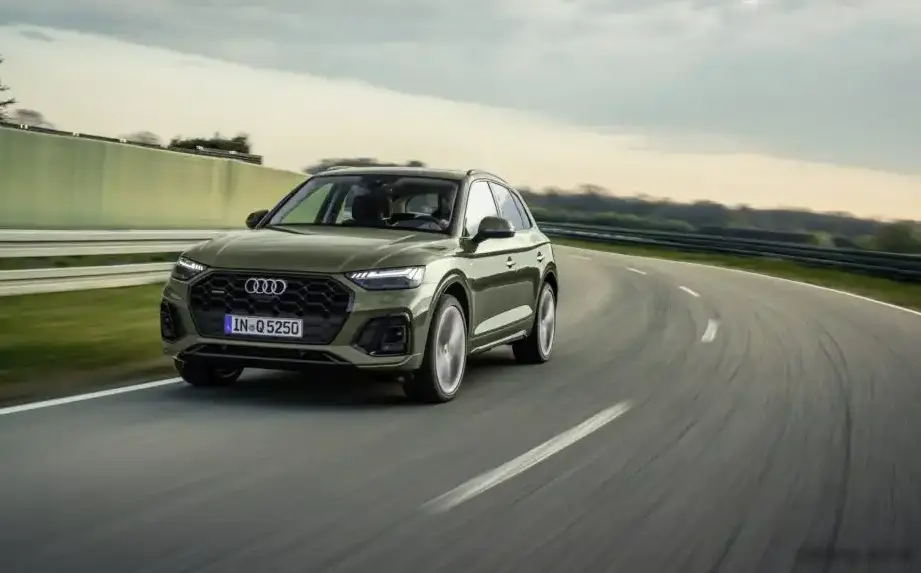
The 50 TFSI e trim typically came standard with a high level of equipment, reflecting Audi’s premium positioning. Standard features included Audi’s virtual cockpit digital instrument cluster, a touchscreen infotainment system with navigation, leather upholstery, three-zone automatic climate control, and a suite of advanced driver-assistance systems such as adaptive cruise control and lane-keeping assist. Optional extras included a panoramic sunroof, premium sound system, and various cosmetic enhancements. Interior trim options ranged from standard aluminum accents to more luxurious wood veneers. The exterior styling was largely consistent with other Q5 models, with subtle “TFSI e” badging to denote the plug-in hybrid powertrain.
Chassis & Braking
The Q5 50 TFSI e utilizes an independent multi-link suspension setup at both the front and rear axles, providing a comfortable and controlled ride. A transverse stabilizer bar is included on both axles to minimize body roll during cornering. The braking system consists of ventilated discs on all four wheels, providing ample stopping power. The quattro all-wheel-drive system distributes power between the front and rear axles as needed, enhancing traction and stability in various driving conditions. The system is electronically controlled, allowing for precise power distribution based on road conditions and driver input.
Market Reception & Comparison
The Audi Q5 50 TFSI e was generally well-received by automotive critics. It was praised for its refined driving experience, generous electric range, and luxurious interior. Fuel economy was a major selling point, with the plug-in hybrid powertrain offering significantly lower running costs compared to traditional gasoline-powered SUVs. Compared to other Q5 trims, the 50 TFSI e offered a compelling alternative for buyers prioritizing efficiency and environmental responsibility. However, some critics noted the reduced trunk space due to the battery pack and the slightly higher price compared to non-hybrid models. Against competitors like the BMW X5 xDrive45e and the Volvo XC60 Recharge, the Q5 50 TFSI e held its own, offering a balanced combination of performance, luxury, and efficiency.
Legacy
The Audi Q5 II 50 TFSI e represents an important step in Audi’s transition towards electric mobility. The powertrain, while superseded by newer and more advanced hybrid systems, has proven to be relatively reliable in real-world use. The DRYA engine is known for its durability, and the hybrid system components have generally held up well over time. On the used car market, the Q5 50 TFSI e remains a desirable option for buyers seeking a premium plug-in hybrid SUV. Its combination of luxury, performance, and efficiency continues to appeal to a wide range of consumers, and its relatively strong resale value reflects its enduring popularity.