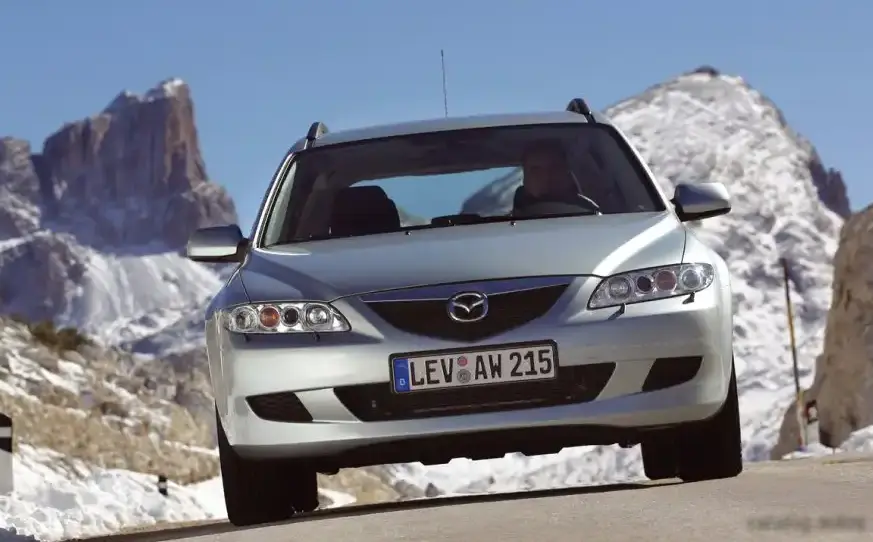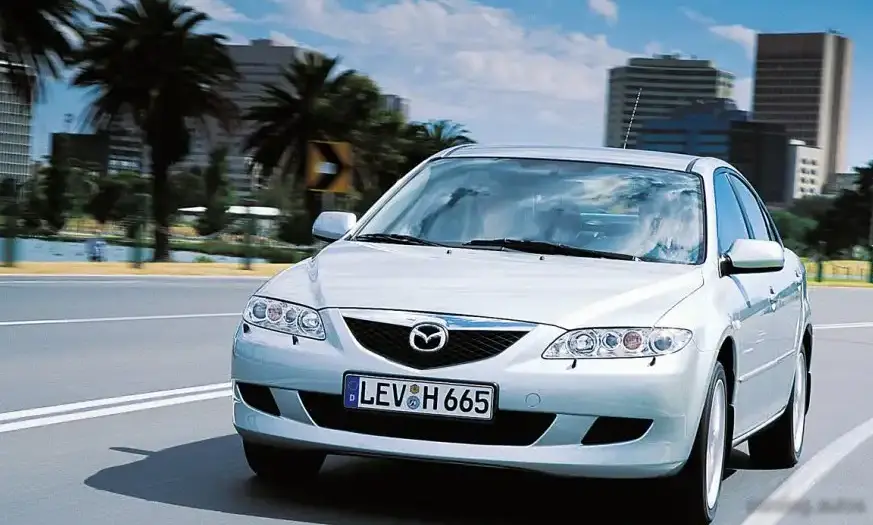
The Mazda 6, known internally as the GG/GY/GG1 generation, was a mid-size sedan produced by Mazda from 2002 to 2008. Representing a significant departure from its more utilitarian predecessors, the 6 aimed to offer a more sophisticated and sporty driving experience. Introduced as a replacement for the 626 and the 929, the first-generation 6 was available with a range of engines and transmissions, catering to diverse market preferences. This article focuses specifically on the 2.0-liter (141 horsepower) variant, a popular choice in many markets, particularly in Europe and Australia, and its introduction to the North American market as a base model.
Technical Specifications
| Brand | Mazda |
| Model | 6 |
| Generation | 6 I Sedan (Typ GG/GY/GG1) |
| Type (Engine) | 2.0 (141 Hp) |
| Start of production | 2002 |
| End of production | 2005 |
| Powertrain Architecture | Internal Combustion engine |
| Body type | Sedan |
| Seats | 5 |
| Doors | 4 |
| Fuel consumption (urban) | 11.8 l/100 km (19.9 US mpg) |
| Fuel consumption (extra urban) | 6.6 l/100 km (35.6 US mpg) |
| Fuel consumption (combined) | 8.5 l/100 km (27.7 US mpg) |
| CO2 emissions | 203 g/km |
| Fuel Type | Petrol (Gasoline) |
| Acceleration 0 – 100 km/h | 9.7 sec |
| Acceleration 0 – 62 mph | 9.7 sec |
| Acceleration 0 – 60 mph | 9.2 sec |
| Maximum speed | 208 km/h (129.25 mph) |
| Emission standard | Euro 4 |
| Weight-to-power ratio | 9 kg/Hp |
| Weight-to-torque ratio | 7 kg/Nm |
| Power | 141 Hp @ 6000 rpm |
| Torque | 181 Nm @ 4100 rpm (133.5 lb.-ft. @ 4100 rpm) |
| Engine layout | Front, Transverse |
| Engine Model/Code | LF17, LF18 |
| Engine displacement | 1999 cm3 (121.99 cu. in.) |
| Number of cylinders | 4 |
| Engine configuration | Inline |
| Cylinder Bore | 87.5 mm (3.44 in.) |
| Piston Stroke | 83.1 mm (3.27 in.) |
| Compression ratio | 10.8:1 |
| Number of valves per cylinder | 4 |
| Fuel injection system | Multi-port manifold injection |
| Engine aspiration | Naturally aspirated engine |
| Valvetrain | DOHC |
| Engine oil capacity | 4.3 l (4.54 US qt | 3.78 UK qt) |
| Coolant | 7.5 l (7.93 US qt | 6.6 UK qt) |
| Kerb Weight | 1275 kg (2810.89 lbs.) |
| Max. weight | 1840 kg (4056.51 lbs.) |
| Max load | 565 kg (1245.61 lbs.) |
| Trunk (boot) space – minimum | 500 l (17.66 cu. ft.) |
| Fuel tank capacity | 64 l (16.91 US gal | 14.08 UK gal) |
| Permitted trailer load with brakes (12%) | 1700 kg (3747.86 lbs.) |
| Permitted trailer load without brakes | 550 kg (1212.54 lbs.) |
| Length | 4680 mm (184.25 in.) |
| Width | 1780 mm (70.08 in.) |
| Height | 1435 mm (56.5 in.) |
| Wheelbase | 2675 mm (105.31 in.) |
| Front track | 1550 mm (61.02 in.) |
| Rear (Back) track | 1550 mm (61.02 in.) |
| Ride height (ground clearance) | 130 mm (5.12 in.) |
| Drag coefficient (Cd) | 0.30 |
| Minimum turning circle (turning diameter) | 10.8 m (35.43 ft.) |
| Drivetrain Architecture | Front wheel drive |
| Drive wheel | Front wheel drive |
| Number of gears and type of gearbox | 5 gears, manual transmission |
| Front brakes | Ventilated discs |
| Rear brakes | Disc |
| Assisting systems | ABS (Anti-lock braking system) |
| Steering type | Steering rack and pinion |
| Tires size | 195/65 R15 V |
| Wheel rims size | 15 |
Powertrain & Engine Architecture
The 2.0-liter engine, designated LF17 or LF18 depending on the specific market, was a naturally aspirated inline-four cylinder engine. It featured a double overhead camshaft (DOHC) valvetrain with four valves per cylinder, contributing to its relatively high output for its displacement. Fuel delivery was handled by a multi-port fuel injection system. The engine’s 10.8:1 compression ratio was a compromise between performance and the ability to run on readily available fuel grades. This engine was paired with a five-speed manual transmission as standard, but a four-speed automatic transmission was also offered, which is the focus of this article. The automatic transmission was designed for smooth operation and fuel efficiency, prioritizing comfort over outright performance.
Driving Characteristics
The 2.0-liter engine with the four-speed automatic transmission delivered adequate, but not exhilarating, performance. Acceleration from 0-60 mph took approximately 9.2 to 9.7 seconds, making it competitive with other mid-size sedans of the era. The automatic transmission’s gear ratios were tuned for fuel economy and drivability, resulting in a somewhat leisurely pace. Compared to the five-speed manual version, the automatic felt noticeably slower, particularly during overtaking maneuvers. However, the automatic provided a more relaxed driving experience, especially in urban traffic. The engine produced sufficient torque for everyday driving, but lacked the punch of the higher-output 2.3-liter or V6 options available in the Mazda 6 lineup.
Equipment & Trim Levels
The 2.0-liter automatic variant typically represented the entry-level trim in many markets. Standard equipment generally included air conditioning, power windows and locks, a basic audio system, and ABS brakes. Interior upholstery was typically cloth, and the dashboard featured a straightforward design. Optional extras included alloy wheels, a sunroof, upgraded audio systems, and side airbags. Higher trim levels, such as the Sport or Luxury models, added features like leather upholstery, automatic climate control, and premium audio systems. The 2.0L automatic was often targeted towards buyers prioritizing affordability and comfort over sporty performance or advanced features.
Chassis & Braking
The Mazda 6 utilized a front-engine, front-wheel-drive layout. The suspension consisted of MacPherson struts at the front and multi-link suspension at the rear, providing a good balance between ride comfort and handling. The 2.0-liter models typically featured ventilated disc brakes at the front and solid disc brakes at the rear. The braking system, combined with ABS, provided adequate stopping power for everyday driving. Stabilizer bars were fitted to both the front and rear axles to reduce body roll during cornering. The chassis was designed to be relatively lightweight, contributing to the car’s overall efficiency.
Market Reception & Comparison
The 2.0-liter Mazda 6 with the automatic transmission received mixed reviews. Critics generally praised the car’s stylish design, comfortable interior, and good value for money. However, the engine and automatic transmission combination were often criticized for being underpowered and lacking refinement compared to competitors. Fuel economy was considered average for the class. Compared to the more powerful 2.3-liter and V6 models, the 2.0-liter automatic offered lower performance but also lower running costs. The 2.0-liter was often seen as a sensible choice for buyers prioritizing practicality and affordability.
Legacy
The 2.0-liter Mazda 6 with the four-speed automatic transmission has proven to be a relatively reliable powertrain. While the automatic transmission is not known for its longevity as some other units, with proper maintenance, it can provide many years of service. The LF engine family is generally considered durable, although regular oil changes and maintenance are crucial. Today, these cars are readily available on the used car market at affordable prices. They represent a good value for buyers seeking a comfortable and reliable mid-size sedan, although potential buyers should be aware of the engine’s modest performance and the automatic transmission’s potential for issues with age. The first-generation Mazda 6, including this 2.0L variant, helped establish Mazda as a brand known for its stylish designs and engaging driving dynamics.