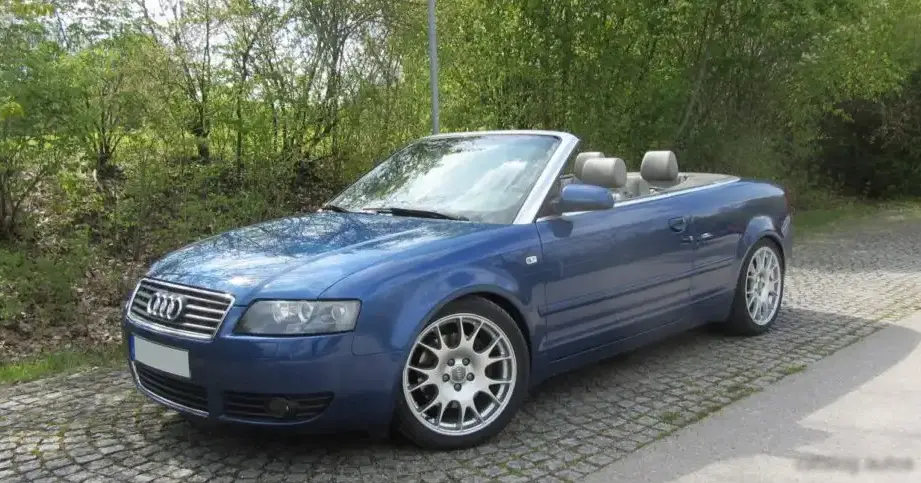
The Audi A4 Cabriolet (B6 8H) 2.4 V6 30V, produced from 2001 to 2003, represented Audi’s entry into the premium compact convertible market. Positioned as a more sophisticated alternative to rivals like the BMW 3 Series Convertible and Mercedes-Benz CLK, the B6 A4 Cabriolet offered a blend of sporty handling, refined comfort, and Audi’s signature build quality. This particular variant, equipped with the 2.4-liter V6 engine producing 170 horsepower, was a mid-range offering within the B6 Cabriolet lineup, slotting between the base 1.8T models and the more potent 3.0 V6 versions. It aimed to provide a balance of performance and affordability for buyers seeking an open-air luxury experience.
Technical Specifications
| Brand | Audi |
| Model | A4 |
| Generation | A4 Cabriolet (B6 8H) |
| Type (Engine) | 2.4 V6 30V (170 Hp) |
| Start of production | 2001 |
| End of production | 2003 |
| Powertrain Architecture | Internal Combustion engine |
| Body type | Cabriolet |
| Seats | 4 |
| Doors | 2 |
| Fuel consumption (urban) | 13.8 l/100 km (17 US mpg, 20.5 UK mpg, 7.2 km/l) |
| Fuel consumption (extra urban) | 7.4 l/100 km (31.8 US mpg, 38.2 UK mpg, 13.5 km/l) |
| Fuel consumption (combined) | 9.7 l/100 km (24.2 US mpg, 29.1 UK mpg, 10.3 km/l) |
| Fuel Type | Petrol (Gasoline) |
| Acceleration 0 – 100 km/h | 9.7 sec |
| Acceleration 0 – 62 mph | 9.7 sec |
| Acceleration 0 – 60 mph | 9.2 sec |
| Maximum speed | 224 km/h (139.19 mph) |
| Weight-to-power ratio | 9.4 kg/Hp, 106.3 Hp/tonne |
| Weight-to-torque ratio | 7 kg/Nm, 143.8 Nm/tonne |
| Power | 170 Hp @ 6000 rpm |
| Power per litre | 71 Hp/l |
| Torque | 230 Nm @ 3200 rpm (169.64 lb.-ft. @ 3200 rpm) |
| Engine layout | Front, Longitudinal |
| Engine Model/Code | BDV |
| Engine displacement | 2393 cm3 (146.03 cu. in.) |
| Number of cylinders | 6 |
| Engine configuration | V-engine |
| Cylinder Bore | 81 mm (3.19 in.) |
| Piston Stroke | 77.4 mm (3.05 in.) |
| Compression ratio | 10.5:1 |
| Number of valves per cylinder | 5 |
| Fuel injection system | Multi-port manifold injection |
| Engine aspiration | Naturally aspirated engine |
| Engine oil capacity | 6 l (6.34 US qt | 5.28 UK qt) |
| Coolant | 8 l (8.45 US qt | 7.04 UK qt) |
| Kerb Weight | 1600 kg (3527.4 lbs.) |
| Max. weight | 2080 kg (4585.62 lbs.) |
| Max load | 480 kg (1058.22 lbs.) |
| Trunk (boot) space – minimum | 246 l (8.69 cu. ft.) |
| Trunk (boot) space – maximum | 315 l (11.12 cu. ft.) |
| Fuel tank capacity | 70 l (18.49 US gal | 15.4 UK gal) |
| Length | 4573 mm (180.04 in.) |
| Width | 1777 mm (69.96 in.) |
| Height | 1391 mm (54.76 in.) |
| Wheelbase | 2654 mm (104.49 in.) |
| Front track | 1523 mm (59.96 in.) |
| Rear (Back) track | 1523 mm (59.96 in.) |
| Drag coefficient (Cd) | 0.30 |
| Minimum turning circle | 11.1 m (36.42 ft.) |
| Drivetrain Architecture | The Internal combustion engine (ICE) drives the front wheels of the vehicle. |
| Drive wheel | Front wheel drive |
| Number of gears | 5 |
| Gearbox type | Manual transmission |
| Front suspension | Independent multi-link suspension |
| Rear suspension | Independent multi-link suspension |
| Front brakes | Ventilated discs |
| Rear brakes | Disc |
| Assisting systems | ABS (Anti-lock braking system) |
| Steering type | Steering rack and pinion |
| Power steering | Hydraulic Steering |
| Tires size | 205/55 R16 |
| Wheel rims size | 7J x 16 |
Powertrain & Engine Architecture
The heart of the A4 Cabriolet 2.4 V6 was the BDV engine code, a 2.4-liter, naturally aspirated V6. This engine featured a 60-degree V-angle, contributing to its smooth operation and relatively compact size. It employed a multi-port fuel injection system, delivering fuel directly into the intake ports, and a five-valve-per-cylinder configuration (three intake, two exhaust) to enhance volumetric efficiency. The engine’s 10.5:1 compression ratio helped extract maximum power from the gasoline. The five-speed manual transmission was standard, offering precise shifts and a direct connection to the engine. The transmission’s gear ratios were tuned for a balance of acceleration and fuel economy, though the Cabriolet’s added weight compared to the coupe version did impact performance slightly.
Driving Characteristics
The 2.4 V6 with the manual transmission provided a reasonably engaging driving experience. While not as overtly sporty as the 3.0 V6 variant, the 170 hp engine delivered adequate power for comfortable cruising and spirited driving. Acceleration from 0-60 mph took around 9.2 seconds, and the car could reach a top speed of 139 mph. The front-wheel-drive layout offered good traction in most conditions, but could exhibit some torque steer under hard acceleration. The Cabriolet’s chassis was well-tuned, providing a comfortable ride without sacrificing handling precision. The steering was responsive, and the car felt stable and predictable in corners. Compared to the 1.8T models, the 2.4 V6 offered a noticeable improvement in performance, while the 3.0 V6 provided even more power but at a higher price point.
Equipment & Trim Levels
The A4 Cabriolet 2.4 V6 typically came well-equipped, reflecting its premium positioning. Standard features included leather upholstery, power-adjustable front seats, automatic climate control, a premium sound system, and alloy wheels. The convertible top was a fully automatic, insulated fabric top that could be raised or lowered in around 10 seconds. Optional extras included heated front seats, a navigation system, and upgraded audio options. Interior trim levels varied, with options for wood or aluminum accents. The overall interior design was typical of Audi at the time – clean, functional, and built with high-quality materials.
Chassis & Braking
The B6 A4 Cabriolet utilized an independent multi-link suspension system at both the front and rear, providing a comfortable ride and good handling characteristics. The front suspension featured coil springs and stabilizer bar, while the rear suspension employed separate springs and dampers. Braking duties were handled by ventilated discs at the front and solid discs at the rear, assisted by an Anti-lock Braking System (ABS). The braking system provided adequate stopping power for the car’s weight and performance.
Market Reception & Comparison
The Audi A4 Cabriolet 2.4 V6 was generally well-received by automotive critics. It was praised for its stylish design, comfortable interior, and refined driving experience. However, some critics noted that the front-wheel-drive layout limited its sporting potential compared to rear-wheel-drive rivals. Fuel economy was considered average for its class, with combined fuel consumption around 24.2 US mpg. Compared to the 1.8T models, the 2.4 V6 offered a significant performance upgrade, making it a more appealing option for drivers who prioritized power. The 3.0 V6, while more powerful, came at a higher price and offered only a marginal improvement in real-world driving performance.
Legacy
The B6 A4 Cabriolet 2.4 V6 has proven to be a relatively reliable vehicle, with the BDV engine generally considered durable. However, like all older vehicles, it requires regular maintenance to prevent issues. Common problems include oil leaks, cooling system failures, and wear and tear on suspension components. Today, the B6 A4 Cabriolet 2.4 V6 is a popular choice among enthusiasts seeking an affordable and stylish convertible. Its classic Audi design, comfortable interior, and relatively simple mechanicals make it a rewarding ownership experience. Well-maintained examples command reasonable prices in the used car market, making it an accessible entry point into the world of Audi convertibles.