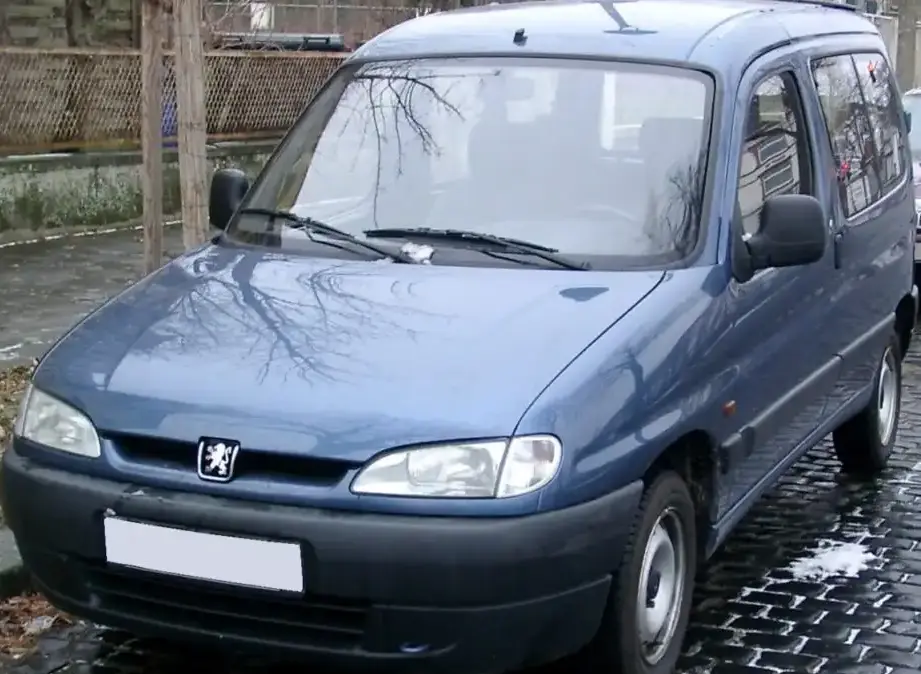
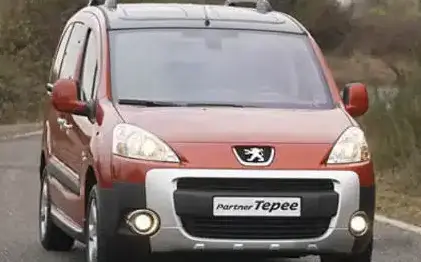
The Peugeot Partner I (Phase II), specifically the 2.0 HDi 90 horsepower variant produced between 2002 and 2006, represents a significant iteration of Peugeot’s popular light commercial vehicle and multi-purpose vehicle (MPV). Positioned as a workhorse and family transport, the Partner I Phase II offered a blend of practicality, affordability, and diesel efficiency. This version sat within the Partner range as a mid-level offering, providing a balance between the base 1.6 HDi models and the more powerful 2.0 HDi 110 and 120 hp options. It was primarily marketed in Europe, where compact vans and MPVs were – and continue to be – in high demand for both commercial and personal use.
Technical Specifications
| Brand | Peugeot |
| Model | Partner |
| Generation | Partner I (Phase II, 2002) |
| Type (Engine) | 2.0 HDi (90 Hp) |
| Start of production | 2002 |
| End of production | 2006 |
| Powertrain Architecture | Internal Combustion engine |
| Body type | Minivan |
| Seats | 5 |
| Doors | 5 |
| Fuel consumption (urban) | 7.3 l/100 km (32.2 US mpg) |
| Fuel consumption (extra urban) | 5 l/100 km (47 US mpg) |
| Fuel consumption (combined) | 5.8 l/100 km (40.6 US mpg) |
| Fuel Type | Diesel |
| Acceleration 0 – 100 km/h | 15.6 sec |
| Acceleration 0 – 62 mph | 15.6 sec |
| Acceleration 0 – 60 mph | 14.8 sec |
| Maximum speed | 160 km/h (99.42 mph) |
| Emission standard | Euro 4 |
| Weight-to-power ratio | 14.6 kg/Hp |
| Weight-to-torque ratio | 6.4 kg/Nm |
| Power | 90 Hp @ 4000 rpm |
| Torque | 205 Nm @ 2000 rpm (151.2 lb.-ft. @ 2000 rpm) |
| Engine layout | Front, Transverse |
| Engine Model/Code | RHY DW10TD |
| Engine displacement | 1997 cm3 (121.86 cu. in.) |
| Number of cylinders | 4 |
| Engine configuration | Inline |
| Cylinder Bore | 85 mm (3.35 in.) |
| Piston Stroke | 88 mm (3.46 in.) |
| Compression ratio | 18:1 |
| Number of valves per cylinder | 2 |
| Fuel injection system | Diesel Commonrail |
| Engine aspiration | Turbocharger, Intercooler |
| Valvetrain | DOHC |
| Engine oil capacity | 4.25 l (4.49 US qt | 3.74 UK qt) |
| Coolant capacity | 9 l (9.51 US qt | 7.92 UK qt) |
| Kerb Weight | 1310 kg (2888.06 lbs.) |
| Max. weight | 1920 kg (4232.88 lbs.) |
| Max load | 610 kg (1344.82 lbs.) |
| Trunk (boot) space – minimum | 625 l (22.07 cu. ft.) |
| Trunk (boot) space – maximum | 2800 l (98.88 cu. ft.) |
| Fuel tank capacity | 60 l (15.85 US gal | 13.2 UK gal) |
| Length | 4140 mm (162.99 in.) |
| Width | 1720 mm (67.72 in.) |
| Height | 1810 mm (71.26 in.) |
| Wheelbase | 2690 mm (105.91 in.) |
| Front track | 1420 mm (55.91 in.) |
| Rear track | 1440 mm (56.69 in.) |
| Minimum turning circle | 11 m (36.09 ft.) |
| Drivetrain Architecture | Front wheel drive |
| Number of gears | 5 |
| Gearbox type | Manual transmission |
| Front suspension | Independent type McPherson |
| Rear suspension | Independent torsion suspension |
| Front brakes | Disc |
| Rear brakes | Drum |
| Assisting systems | ABS (Anti-lock braking system) |
| Steering type | Steering rack and pinion |
| Power steering | Hydraulic |
| Tires size | 185/65 R15 |
Powertrain & Engine Architecture
The heart of the Partner 1.8 HDi 90 is the DW10TD engine, specifically the RHY variant. This 1.997-liter, four-cylinder diesel engine utilizes a common rail direct injection system, a technology that was becoming increasingly prevalent in the early 2000s. The DW10 engine family is known for its robustness and relatively simple design, contributing to its longevity. The RHY version features a turbocharger with an intercooler, boosting power output to 90 horsepower at 4000 rpm and 205 Nm (151.2 lb-ft) of torque at 2000 rpm. The engine employs a double overhead camshaft (DOHC) valvetrain with two valves per cylinder. The five-speed manual transmission was the standard offering, providing a balance between fuel efficiency and usability. The engine’s design prioritized fuel economy and low-end torque, making it well-suited for carrying loads and navigating urban environments.
Driving Characteristics
The 2.0 HDi 90 hp version of the Partner I offered a practical, if not particularly exciting, driving experience. Acceleration was modest, with a 0-60 mph time of around 14.8 seconds. The focus was on usability rather than outright speed. The engine’s strong low-end torque made it capable of hauling loads and tackling inclines without excessive gear changes. The five-speed manual transmission was well-matched to the engine’s characteristics, providing adequate spacing between gears. Compared to the higher-output 2.0 HDi variants, the 90 hp model felt noticeably less powerful, especially when fully loaded. However, this trade-off was offset by improved fuel economy. The suspension, tuned for comfort and load-carrying capacity, provided a reasonably smooth ride, even on uneven surfaces.
Equipment & Trim Levels
The Partner I Phase II 2.0 HDi 90 typically came with a fairly basic level of equipment, reflecting its commercial vehicle roots. Standard features generally included power steering, ABS brakes, a driver’s airbag, and a basic audio system. Interior upholstery was typically durable cloth. Optional extras included air conditioning, electric windows, and a passenger airbag. Trim levels varied depending on the market, but generally focused on adding convenience features rather than luxury items. The Partner was designed to be a functional vehicle, and the emphasis was on practicality and durability.
Chassis & Braking
The Partner I utilized a front-wheel-drive layout with an independent McPherson strut suspension at the front and an independent torsion beam suspension at the rear. This setup provided a good balance between ride comfort and handling. The front brakes were discs, while the rear brakes were drums – a cost-saving measure common in this class of vehicle. ABS (Anti-lock Braking System) was standard, enhancing safety. The chassis was designed to withstand the stresses of carrying loads, and the suspension was tuned to provide a stable and controlled ride even when fully laden.
Market Reception & Comparison
The Peugeot Partner I 2.0 HDi 90 was generally well-received by critics and buyers alike. It was praised for its fuel efficiency, practicality, and reliability. Compared to the more powerful 2.0 HDi variants, the 90 hp model offered a lower purchase price and slightly better fuel economy. However, it lacked the performance of its more potent siblings. Against competitors like the Citroën Berlingo (with which it shared many components), Renault Kangoo, and Volkswagen Caddy, the Partner offered a competitive package in terms of price, features, and reliability. Its diesel engine provided a significant advantage in terms of fuel economy compared to gasoline-powered rivals.
Legacy
The Peugeot Partner I 2.0 HDi 90 has proven to be a durable and reliable vehicle. Many examples are still on the road today, testament to the robustness of the DW10 engine and the overall build quality of the vehicle. The DW10 engine family, in particular, has a reputation for longevity, and with proper maintenance, can easily exceed 200,000 miles. In the used car market, these Partners are often sought after as affordable and practical work vehicles or family transport. While not a performance icon, the 2.0 HDi 90 represents a solid and dependable choice for those seeking a no-nonsense, fuel-efficient van or MPV.