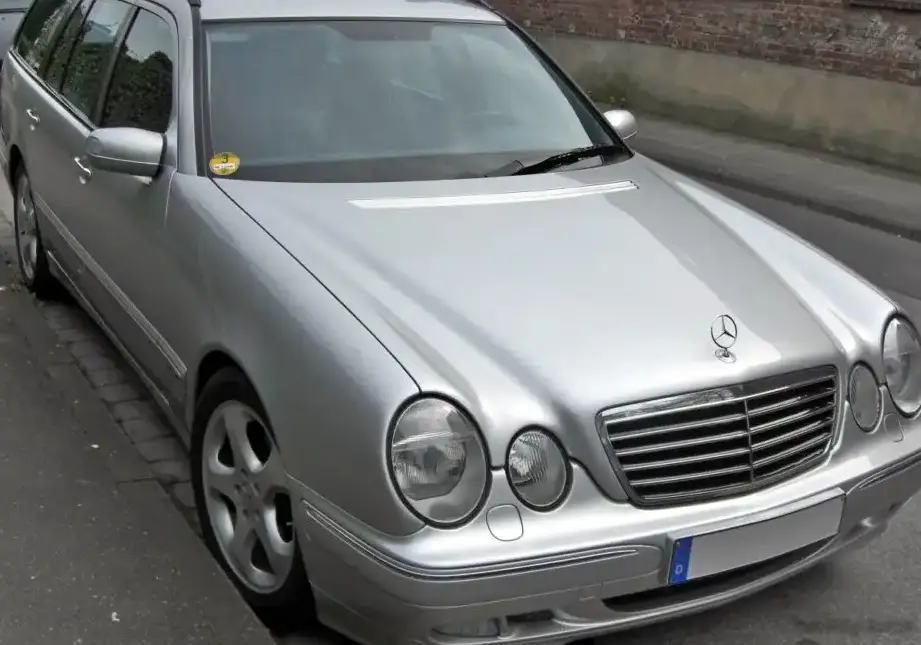
The Mercedes-Benz E-Class T-modell (S210) facelift E 240 V6, produced from July 1999 to June 2000, represents a refined iteration of the W210-series estate car. This variant occupied a middle ground within the E-Class T-modell lineup, offering a balance between performance, luxury, and practicality. It was positioned above the four-cylinder models and below the higher-performance E 320 and E 55 AMG versions. The S210 facelift brought significant updates to the W210, addressing criticisms of the pre-facelift models and enhancing overall refinement. This particular E 240 V6 model aimed to provide a comfortable and capable wagon for families and individuals needing substantial cargo space without sacrificing the Mercedes-Benz driving experience.
Technical Specifications
| Brand | Mercedes-Benz |
| Model | E-Class |
| Generation | E-Class T-modell (S210, facelift 1999) |
| Type (Engine) | E 240 V6 (170 Hp) |
| Start of production | July, 1999 |
| End of production | June, 2000 |
| Powertrain Architecture | Internal Combustion engine |
| Body type | Station wagon (estate) |
| Seats | 5 |
| Doors | 5 |
| Fuel consumption (urban) | 16.3 l/100 km (14.4 US mpg, 17.3 UK mpg, 6.1 km/l) |
| Fuel consumption (extra urban) | 8.3 l/100 km (28.3 US mpg, 34 UK mpg, 12 km/l) |
| Fuel consumption (combined) | 11.2 l/100 km (21 US mpg, 25.2 UK mpg, 8.9 km/l) |
| Fuel Type | Petrol (Gasoline) |
| Acceleration 0 – 100 km/h | 10.7 sec |
| Acceleration 0 – 62 mph | 10.7 sec |
| Acceleration 0 – 60 mph | 10.2 sec |
| Maximum speed | 215 km/h (133.59 mph) |
| Weight-to-power ratio | 9.8 kg/Hp, 101.8 Hp/tonne |
| Weight-to-torque ratio | 7.4 kg/Nm, 134.7 Nm/tonne |
| Power | 170 Hp @ 5900 rpm |
| Power per litre | 70.9 Hp/l |
| Torque | 225 Nm @ 3000-5000 rpm (165.95 lb.-ft. @ 3000-5000 rpm) |
| Engine layout | Front, Longitudinal |
| Engine Model/Code | M 112 E 24 / 112.911 |
| Engine displacement | 2398 cm3 (146.33 cu. in.) |
| Number of cylinders | 6 |
| Engine configuration | V-engine |
| Cylinder Bore | 83.2 mm (3.28 in.) |
| Piston Stroke | 73.5 mm (2.89 in.) |
| Compression ratio | 10:1 |
| Number of valves per cylinder | 3 |
| Fuel injection system | Multi-port manifold injection |
| Engine aspiration | Naturally aspirated engine |
| Valvetrain | SOHC |
| Engine oil capacity | 8 l (8.45 US qt | 7.04 UK qt) |
| Coolant | 10 l (10.57 US qt | 8.8 UK qt) |
| Kerb Weight | 1670 kg (3681.72 lbs.) |
| Max. weight | 2250 kg (4960.4 lbs.) |
| Max load | 580 kg (1278.68 lbs.) |
| Trunk (boot) space – minimum | 600 l (21.19 cu. ft.) |
| Trunk (boot) space – maximum | 1920 l (67.8 cu. ft.) |
| Fuel tank capacity | 70 l (18.49 US gal | 15.4 UK gal) |
| Length | 4839 mm (190.51 in.) |
| Width | 1799 mm (70.83 in.) |
| Height | 1505 mm (59.25 in.) |
| Wheelbase | 2833 mm (111.54 in.) |
| Front track | 1542 mm (60.71 in.) |
| Rear (Back) track | 1546 mm (60.87 in.) |
| Drivetrain Architecture | The Internal combustion engine (ICE) drives the rear wheels of the vehicle. |
| Drive wheel | Rear wheel drive |
| Number of gears and type of gearbox | 6 gears, manual transmission |
| Front suspension | Double wishbone |
| Rear suspension | Hydro-pneumatic element, Independent multi-link suspension |
| Front brakes | Ventilated discs |
| Rear brakes | Disc |
| Assisting systems | ABS (Anti-lock braking system) |
| Steering type | Steering rack and pinion |
| Power steering | Hydraulic Steering |
| Tires size | 205/65 R15 |
| Wheel rims size | 7J x 15 |
Powertrain & Engine Architecture
The E 240 V6 was powered by the M112 E 24 engine, a 2.4-liter naturally aspirated V6. This engine, designated with the code 112.911, was a significant departure from the inline-six engines previously used in the E-Class. The M112 featured all-aluminum construction, three valves per cylinder (two intake, one exhaust), and a single overhead camshaft (SOHC). Fuel delivery was handled by a multi-port fuel injection system. The engine produced 170 horsepower at 5900 rpm and 225 Nm (165.95 lb-ft) of torque between 3000 and 5000 rpm. The six-speed manual transmission was standard, providing precise gear changes and contributing to a more engaging driving experience. While an automatic transmission was available, the manual was favored by enthusiasts for its responsiveness.
Driving Characteristics
The E 240 V6 with the manual transmission offered a balanced driving experience. Acceleration from 0 to 60 mph took approximately 10.2 seconds, and the car could reach a top speed of 215 km/h (133.59 mph). While not a sports car, the V6 provided ample power for everyday driving and comfortable highway cruising. The six-speed manual transmission allowed drivers to keep the engine in its optimal power band, resulting in brisk acceleration. Compared to the more powerful E 320, the E 240 V6 felt less urgent, but it offered better fuel economy and a lighter feel. The manual gearbox also provided a more connected feel to the car than the optional automatic.
Equipment & Trim Levels
The E 240 V6 T-modell came standard with a respectable array of features, including automatic climate control, power windows and locks, a multi-function steering wheel, and a high-quality audio system. Upholstery was typically cloth, but leather was available as an option. Optional extras included a sunroof, navigation system, heated seats, and upgraded audio systems. The facelift models also benefited from improved interior materials and a more modern dashboard design compared to the pre-facelift W210s. The estate body style itself added to the practicality, with a spacious cargo area that could be expanded by folding down the rear seats.
Chassis & Braking
The S210 E-Class featured a double wishbone front suspension and an independent multi-link rear suspension, providing a comfortable and controlled ride. The E 240 V6 was equipped with ventilated disc brakes at the front and solid discs at the rear. Anti-lock braking system (ABS) was standard. The suspension was tuned to prioritize comfort, but it also offered good handling characteristics. The steering was hydraulic power-assisted, providing a responsive and precise feel.
Market Reception & Comparison
The E 240 V6 T-modell was generally well-received by automotive critics. It was praised for its comfortable ride, spacious interior, and refined engine. However, some critics noted that the engine lacked the outright performance of the E 320. Fuel economy was considered reasonable for a vehicle of its size and class. Compared to the E 320, the E 240 V6 offered a more affordable entry point into the E-Class range, making it an attractive option for buyers who prioritized value and practicality. The manual transmission version was particularly appreciated by driving enthusiasts.
Legacy
The M112 engine family proved to be remarkably reliable, and the E 240 V6 is generally considered a durable and dependable vehicle. While age and mileage can introduce typical wear and tear, these engines are known for their longevity. Today, the S210 E-Class T-modell, including the E 240 V6, has a growing following among classic Mercedes-Benz enthusiasts. Well-maintained examples are becoming increasingly sought after, offering a blend of classic styling, practicality, and the renowned Mercedes-Benz build quality. The availability of parts remains good, making it a viable option for those seeking a comfortable and reliable estate car with a touch of German engineering.