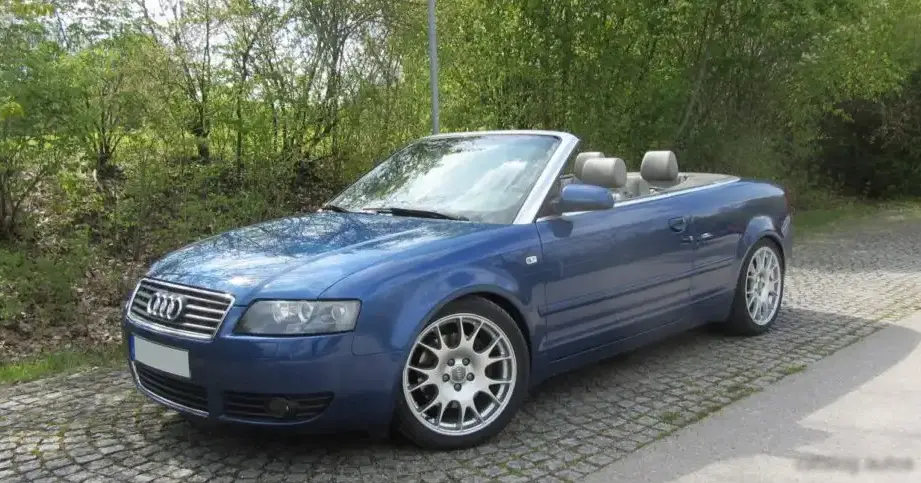
The Audi A4 Cabriolet (B6 8H) 3.0 V6 30V, produced from 2001 to 2003, represented a significant offering in Audi’s open-top luxury segment. This variant, powered by the ASN or AVK engine code, was positioned as the premium engine choice within the B6 Cabriolet range, sitting above the 1.8T and 2.0 models. It was a key component of the B6 generation (2002-2005) A4 family, built on the Volkswagen Group’s PL45 platform, also known as the 1HX0 platform for the A4. The Cabriolet specifically aimed to blend the A4’s refined driving experience with the enjoyment of open-air motoring, targeting buyers who desired a sophisticated and sporty convertible.
Technical Specifications
| Brand | Audi |
| Model | A4 |
| Generation | A4 Cabriolet (B6 8H) |
| Type (Engine) | 3.0 V6 30V (220 Hp) |
| Start of production | 2001 |
| End of production | 2003 |
| Powertrain Architecture | Internal Combustion engine |
| Body type | Cabriolet |
| Seats | 4 |
| Doors | 2 |
| Fuel consumption (urban) | 14.4 l/100 km (16.3 US mpg, 19.6 UK mpg, 6.9 km/l) |
| Fuel consumption (extra urban) | 7.3 l/100 km (32.2 US mpg, 38.7 UK mpg, 13.7 km/l) |
| Fuel consumption (combined) | 9.9 l/100 km (23.8 US mpg, 28.5 UK mpg, 10.1 km/l) |
| CO2 emissions | 238 g/km |
| Fuel Type | Petrol (Gasoline) |
| Acceleration 0 – 100 km/h | 7.8 sec |
| Acceleration 0 – 62 mph | 7.8 sec |
| Acceleration 0 – 60 mph | 7.4 sec |
| Maximum speed | 243 km/h (150.99 mph) |
| Emission standard | Euro 4 |
| Weight-to-power ratio | 7.2 kg/Hp, 138.4 Hp/tonne |
| Weight-to-torque ratio | 5.3 kg/Nm, 188.7 Nm/tonne |
| Power | 220 Hp @ 6300 rpm |
| Power per litre | 73.9 Hp/l |
| Torque | 300 Nm @ 3200 rpm (221.27 lb.-ft. @ 3200 rpm) |
| Engine layout | Front, Longitudinal |
| Engine Model/Code | ASN, AVK |
| Engine displacement | 2976 cm3 (181.61 cu. in.) |
| Number of cylinders | 6 |
| Engine configuration | V-engine |
| Cylinder Bore | 82.5 mm (3.25 in.) |
| Piston Stroke | 92.8 mm (3.65 in.) |
| Compression ratio | 10.5:1 |
| Number of valves per cylinder | 5 |
| Fuel injection system | Multi-port manifold injection |
| Engine aspiration | Naturally aspirated engine |
| Valvetrain | DOHC |
| Engine oil capacity | 6.3 l (6.66 US qt | 5.54 UK qt) |
| Coolant | 9 l (9.51 US qt | 7.92 UK qt) |
| Kerb Weight | 1590 kg (3505.35 lbs.) |
| Max. weight | 2070 kg (4563.57 lbs.) |
| Max load | 480 kg (1058.22 lbs.) |
| Trunk (boot) space – minimum | 246 l (8.69 cu. ft.) |
| Trunk (boot) space – maximum | 315 l (11.12 cu. ft.) |
| Fuel tank capacity | 70 l (18.49 US gal | 15.4 UK gal) |
| Permitted trailer load with brakes (8%) | 1800 kg (3968.32 lbs.) |
| Permitted trailer load with brakes (12%) | 1600 kg (3527.4 lbs.) |
| Permitted trailer load without brakes | 750 kg (1653.47 lbs.) |
| Permitted towbar download | 80 kg (176.37 lbs.) |
| Length | 4573 mm (180.04 in.) |
| Width | 1777 mm (69.96 in.) |
| Height | 1391 mm (54.76 in.) |
| Wheelbase | 2654 mm (104.49 in.) |
| Front track | 1523 mm (59.96 in.) |
| Rear (Back) track | 1523 mm (59.96 in.) |
| Drag coefficient (Cd) | 0.30 |
| Minimum turning circle (turning diameter) | 11.1 m (36.42 ft.) |
| Drivetrain Architecture | The Internal combustion engine (ICE) drives the front wheels of the vehicle. |
| Drive wheel | Front wheel drive |
| Number of gears and type of gearbox | 6 gears, manual transmission |
| Front suspension | Independent multi-link suspension |
| Rear suspension | Independent multi-link suspension |
| Front brakes | Ventilated discs |
| Rear brakes | Disc |
| Assisting systems | ABS (Anti-lock braking system) |
| Steering type | Steering rack and pinion |
| Power steering | Hydraulic Steering |
| Tires size | 215/55 R16 |
| Wheel rims size | 7J x 16 |
Powertrain & Engine Architecture
The heart of the A4 Cabriolet 3.0 V6 was the ASN or AVK engine, a 2.976-liter naturally aspirated V6. This engine was a member of Audi’s long-running V6 family, known for its smoothness and relatively high output. The engine featured a 60-degree V-angle, contributing to its compact dimensions and balance. It employed multi-port fuel injection and a double overhead camshaft (DOHC) valvetrain with five valves per cylinder (three intake, two exhaust). This configuration maximized breathing and contributed to the engine’s power delivery. The 6-speed manual transmission was standard, providing precise control and enhancing the driving experience. The engine’s longitudinal mounting and front-wheel drive configuration were typical for Audi’s at the time, though quattro all-wheel drive was available as an option on other A4 models.
Driving Characteristics
The 3.0 V6 Cabriolet offered a noticeably more engaging driving experience than the lower-displacement models. With 220 horsepower and 221 lb-ft of torque, acceleration from 0-60 mph took approximately 7.4 seconds, and it could reach a top speed of 151 mph. The engine delivered a broad torque curve, making it responsive in everyday driving situations. The 6-speed manual transmission allowed drivers to fully exploit the engine’s power, while the well-tuned suspension provided a comfortable yet controlled ride. Compared to the 1.8T models, the V6 offered significantly more power and a more refined feel. While the 1.8T was known for its turbo lag, the V6 provided instant and linear power delivery. The V6 also felt more stable at higher speeds, thanks to its increased weight and improved balance.
Equipment & Trim Levels
The 3.0 V6 Cabriolet typically came well-equipped, reflecting its position as the premium trim level. Standard features included leather upholstery, automatic climate control, power windows and locks, and a high-quality audio system. Optional extras included heated front seats, a premium sound system, and a wind deflector to reduce turbulence in the cabin with the top down. Interior trim options varied, with choices in wood or aluminum accents. The dashboard layout was typical of the B6 A4, with a focus on ergonomics and functionality.
Chassis & Braking
The A4 Cabriolet’s chassis was reinforced to compensate for the lack of a fixed roof, ensuring structural rigidity. The suspension utilized an independent multi-link setup at both the front and rear, providing a comfortable ride and precise handling. Brakes consisted of ventilated discs at the front and solid discs at the rear, providing adequate stopping power for the vehicle’s weight and performance. Anti-lock braking system (ABS) was standard.
Market Reception & Comparison
The A4 Cabriolet 3.0 V6 was generally well-received by automotive critics. It was praised for its refined engine, comfortable ride, and stylish design. However, some critics noted that the Cabriolet was more expensive than its competitors, such as the BMW 3 Series Convertible and the Mercedes-Benz CLK Cabriolet. Fuel economy was also a concern, with the V6 engine consuming significantly more fuel than the turbocharged four-cylinder models. In terms of reliability, the 3.0 V6 engine proved to be relatively robust, although regular maintenance was essential to prevent issues such as oil leaks and timing chain wear.
Legacy
Today, the Audi A4 Cabriolet 3.0 V6 (B6) is considered a desirable classic by many Audi enthusiasts. Well-maintained examples are becoming increasingly rare and valuable. The ASN/AVK V6 engine is known for its durability, but preventative maintenance, particularly regarding the timing chain and oil leaks, is crucial. The car represents a sweet spot in Audi’s history, combining a sophisticated driving experience with the open-air enjoyment of a convertible. Its blend of performance, luxury, and style continues to appeal to collectors and enthusiasts alike.