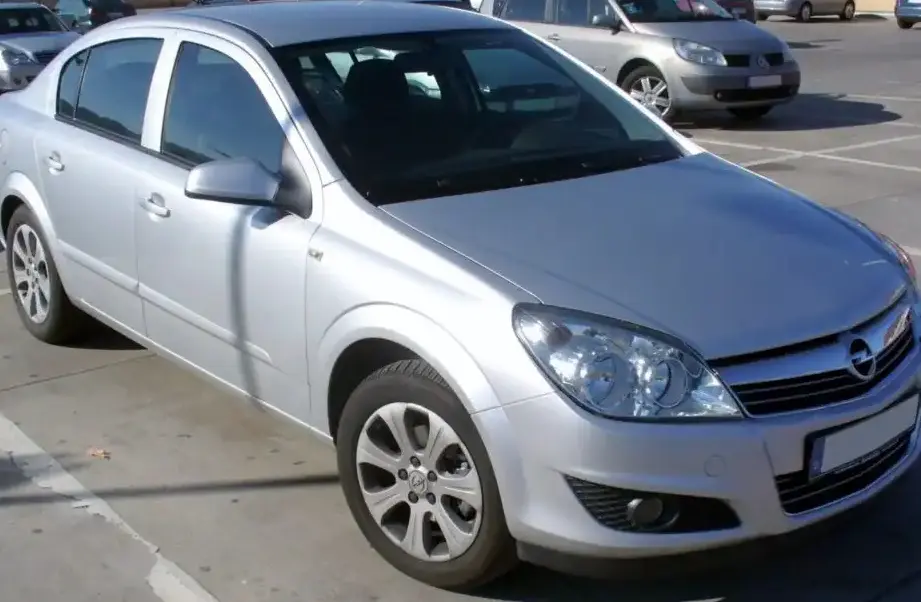
The Opel Astra H Sedan 1.8i 16V, produced between 2007 and 2010, represented a key offering in Opel’s mid-size sedan lineup. Positioned as a step up from the base models, this variant aimed to provide a balance of performance and fuel efficiency within the broader Astra H range, which utilized the GM Delta platform (also known as the 1HX0). The Astra H Sedan, specifically, was designed to appeal to buyers seeking a more traditional sedan body style compared to the hatchback versions prevalent in Europe. This model was primarily marketed in Europe, where sedans held a significant share of the market, and offered a more affordable entry point into the Astra H family than the higher-performance or diesel-powered options.
Technical Specifications
| Brand | Opel |
| Model | Astra |
| Generation | Astra H Sedan |
| Type (Engine) | 1.8i 16V (140 Hp) |
| Start of production | 2007 |
| End of production | 2010 |
| Powertrain Architecture | Internal Combustion engine |
| Body type | Sedan |
| Seats | 5 |
| Doors | 4 |
| Fuel consumption (urban) | 10 l/100 km (23.5 US mpg) |
| Fuel consumption (extra urban) | 5.9 l/100 km (39.9 US mpg) |
| Fuel consumption (combined) | 7.4 l/100 km (31.8 US mpg) |
| CO2 emissions | 178 g/km |
| Fuel Type | Petrol (Gasoline) |
| Acceleration 0 – 100 km/h | 10.2 sec |
| Acceleration 0 – 62 mph | 10.2 sec |
| Acceleration 0 – 60 mph | 9.7 sec |
| Maximum speed | 207 km/h (128.62 mph) |
| Emission standard | Euro 4 |
| Weight-to-power ratio | 8.8 kg/Hp |
| Weight-to-torque ratio | 7 kg/Nm |
| Power | 140 Hp @ 6300 rpm |
| Torque | 175 Nm @ 3800 rpm (129.07 lb.-ft. @ 3800 rpm) |
| Engine layout | Front, Transverse |
| Engine Model/Code | Z18XER |
| Engine displacement | 1796 cm3 (109.6 cu. in.) |
| Number of cylinders | 4 |
| Engine configuration | Inline |
| Cylinder Bore | 80.5 mm (3.17 in.) |
| Piston Stroke | 88.2 mm (3.47 in.) |
| Compression ratio | 10.5:1 |
| Number of valves per cylinder | 4 |
| Fuel injection system | Multi-port manifold injection |
| Engine aspiration | Naturally aspirated engine |
| Valvetrain | DOHC |
| Engine oil capacity | 4.25 l (4.49 US qt | 3.74 UK qt) |
| Coolant capacity | 6.1 l (6.45 US qt | 5.37 UK qt) |
| Kerb Weight | 1230 kg (2711.69 lbs.) |
| Max. weight | 1800 kg (3968.32 lbs.) |
| Max load | 570 kg (1256.63 lbs.) |
| Trunk (boot) space – maximum | 490 l (17.3 cu. ft.) |
| Fuel tank capacity | 52 l (13.74 US gal | 11.44 UK gal) |
| Max. roof load | 75 kg (165.35 lbs.) |
| Length | 4587 mm (180.59 in.) |
| Width | 1753 mm (69.02 in.) |
| Width with mirrors folded | 1804 mm (71.02 in.) |
| Width including mirrors | 2033 mm (80.04 in.) |
| Height | 1458 mm (57.4 in.) |
| Wheelbase | 2703 mm (106.42 in.) |
| Front track | 1488 mm (58.58 in.) |
| Rear (Back) track | 1479 mm (58.23 in.) |
| Ride height (ground clearance) | 170 mm (6.69 in.) |
| Drag coefficient (Cd) | 0.30 |
| Minimum turning circle | 11.50 m (37.73 ft.) |
| Drivetrain Architecture | Front wheel drive |
| Number of gears | 5 |
| Gearbox type | Manual transmission |
| Front suspension | Independent, McPherson with coil spring and anti-roll bar |
| Rear suspension | Rigid axle suspension |
| Front brakes | Ventilated discs |
| Rear brakes | Disc |
| Assisting systems | ABS (Anti-lock braking system) |
| Steering type | Steering rack and pinion |
| Tires size | 195/65 R15 |
| Wheel rims size | 15 |
Powertrain & Engine Architecture
The heart of the Astra H Sedan 1.8i 16V is the Z18XER engine, a 1.8-liter inline-four cylinder gasoline engine. This engine belongs to Opel’s ‘Ecotec’ family, known for its focus on efficiency and refinement. The Z18XER features a dual overhead camshaft (DOHC) valvetrain with four valves per cylinder, contributing to its relatively high power output for its displacement. Fuel delivery is managed by a multi-port fuel injection system, providing precise fuel metering for optimal combustion. The engine produces 140 horsepower at 6300 rpm and 175 Nm (129 lb-ft) of torque at 3800 rpm. The engine’s design prioritized smooth operation and reasonable fuel economy over outright performance. The 5-speed manual transmission was the standard offering, designed to complement the engine’s power band and provide a comfortable driving experience.
Driving Characteristics
The 1.8i 16V Astra H Sedan offered a balanced driving experience. Acceleration from 0 to 60 mph took approximately 9.7 seconds, and top speed was around 128.62 mph. While not a sports car, the engine provided adequate power for everyday driving and highway cruising. The 5-speed manual transmission allowed for reasonable control over the engine’s power, although the gear ratios were tuned more for fuel efficiency than spirited acceleration. Compared to the more powerful 1.9 CDTi diesel or the turbocharged 2.0 Turbo models, the 1.8i felt less responsive, particularly at lower engine speeds. However, it offered a smoother and quieter driving experience than the diesel, and was generally considered more reliable than the early iterations of the 2.0 Turbo.
Equipment & Trim Levels
The Astra H Sedan 1.8i 16V typically came equipped with a respectable level of standard features. These included power windows, central locking, air conditioning, and an audio system. Interior upholstery was typically cloth, with options for upgraded materials available. Trim levels varied slightly depending on the market, but generally included options for alloy wheels, fog lights, and a more advanced audio system with CD player. Safety features such as ABS and front airbags were standard. Optional extras included rear parking sensors, cruise control, and a sunroof.
Chassis & Braking
The Astra H Sedan utilized a McPherson strut front suspension and a rigid axle rear suspension. This setup provided a comfortable ride quality, although it wasn’t particularly sporty. The front brakes were ventilated discs, while the rear brakes were solid discs. ABS (Anti-lock Braking System) was standard, enhancing braking performance and safety. The chassis was designed to provide a good balance between handling and ride comfort, prioritizing stability and predictability over sharp cornering ability. The relatively lightweight nature of the 1.8i variant, weighing in at around 1230 kg (2711.69 lbs), contributed to its manageable handling characteristics.
Market Reception & Comparison
The Astra H Sedan 1.8i 16V was generally well-received by automotive critics as a practical and affordable family sedan. It was praised for its comfortable ride, decent fuel economy (around 31.8 US mpg combined), and relatively low running costs. However, it was often criticized for its lack of outright performance compared to some of its rivals. Compared to the diesel variants, the 1.8i offered lower torque but a smoother and quieter driving experience. Compared to the turbocharged 2.0 Turbo models, it provided less power but was generally considered more reliable. The 1.8i 16V appealed to buyers who prioritized practicality, comfort, and affordability over sporty performance.
Legacy
The Z18XER engine, found in the Astra H Sedan 1.8i 16V, has proven to be a relatively reliable powertrain. While not immune to age-related issues, it is generally considered durable and capable of high mileage with proper maintenance. In the used car market, these Astras represent a good value proposition, offering a comfortable and practical mode of transportation at an affordable price. Common issues include occasional oil leaks and sensor failures, but these are typically relatively inexpensive to repair. The Astra H Sedan 1.8i 16V remains a popular choice for budget-conscious buyers seeking a dependable and fuel-efficient family sedan.