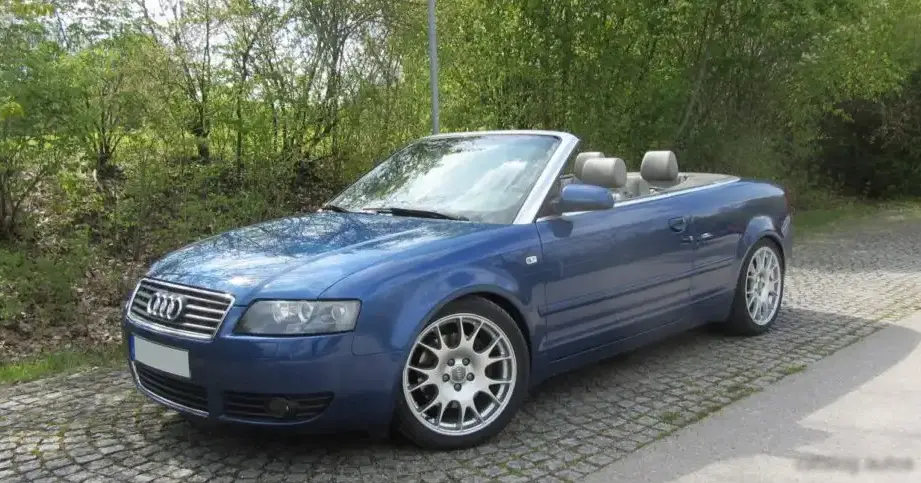
The Audi A4 Cabriolet (B6 8H) 3.0 V6 30V quattro Tiptronic, produced between 2003 and 2005, represented a compelling blend of open-air motoring and Audi’s renowned quattro all-wheel-drive system. This variant occupied a premium position within the B6 A4 Cabriolet range, offering a significant step up in performance and refinement compared to the four-cylinder models. It was positioned as the flagship engine option for those desiring a more spirited driving experience without sacrificing the comfort and practicality of a four-seater convertible. The B6 generation A4 Cabriolet, built on the Volkswagen Group’s PL45 (1HX0/A3) platform, aimed to deliver a more sophisticated and modern alternative to competitors like the BMW 3 Series Convertible and Mercedes-Benz CLK Cabriolet.
Technical Specifications
| Brand | Audi |
| Model | A4 |
| Generation | A4 Cabriolet (B6 8H) |
| Type (Engine) | 3.0 V6 30V (220 Hp) quattro Tiptronic |
| Start of production | 2003 |
| End of production | 2005 |
| Powertrain Architecture | Internal Combustion engine |
| Body type | Cabriolet |
| Seats | 4 |
| Doors | 2 |
| Fuel consumption (urban) | 16.5 l/100 km (14.3 US mpg, 17.1 UK mpg, 6.1 km/l) |
| Fuel consumption (extra urban) | 8.2 l/100 km (28.7 US mpg, 34.4 UK mpg, 12.2 km/l) |
| Fuel consumption (combined) | 11.3 l/100 km (20.8 US mpg, 25 UK mpg, 8.8 km/l) |
| CO2 emissions | 263 g/km |
| Fuel Type | Petrol (Gasoline) |
| Acceleration 0 – 100 km/h | 9.7 sec |
| Acceleration 0 – 62 mph | 9.7 sec |
| Acceleration 0 – 60 mph | 9.2 sec |
| Maximum speed | 238 km/h (147.89 mph) |
| Emission standard | Euro 4 |
| Weight-to-power ratio | 7.8 kg/Hp, 127.9 Hp/tonne |
| Weight-to-torque ratio | 5.7 kg/Nm, 174.4 Nm/tonne |
| Power | 220 Hp @ 6300 rpm |
| Power per litre | 73.9 Hp/l |
| Torque | 300 Nm @ 3200 rpm (221.27 lb.-ft. @ 3200 rpm) |
| Engine layout | Front, Longitudinal |
| Engine Model/Code | ASN, AVK |
| Engine displacement | 2976 cm3 (181.61 cu. in.) |
| Number of cylinders | 6 |
| Engine configuration | V-engine |
| Cylinder Bore | 82.5 mm (3.25 in.) |
| Piston Stroke | 92.8 mm (3.65 in.) |
| Compression ratio | 10.5:1 |
| Number of valves per cylinder | 5 |
| Fuel injection system | Multi-port manifold injection |
| Engine aspiration | Naturally aspirated engine |
| Valvetrain | DOHC |
| Engine oil capacity | 6.3 l (6.66 US qt | 5.54 UK qt) |
| Coolant | 9 l (9.51 US qt | 7.92 UK qt) |
| Kerb Weight | 1720 kg (3791.95 lbs.) |
| Max. weight | 2200 kg (4850.17 lbs.) |
| Max load | 480 kg (1058.22 lbs.) |
| Trunk (boot) space – minimum | 246 l (8.69 cu. ft.) |
| Trunk (boot) space – maximum | 315 l (11.12 cu. ft.) |
| Fuel tank capacity | 66 l (17.44 US gal | 14.52 UK gal) |
| Permitted trailer load with brakes (8%) | 1800 kg (3968.32 lbs.) |
| Permitted trailer load with brakes (12%) | 1700 kg (3747.86 lbs.) |
| Permitted trailer load without brakes | 750 kg (1653.47 lbs.) |
| Permitted towbar download | 80 kg (176.37 lbs.) |
| Length | 4573 mm (180.04 in.) |
| Width | 1778 mm (70 in.) |
| Height | 1391 mm (54.76 in.) |
| Wheelbase | 2654 mm (104.49 in.) |
| Front track | 1523 mm (59.96 in.) |
| Rear (Back) track | 1523 mm (59.96 in.) |
| Drag coefficient (Cd) | 0.31 |
| Minimum turning circle (turning diameter) | 11.1 m (36.42 ft.) |
| Drivetrain Architecture | The Internal combustion engine (ICE) drives permanently the four wheels of the vehicle. |
| Drive wheel | All wheel drive (4×4) |
| Number of gears and type of gearbox | 5 gears, automatic transmission Tiptronic |
| Front suspension | Independent multi-link suspension |
| Rear suspension | Independent multi-link suspension |
| Front brakes | Ventilated discs |
| Rear brakes | Disc |
| Assisting systems | ABS (Anti-lock braking system) |
| Steering type | Steering rack and pinion |
| Power steering | Hydraulic Steering |
| Tires size | 215/55 R16 |
| Wheel rims size | 7J x 16 |
Powertrain & Engine Architecture
The heart of the A4 Cabriolet 3.0 V6 quattro Tiptronic is the ASN or AVK engine code, a 2.976-liter naturally aspirated V6 engine. This engine featured a 60-degree V-angle, contributing to its smooth operation and relatively compact size. It employed multi-port fuel injection and a double overhead camshaft (DOHC) valvetrain with five valves per cylinder (three intake, two exhaust). This configuration maximized volumetric efficiency and contributed to the engine’s responsive nature. The engine’s robust construction and use of quality materials ensured a degree of durability. The ‘Tiptronic’ transmission was a five-speed automatic gearbox with a manual shift mode, allowing drivers to exert more control over gear selection. This transmission was specifically tuned to handle the V6’s torque output and provide smooth, refined shifts.
Driving Characteristics
The 3.0 V6 with the Tiptronic transmission delivered a noticeably more engaging driving experience than the base four-cylinder A4 Cabriolets. While not a sports car, the 220 horsepower and 300 Nm (221 lb-ft) of torque provided ample power for confident overtaking and cruising. The Tiptronic transmission, while smooth, wasn’t as quick-shifting as some contemporary dual-clutch transmissions. The quattro all-wheel-drive system provided excellent traction in all weather conditions, enhancing stability and confidence. The gear ratios were optimized for a balance of acceleration and fuel economy, but the car’s weight (1720 kg / 3792 lbs) meant that 0-60 mph acceleration took around 9.2 seconds. The engine’s power delivery was linear and predictable, making it easy to modulate throttle inputs.
Equipment & Trim Levels
The 3.0 V6 quattro Tiptronic Cabriolet typically came well-equipped. Standard features included leather upholstery, automatic climate control, a premium sound system, and power-adjustable front seats. Alloy wheels were also standard. Optional extras included a wind deflector (to reduce wind buffeting with the top down), heated seats, a navigation system, and upgraded interior trim options. The interior design was typical of early 2000s Audis – functional, well-built, and featuring a clean, understated aesthetic.
Chassis & Braking
The A4 Cabriolet’s chassis featured independent multi-link suspension at both the front and rear, providing a comfortable ride and good handling characteristics. The front suspension utilized coil springs and shock absorbers, while the rear suspension incorporated a separate spring and damper arrangement. The braking system consisted of ventilated discs at the front and solid discs at the rear, coupled with an Anti-lock Braking System (ABS). The steering was a hydraulic power-assisted rack and pinion system, offering precise and responsive control.
Market Reception & Comparison
The A4 Cabriolet 3.0 V6 quattro Tiptronic was generally well-received by automotive critics. It was praised for its refined engine, comfortable ride, and all-weather capability. However, some reviewers noted that the Tiptronic transmission wasn’t as sporty as a manual gearbox. Compared to the 1.8T models, the V6 offered significantly more power and torque, but at the cost of increased fuel consumption. The V6 also commanded a higher price tag. Against competitors like the BMW 3 Series Convertible, the A4 Cabriolet offered a more understated and sophisticated character.
Legacy
The ASN and AVK V6 engines, when properly maintained, have proven to be relatively reliable. Common issues include oil leaks and occasional problems with the timing chain tensioners. The Tiptronic transmission can also require attention as it ages, with potential issues related to valve body wear. Today, the A4 Cabriolet 3.0 V6 quattro Tiptronic represents a desirable classic for enthusiasts seeking a comfortable and capable open-top tourer. Its combination of performance, refinement, and all-wheel-drive capability continues to appeal to those looking for a stylish and practical convertible.