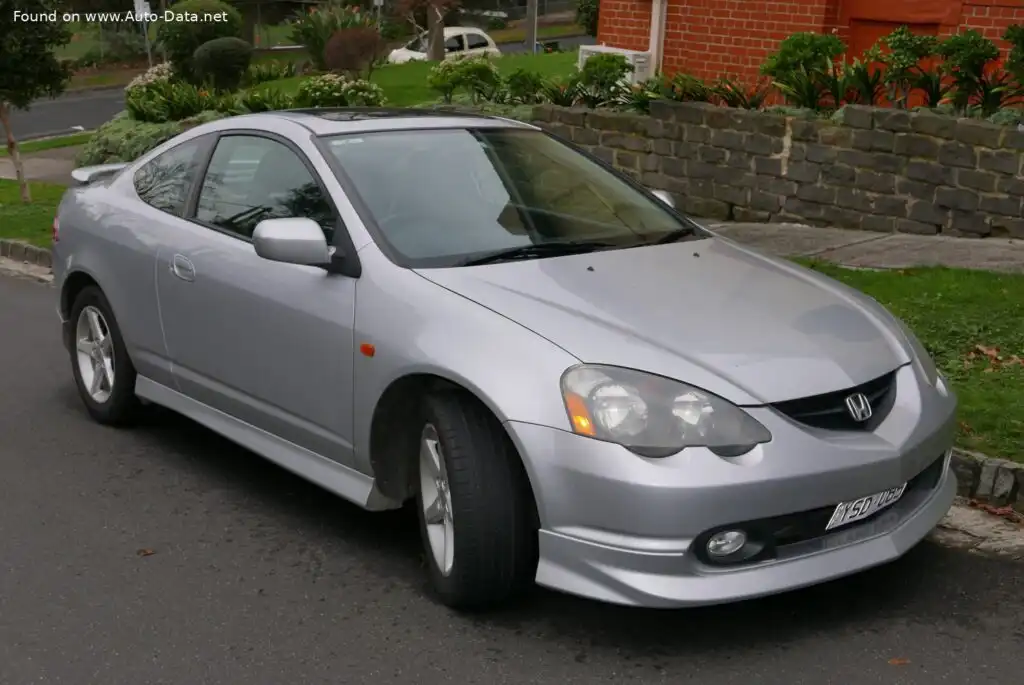
The Honda Integra IV (DC5), produced between 2001 and 2004, represents the third generation of the Integra line, though marketed as the fourth in some regions. This liftback coupe, built on the Honda New Absolute Control (NAC) platform, was a significant departure from previous Integras, focusing on a more youthful and sporty image. The 2.0-liter (160 hp) automatic variant occupied a middle ground in the DC5 lineup, offering a balance between performance and convenience, aimed at buyers who desired the Integra’s styling and handling without the engagement of a manual transmission or the higher price point of the Type R model. It was primarily sold in the Japanese domestic market (JDM), with limited exports to other regions.
Technical Specifications
| Brand | Honda |
| Model | Integra |
| Generation | Integra IV (DC5) |
| Type (Engine) | 2.0 (160 Hp) Automatic |
| Start of production | 2001 |
| End of production | 2004 |
| Powertrain Architecture | Internal Combustion engine |
| Body type | Liftback |
| Seats | 4 |
| Doors | 3 |
| Fuel Type | Petrol (Gasoline) |
| Maximum speed | 200 km/h (124.27 mph) |
| Weight-to-power ratio | 7.6 kg/Hp, 131.1 Hp/tonne |
| Weight-to-torque ratio | 6.4 kg/Nm, 156.6 Nm/tonne |
| Power | 160 Hp @ 6500 rpm |
| Power per litre | 80.1 Hp/l |
| Torque | 191 Nm @ 4000 rpm (140.87 lb.-ft. @ 4000 rpm) |
| Engine layout | Front, Transverse |
| Engine Model/Code | K20A3 |
| Engine displacement | 1998 cm3 (121.93 cu. in.) |
| Number of cylinders | 4 |
| Engine configuration | Inline |
| Cylinder Bore | 86 mm (3.39 in.) |
| Piston Stroke | 86 mm (3.39 in.) |
| Compression ratio | 9.8:1 |
| Number of valves per cylinder | 4 |
| Fuel injection system | Multi-port manifold injection |
| Engine aspiration | Naturally aspirated engine |
| Valvetrain | DOHC i-VTEC |
| Engine oil capacity | 4.2 l (4.44 US qt | 3.7 UK qt) |
| Coolant | 6.4 l (6.76 US qt | 5.63 UK qt) |
| Kerb Weight | 1220 kg (2689.64 lbs.) |
| Trunk (boot) space – minimum | 321 l (11.34 cu. ft.) |
| Fuel tank capacity | 50 l (13.21 US gal | 11 UK gal) |
| Permitted trailer load with brakes (12%) | 450 kg (992.08 lbs.) |
| Permitted trailer load without brakes | 450 kg (992.08 lbs.) |
| Length | 4400 mm (173.23 in.) |
| Width | 1725 mm (67.91 in.) |
| Height | 1400 mm (55.12 in.) |
| Wheelbase | 2570 mm (101.18 in.) |
| Front track | 1485 mm (58.46 in.) |
| Rear (Back) track | 1485 mm (58.46 in.) |
| Ride height (ground clearance) | 152 mm (5.98 in.) |
| Minimum turning circle (turning diameter) | 11.4 m (37.4 ft.) |
| Drivetrain Architecture | The Internal combustion engine (ICE) drives the front wheels of the vehicle. |
| Drive wheel | Front wheel drive |
| Number of gears and type of gearbox | 5 gears, automatic transmission |
| Front suspension | Independent, type McPherson with coil spring and anti-roll bar |
| Rear suspension | Double wishbone, Transverse stabilizer, Coil spring |
| Front brakes | Ventilated discs, 254 mm |
| Rear brakes | Disc, 254 mm |
| Assisting systems | ABS (Anti-lock braking system) |
| Steering type | Steering rack and pinion |
| Power steering | Hydraulic Steering |
| Tires size | 205/55 R16 |
| Wheel rims size | 6.5J x 16 |
Introduction
The DC5 Integra 2.0 Automatic was introduced as a more accessible entry point into the Integra range. While the high-performance Type R catered to enthusiasts, and other trims offered manual transmissions, the 2.0-liter automatic model aimed for a broader audience seeking a stylish, reliable, and reasonably efficient coupe. Positioned as a mid-range offering, it provided a step up from the base models in terms of engine output and features, without the premium price tag of the Type R. Production spanned from 2001 to 2004, primarily for the Japanese market, with limited grey market imports to North America and Europe.
Powertrain & Engine Architecture
At the heart of the DC5 Integra 2.0 Automatic lies the K20A3 engine, a 1998cc inline-four cylinder powerplant. Unlike the higher-output K20A and K20Z engines found in the Type R, the K20A3 utilizes a slightly less aggressive camshaft profile and a lower compression ratio (9.8:1 versus 11:1 in the Type R). This results in a more modest 160 horsepower at 6500 rpm and 191 Nm (140.87 lb-ft) of torque at 4000 rpm. The engine features Honda’s sophisticated DOHC i-VTEC (Variable Valve Timing and Lift Electronic Control) system, which optimizes valve timing for improved performance and fuel efficiency across the rev range. Fuel delivery is managed by a multi-port fuel injection system. The engine is transversely mounted in the front of the vehicle.
The automatic transmission paired with the K20A3 is a five-speed unit. While not known for its sportiness compared to a manual, it provides smooth and convenient gear changes. The transmission’s gear ratios are tuned for everyday drivability and fuel economy, prioritizing comfort over outright acceleration. It lacks the paddle shifters or manual shift mode found in some contemporary automatic transmissions.
Driving Characteristics
The Integra 2.0 Automatic delivers a comfortable and refined driving experience. Acceleration is adequate for daily commuting and highway cruising, but it lacks the urgency of the manual transmission or Type R variants. The automatic transmission tends to prioritize fuel efficiency, resulting in slightly slower shifts and a less engaging driving feel. The weight distribution is well-balanced, contributing to predictable handling, but the suspension setup is softer than the Type R, resulting in more body roll during cornering. The steering is precise and responsive, providing good feedback to the driver. Overall, the driving experience is geared towards practicality and ease of use rather than outright performance.
Equipment & Trim Levels
The DC5 Integra 2.0 Automatic typically came equipped with features such as power windows, power locks, air conditioning, and a basic audio system. Interior upholstery was generally cloth, with optional leather available. Dashboard configuration was relatively straightforward, with a focus on functionality. Optional extras included a sunroof, upgraded audio systems, and alloy wheels. Trim levels varied depending on the market, but generally offered a range of cosmetic and convenience upgrades.
Chassis & Braking
The DC5 Integra utilizes a McPherson strut front suspension and a double wishbone rear suspension, providing a good balance of ride comfort and handling. Stabilizer bars are fitted to both the front and rear axles to reduce body roll. The braking system consists of ventilated discs at the front and solid discs at the rear, providing adequate stopping power for the vehicle’s weight and performance. An Anti-lock Braking System (ABS) is standard, enhancing safety during emergency braking situations.
Market Reception & Comparison
The Integra 2.0 Automatic was generally well-received by critics as a practical and stylish coupe. However, it was often criticized for its lack of sporting credentials compared to the manual transmission and Type R models. Fuel economy was considered good for its class, and reliability was generally high, typical of Honda products. Compared to the Type R, the 2.0 Automatic offered a significantly lower price point but sacrificed a substantial amount of performance. Compared to other 2.0-liter coupes of the era, the Integra offered a compelling combination of handling, reliability, and features.
Legacy
The DC5 Integra, including the 2.0 Automatic variant, has gained a loyal following among enthusiasts. The K20A3 engine is known for its durability and potential for modification. While not as highly sought after as the Type R, the 2.0 Automatic remains a popular choice for those seeking a reliable and affordable Honda coupe. In the used car market, these Integras are generally well-maintained and can be found in good condition, though prices have been steadily increasing in recent years due to their growing popularity and rarity. The DC5 Integra represents a significant chapter in Honda’s history, bridging the gap between practical transportation and sporty performance.