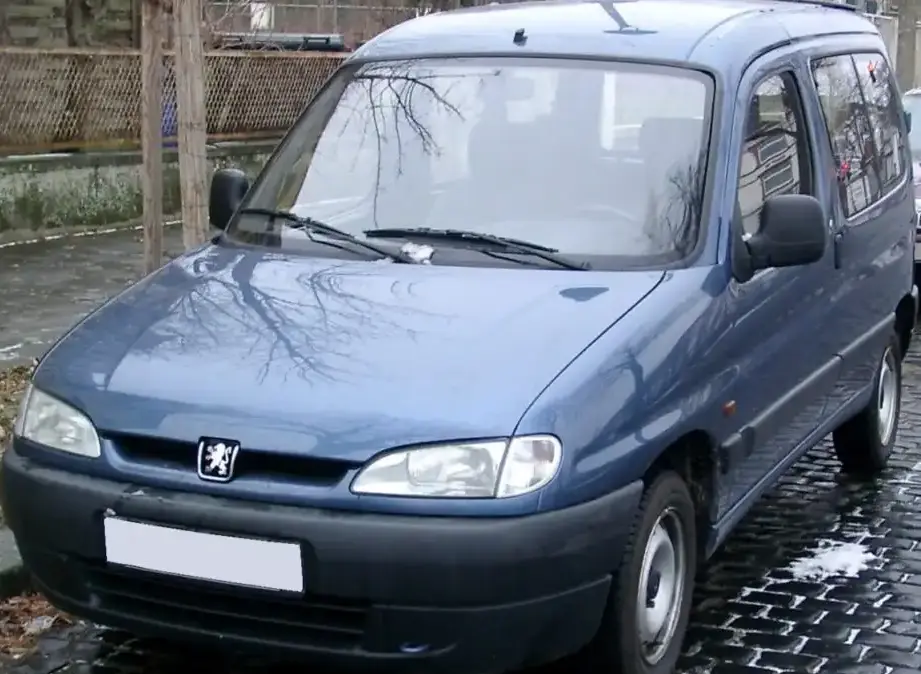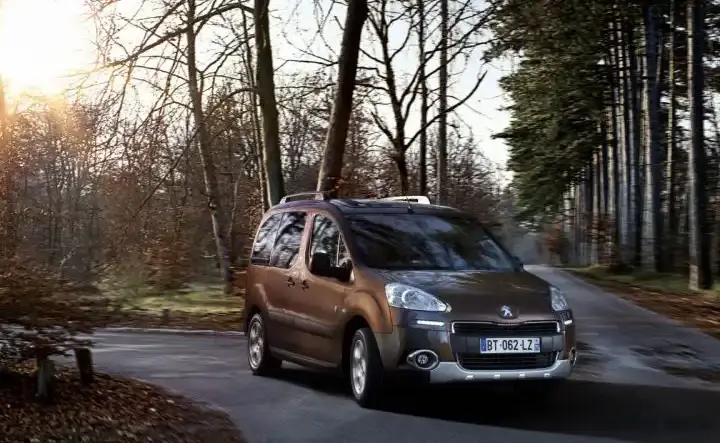
The Peugeot Partner II Tepee, specifically the Phase II model produced from 2012 to 2018, represented a significant iteration of Peugeot’s popular leisure activity vehicle (LAV). This variant, equipped with the 1.6 HDi 90 horsepower diesel engine and offering seating for seven, was a common sight in European markets. Positioned as a practical and affordable option within the Partner Tepee range, it catered to families and those requiring flexible passenger and cargo space. The Phase II updates brought styling revisions and improvements to interior equipment compared to the initial Partner II Tepee launch.
Technical Specifications
| Brand | Peugeot |
| Model | Partner |
| Generation | Partner II Tepee (Phase II, 2012) |
| Type (Engine) | 1.6 HDi (90 Hp) 7places |
| Start of production | 2012 |
| End of production | 2018 |
| Powertrain Architecture | Internal Combustion engine |
| Body type | Minivan |
| Seats | 7 |
| Doors | 5 |
| Fuel consumption (urban) | 6.4 l/100 km (36.8 US mpg, 44.1 UK mpg, 15.6 km/l) |
| Fuel consumption (extra urban) | 5 l/100 km (47 US mpg, 56.5 UK mpg, 20 km/l) |
| Fuel consumption (combined) | 5.5 l/100 km (42.8 US mpg, 51.4 UK mpg, 18.2 km/l) |
| CO2 emissions | 144 g/km |
| Fuel Type | Diesel |
| Acceleration 0 – 100 km/h | 15.2 sec |
| Acceleration 0 – 62 mph | 15.2 sec |
| Acceleration 0 – 60 mph | 14.4 sec |
| Maximum speed | 161 km/h (100.04 mph) |
| Emission standard | Euro 5 |
| Weight-to-power ratio | 17.5 kg/Hp, 57.1 Hp/tonne |
| Weight-to-torque ratio | 6.9 kg/Nm, 145.9 Nm/tonne |
| Power | 90 Hp @ 4000 rpm |
| Power per litre | 57.7 Hp/l |
| Torque | 230 Nm @ 1750 rpm (169.64 lb.-ft. @ 1750 rpm) |
| Engine layout | Front, Transverse |
| Engine Model/Code | 9HF DV6DTED |
| Engine displacement | 1560 cm3 (95.2 cu. in.) |
| Number of cylinders | 4 |
| Engine configuration | Inline |
| Cylinder Bore | 75 mm (2.95 in.) |
| Piston Stroke | 88.3 mm (3.48 in.) |
| Number of valves per cylinder | 2 |
| Fuel injection system | Diesel Commonrail |
| Engine aspiration | Turbocharger, Intercooler |
| Engine oil capacity | 3.75 l (3.96 US qt | 3.3 UK qt) |
| Coolant capacity | 6 l (6.34 US qt | 5.28 UK qt) |
| Kerb Weight | 1576 kg (3474.49 lbs.) |
| Max. weight | 2180 kg (4806.08 lbs.) |
| Max load | 604 kg (1331.59 lbs.) |
| Trunk (boot) space – minimum | 100 l (3.53 cu. ft.) |
| Trunk (boot) space – maximum | 3000 l (105.94 cu. ft.) |
| Fuel tank capacity | 60 l (15.85 US gal | 13.2 UK gal) |
| Length | 4380 mm (172.44 in.) |
| Width | 1810 mm (71.26 in.) |
| Height | 1852 mm (72.91 in.) |
| Wheelbase | 2728 mm (107.4 in.) |
| Front track | 1505 mm (59.25 in.) |
| Rear (Back) track | 1554 mm (61.18 in.) |
| Minimum turning circle | 11 m (36.09 ft.) |
| Drivetrain Architecture | Front wheel drive |
| Number of gears | 5 |
| Gearbox type | Manual transmission |
| Front suspension | Independent, McPherson with coil spring and anti-roll bar |
| Rear suspension | Independent coil spring |
| Front brakes | Ventilated discs |
| Rear brakes | Disc |
| Assisting systems | ABS (Anti-lock braking system) |
| Steering type | Steering rack and pinion |
| Tires size | 205/65 R15 |
| Wheel rims size | 15 |
INTRODUCTION
The Peugeot Partner II Tepee 1.6 HDi 90 hp 7-place, introduced in 2012 as part of the Phase II refresh, was a popular choice for families and commercial users alike. Built on the Citroën/Peugeot shared platform (often referred to as the 1HX0 platform, also underpinning the Citroën Berlingo), the Tepee variant offered a more car-like experience compared to the standard Partner van. The seven-seat configuration, combined with the fuel efficiency of the 1.6 HDi engine, made it a versatile vehicle for a wide range of applications. This specific engine and trim level was aimed at buyers prioritizing practicality and low running costs over outright performance.
Powertrain & Engine Architecture
At the heart of this Partner Tepee variant lies the 1.6 HDi (9HF) diesel engine. This engine, part of Peugeot/Citroën’s DV6 family, is a four-cylinder, inline configuration utilizing a common rail direct injection system. The 9HF engine code denotes a specific calibration of the DV6DTED engine, producing 90 horsepower at 4000 rpm and 230 Nm (169.64 lb-ft) of torque at 1750 rpm. The engine features a turbocharger with an intercooler to enhance power and efficiency. The fuel injection system is a high-pressure common rail system, allowing for precise fuel delivery and optimized combustion. This particular model was exclusively offered with a five-speed manual transmission, chosen for its simplicity and fuel economy. The transmission’s gear ratios were geared towards maximizing fuel efficiency rather than providing sporty acceleration.
Driving Characteristics
The 1.6 HDi 90 hp engine, paired with the five-speed manual gearbox, delivered adequate, but not exhilarating, performance. Acceleration from 0-60 mph took around 14.4 seconds, and top speed was approximately 100 mph. The engine’s strength lay in its low-end torque, making it suitable for everyday driving and carrying a full load of passengers or cargo. The gear ratios were relatively long, prioritizing fuel economy over rapid acceleration. Compared to higher-powered versions of the Partner Tepee, such as those with the 110 hp or 115 hp HDi engines, this variant felt noticeably slower, especially when fully loaded or tackling inclines. However, the lower power output also contributed to improved fuel economy and reduced stress on the drivetrain.
Equipment & Trim Levels
The 1.6 HDi 90 hp 7-place Tepee typically came with a reasonable level of standard equipment. This included power steering, central locking, electric front windows, and an audio system with USB connectivity. Safety features such as ABS and driver/passenger airbags were also standard. The interior upholstery was typically cloth, with a durable and practical design. Optional extras included air conditioning, rear parking sensors, and upgraded audio systems. Higher trim levels, if selected, could add features like alloy wheels, fog lights, and a trip computer. The dashboard layout was functional and straightforward, prioritizing ease of use over aesthetic flair.
Chassis & Braking
The Partner II Tepee utilized a McPherson strut front suspension and a trailing arm rear suspension. This setup provided a comfortable ride quality, although it wasn’t particularly sporty. The front brakes were ventilated discs, while the rear brakes were solid discs. ABS (Anti-lock Braking System) was standard, enhancing braking performance and stability. The suspension was tuned to prioritize ride comfort and load-carrying capacity, rather than sharp handling. The vehicle’s relatively high center of gravity and soft suspension settings meant that it wasn’t designed for aggressive cornering.
Market Reception & Comparison
The Peugeot Partner II Tepee 1.6 HDi 90 hp 7-place was generally well-received by critics as a practical and affordable family vehicle. Its fuel economy was a major selling point, and its spacious interior and seven-seat configuration made it a versatile option for larger families. Compared to the more powerful HDi variants, this model offered a lower purchase price and potentially lower running costs, but at the expense of performance. It competed with other compact MPVs such as the Citroën Berlingo, Renault Kangoo, and Fiat Doblo. The Berlingo, being mechanically similar, was a particularly close competitor.
Legacy
The 1.6 HDi engine, in its various iterations, proved to be a reliable and durable powertrain. However, like many modern diesel engines, it’s susceptible to issues with the diesel particulate filter (DPF) if not driven on longer journeys regularly. The Partner II Tepee, in general, has a good reputation for reliability, although regular maintenance is essential. On the used car market, these models represent good value for money, offering a lot of space and practicality for a relatively low price. The 1.6 HDi 90 hp variant remains a popular choice for those seeking an economical and versatile family vehicle.