Technical Specifications
| Brand | Jeep |
| Model | Grand Cherokee |
| Generation | Grand Cherokee II (WJ, facelift 2003) |
| Type (Engine) | 4.7 HO V8 (265 Hp) Automatic |
| Start of production | 2003 |
| End of production | 2004 |
| Powertrain Architecture | Internal Combustion engine |
| Body type | SUV |
| Seats | 5 |
| Doors | 5 |
| Fuel consumption (economy) – urban (EPA) | 15.7 l/100 km (15 US mpg, 18 UK mpg, 6.4 km/l) |
| Fuel consumption (economy) – extra urban (EPA) | 11.8 l/100 km (19.9 US mpg, 23.9 UK mpg, 8.5 km/l) |
| Fuel consumption (economy) – combined (EPA) | 13.8 l/100 km (17 US mpg, 20.5 UK mpg, 7.2 km/l) |
| Fuel Type | Petrol (Gasoline) |
| Weight-to-power ratio | 6.6 kg/Hp, 150.7 Hp/tonne |
| Weight-to-torque ratio | 4 kg/Nm, 250.7 Nm/tonne |
| Power | 265 Hp @ 5200 rpm |
| Power per litre | 56.4 Hp/l |
| Torque | 441 Nm @ 3600 rpm (325.26 lb.-ft. @ 3600 rpm) |
| Engine layout | Front, Longitudinal |
| Engine Model/Code | EVC |
| Engine displacement | 4701 cm3 (286.87 cu. in.) |
| Number of cylinders | 8 |
| Engine configuration | V-engine |
| Cylinder Bore | 93 mm (3.66 in.) |
| Piston Stroke | 86.5 mm (3.41 in.) |
| Compression ratio | 9.7:1 |
| Number of valves per cylinder | 2 |
| Fuel injection system | Multi-port manifold injection |
| Engine aspiration | Naturally aspirated engine |
| Valvetrain | SOHC |
| Engine oil capacity | 5.7 l (6.02 US qt | 5.02 UK qt) |
| Coolant | 13.7 l (14.48 US qt | 12.05 UK qt) |
| Kerb Weight | 1759 kg (3877.93 lbs.) |
| Max. weight | 2359 kg (5200.7 lbs.) |
| Max load | 600 kg (1322.77 lbs.) |
| Trunk (boot) space – minimum | 1104 l (38.99 cu. ft.) |
| Trunk (boot) space – maximum | 2047 l (72.29 cu. ft.) |
| Fuel tank capacity | 78 l (20.61 US gal | 17.16 UK gal) |
| Permitted trailer load with brakes (12%) | 2948 kg (6499.23 lbs.) |
| Permitted towbar download | 340 kg (749.57 lbs.) |
| Length | 4610 mm (181.5 in.) |
| Width | 1836 mm (72.28 in.) |
| Height | 1786 mm (70.31 in.) |
| Wheelbase | 2690 mm (105.91 in.) |
| Front track | 1511 mm (59.49 in.) |
| Rear (Back) track | 1511 mm (59.49 in.) |
| Front overhang | 815 mm (32.09 in.) |
| Rear overhang | 1105 mm (43.5 in.) |
| Ride height (ground clearance) | 221 mm (8.7 in.) |
| Drag coefficient (Cd) | 0.45 |
| Minimum turning circle (turning diameter) | 11.4 m (37.4 ft.) |
| Approach angle | 36.7° |
| Departure angle | 28.6° |
| Ramp-over (brakeover) angle | 22.6° |
| Drivetrain Architecture | The Internal combustion engine (ICE) drives the rear wheels of the vehicle. |
| Drive wheel | Rear wheel drive |
| Number of gears and type of gearbox | 5 gears, automatic transmission |
| Front suspension | Coil spring, Rigid axle suspension, Transverse stabilizer |
| Rear suspension | Rigid axle suspension, Transverse stabilizer, Trailing arm, Coil spring |
| Front brakes | Ventilated discs, 305 mm |
| Rear brakes | Disc, 305 mm |
| Assisting systems | ABS (Anti-lock braking system) |
| Steering type | Cone worm with recirculation balls |
| Power steering | Hydraulic Steering |
| Tires size | 235/65 R17 |
| Wheel rims size | 7.5J x 17 |
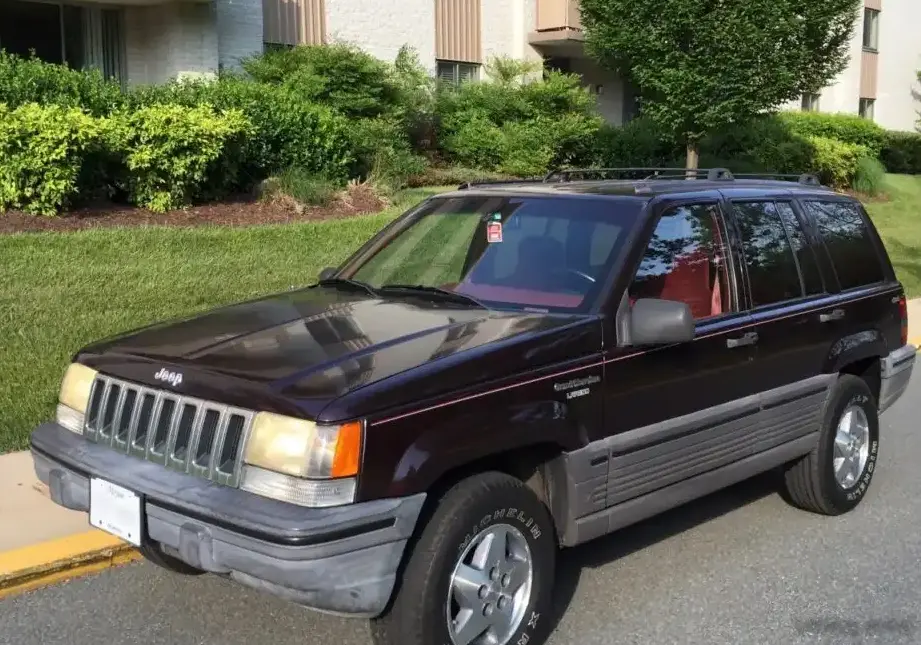
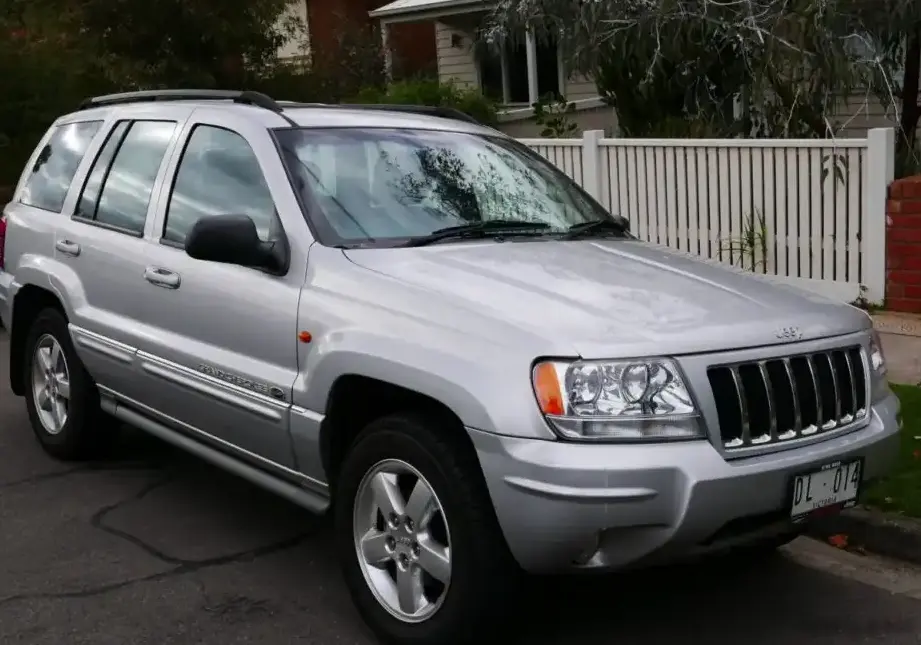
The Jeep Grand Cherokee II (WJ), specifically the facelifted version produced from 2003 to 2004, represented a refinement of the popular American SUV. This generation, internally designated WJ, brought a more polished interior, improved ride quality, and a broader selection of engine options compared to the previous ZJ model. The 4.7 HO V8 paired with an automatic transmission was a frequently chosen configuration, positioned as a solid mid-range offering that balanced performance with everyday usability. It occupied the space between the base 3.7L V6 and the more potent 4.7L V8 and the high-performance 5.7L HEMI V8 options.
Powertrain & Engine Architecture
The cornerstone of this Grand Cherokee variant was the 4.7-liter V8 engine, internally known as the EVC. This engine belonged to Chrysler’s second-generation small-block V8 family. It featured a cast iron block with aluminum cylinder heads, a single overhead camshaft (SOHC) design operating two valves per cylinder, and a multi-port fuel injection system. The “HO” (High Output) designation indicated upgrades like revised cylinder heads and an enhanced intake manifold, contributing to the engine’s increased power. The engine generated 265 horsepower at 5200 rpm and 325 lb-ft of torque at 3600 rpm. The engine’s relatively uncomplicated design was a factor in its overall dependability. The 42RE automatic transmission, a four-speed unit, was the standard transmission choice for the 4.7 HO. This transmission was known for its robustness, though its gear ratios were tuned more for towing and cruising than for rapid acceleration.
Driving Characteristics
The 4.7L V8 automatic Grand Cherokee delivered a comfortable and capable driving experience. While not a performance-oriented vehicle, the engine provided sufficient power for highway merging and passing maneuvers. The automatic transmission, while smooth, wasn’t particularly quick to downshift, resulting in a slightly less responsive feel compared to the available manual transmission options. The 42RE’s gear ratios prioritized fuel efficiency and towing capacity over quick acceleration. The rear-wheel-drive configuration provided a traditional SUV feel, and the optional four-wheel-drive systems enhanced traction in adverse weather or off-road conditions. Ride quality was generally comfortable, thanks to the coil-spring suspension, but the solid rear axle could occasionally transmit road imperfections to the cabin.
Equipment & Trim Levels
The 4.7 HO V8 typically came equipped as a mid-range trim level, offering a good balance of features. Standard equipment generally included air conditioning, power windows and locks, cruise control, and an AM/FM stereo with a CD player. Higher trim levels added features such as leather upholstery, heated seats, a premium sound system, and a sunroof. Optional extras included a navigation system, a rear-seat entertainment system, and upgraded wheel designs. Interior upholstery was typically cloth, with leather available as an upgrade. The dashboard layout was functional and straightforward, with easy-to-read gauges and conveniently placed controls.
Chassis & Braking
The WJ Grand Cherokee utilized a body-on-frame construction, providing a strong and durable platform. The front suspension consisted of a coil spring and rigid axle setup with a transverse stabilizer bar. The rear suspension also employed a rigid axle with coil springs and a transverse stabilizer bar, utilizing a trailing arm design. Braking was handled by ventilated discs at the front and discs at the rear, providing adequate stopping power for the vehicle’s weight. An Anti-lock Braking System (ABS) was standard, enhancing safety during emergency braking situations.
Market Reception & Comparison
The 4.7 HO V8 automatic Grand Cherokee was well-received by both automotive critics and consumers. It offered a compelling combination of power, comfort, and capability. Compared to the base 3.7L V6, the 4.7 HO provided a noticeable performance improvement. However, it wasn’t as fuel-efficient. Compared to the 5.7L HEMI V8, the 4.7 HO offered a more accessible price point and slightly better fuel economy, though at the cost of ultimate power. Reliability was generally good, although some owners reported issues with the cooling system and the automatic transmission over the long term.
Legacy
The 4.7 HO V8-powered Grand Cherokee WJ continues to be a popular choice in the used car market. Its robust powertrain and relatively simple design contribute to its long-term reliability. While not as technologically advanced as contemporary SUVs, it offers a classic American driving experience and a capable platform for both on-road and off-road use. Parts availability is generally good, making maintenance and repairs relatively straightforward. The 4.7 HO engine, while not known for exceptional fuel economy, has proven to be a durable and dependable powerplant, ensuring that these Grand Cherokees continue to provide years of service.