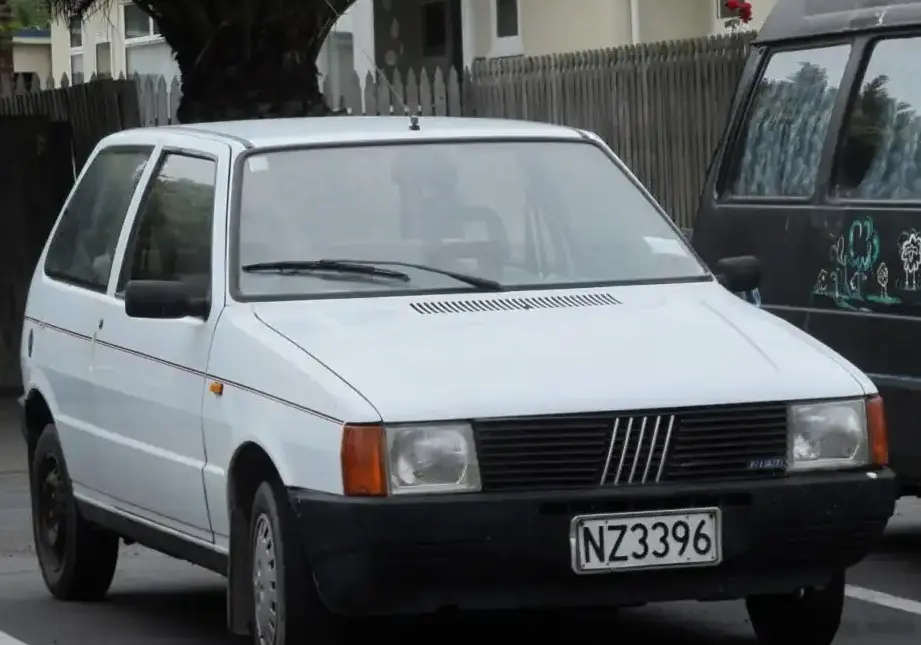
The Fiat Uno 1.1 i, producing 51 horsepower, was a mainstay of the Fiat Uno range from 1995 through 2002. Positioned as the entry-level model, it offered affordable transportation within the supermini segment, particularly in European and South American markets. This variant played a crucial role in making the Uno accessible to a wider customer base, emphasizing fuel efficiency and practicality over outright performance. The Uno, in its entirety, represented a significant step forward for Fiat in terms of compact car design and manufacturing, and the 1.1 i version was instrumental in its commercial success.
Technical Specifications
| Brand | Fiat |
| Model | UNO |
| Generation | UNO |
| Type (Engine) | 1.1 i (51 Hp) |
| Start of production | 1995 year |
| End of production | 2002 year |
| Powertrain Architecture | Internal Combustion engine |
| Body type | Hatchback |
| Seats | 5 |
| Doors | 3-5 |
| Fuel consumption (economy) – urban | 7.6 l/100 km (30.9 US mpg, 37.2 UK mpg, 13.2 km/l) |
| Fuel consumption (economy) – extra urban | 4.8 l/100 km (49 US mpg, 58.9 UK mpg, 20.8 km/l) |
| Fuel consumption (economy) – combined | 6.5 l/100 km (36.2 US mpg, 43.5 UK mpg, 15.4 km/l) |
| Fuel Type | Petrol (Gasoline) |
| Acceleration 0 – 100 km/h | 16 sec |
| Acceleration 0 – 62 mph | 16 sec |
| Acceleration 0 – 60 mph | 15.2 sec |
| Maximum speed | 150 km/h (93.21 mph) |
| Weight-to-power ratio | 14.9 kg/Hp (67.1 Hp/tonne) |
| Weight-to-torque ratio | 9 kg/Nm (110.5 Nm/tonne) |
| Power | 51 Hp @ 5250 rpm |
| Power per litre | 46 Hp/l |
| Torque | 84 Nm @ 3000 rpm (61.96 lb.-ft. @ 3000 rpm) |
| Engine layout | Front, Transverse |
| Engine Model/Code | 156 C.046 |
| Engine displacement | 1108 cm3 (67.61 cu. in.) |
| Number of cylinders | 4 |
| Engine configuration | Inline |
| Cylinder Bore | 70 mm (2.76 in.) |
| Piston Stroke | 72 mm (2.83 in.) |
| Compression ratio | 9.6:1 |
| Number of valves per cylinder | 2 |
| Fuel injection system | Single-point injection |
| Engine aspiration | Naturally aspirated engine |
| Engine oil capacity | 3.8 l (4.02 US qt | 3.34 UK qt) |
| Coolant | 4.5 l (4.76 US qt | 3.96 UK qt) |
| Kerb Weight | 760 kg (1675.51 lbs.) |
| Max. weight | 1260 kg (2777.82 lbs.) |
| Max load | 500 kg (1102.31 lbs.) |
| Trunk (boot) space – minimum | 270 l (9.53 cu. ft.) |
| Trunk (boot) space – maximum | 970 l (34.26 cu. ft.) |
| Fuel tank capacity | 40 l (10.57 US gal | 8.8 UK gal) |
| Length | 3690 mm (145.28 in.) |
| Width | 1560 mm (61.42 in.) |
| Height | 1420 mm (55.91 in.) |
| Wheelbase | 2360 mm (92.91 in.) |
| Front track | 1340 mm (52.76 in.) |
| Rear (Back) track | 1300 mm (51.18 in.) |
| Minimum turning circle | 9.8 m (32.15 ft.) |
| Drivetrain Architecture | The Internal combustion engine (ICE) drives the front wheels of the vehicle. |
| Drive wheel | Front wheel drive |
| Number of gears and type of gearbox | 5 gears, manual transmission |
| Front suspension | Coil spring |
| Rear suspension | Coil spring |
| Front brakes | Disc |
| Rear brakes | Drum |
| Steering type | Steering rack and pinion |
| Power steering | Hydraulic Steering |
| Tires size | 155/70 R13 |
Introduction
The Fiat Uno 1.1 i, launched in 1995 as part of the second-generation Uno (Tipo 146), was designed to provide economical and reliable transportation. It served as the base model within the Uno lineup, appealing to budget-conscious buyers and those prioritizing fuel efficiency. The Uno itself was a revolutionary vehicle for Fiat, introducing a space-efficient design and a focus on practicality. The 1.1 i variant, with its modest power output, was particularly popular in regions where fuel costs were high and driving conditions were primarily urban.
Powertrain & Engine Architecture
The heart of the Uno 1.1 i is the 156 C.046 engine, a 1108cc inline-four cylinder petrol engine. This engine utilizes a single-point fuel injection system, a relatively simple and cost-effective technology for the time. The engine features two valves per cylinder and a compression ratio of 9.6:1. Its modest output of 51 horsepower at 5250 rpm and 84 Nm (62 lb-ft) of torque at 3000 rpm reflects its focus on fuel economy rather than performance. The engine’s transverse mounting and front-wheel drive configuration were standard for compact cars of this era. The Uno 1.1 i was exclusively offered with a five-speed manual transmission, optimized for maximizing fuel efficiency and providing adequate acceleration for city driving.
Driving Characteristics
The driving experience in the Uno 1.1 i is characterized by its light steering and nimble handling, making it easy to maneuver in urban environments. Acceleration is modest, taking approximately 16 seconds to reach 62 mph (100 km/h). The five-speed manual transmission allows drivers to keep the engine in its optimal power band, but the limited horsepower means that overtaking maneuvers require careful planning. Compared to higher-spec Uno models with larger engines (like the 1.4 or 1.6), the 1.1 i feels significantly less powerful. However, its lighter weight and efficient engine contribute to excellent fuel economy, making it a practical choice for daily commuting.
Equipment & Trim Levels
The Uno 1.1 i was typically equipped with basic but functional features. Standard equipment generally included cloth upholstery, a simple dashboard layout, and manual windows and door locks. Safety features were limited by the standards of the time, typically consisting of seatbelts and a basic braking system. Optional extras, depending on the market, could include power steering, upgraded audio systems, and central locking. The interior was designed with practicality in mind, offering a reasonable amount of space for passengers and luggage considering the car’s compact dimensions.
Chassis & Braking
The Uno 1.1 i features a relatively simple chassis design. Front suspension utilizes coil springs, while the rear suspension also employs coil springs. The braking system consists of disc brakes on the front wheels and drum brakes on the rear wheels. The steering is a rack and pinion system, providing responsive handling. The car’s relatively light weight (approximately 760 kg or 1675 lbs) contributes to its agility and helps to offset the limited power output. Tire size was typically 155/70 R13.
Market Reception & Comparison
The Fiat Uno 1.1 i was generally well-received as an affordable and economical city car. Critics praised its fuel efficiency, nimble handling, and practicality. However, its limited power and basic equipment levels were often noted. Compared to other superminis of the time, such as the Peugeot 205 or Renault Clio, the Uno 1.1 i offered a more budget-friendly option, albeit with less refinement and performance. Its fuel economy was a key selling point, particularly in markets where gasoline prices were high. Reliability was generally good, although the single-point fuel injection system could require occasional maintenance.
Legacy
The Fiat Uno 1.1 i remains a popular choice among classic car enthusiasts and budget-conscious buyers in the used car market. Its simple mechanical design makes it relatively easy and inexpensive to maintain. While not known for its performance, the Uno 1.1 i is appreciated for its reliability, fuel efficiency, and practicality. The engine, while dated by modern standards, is known for its durability. Today, well-maintained examples of the Uno 1.1 i are becoming increasingly collectible, representing a nostalgic reminder of a simpler era of automotive design.