Technical Specifications
| Brand | Audi |
| Model | Q5 |
| Generation | Q5 III (GU) |
| Type (Engine) | 2.0 TFSI (367 Hp) e-hybrid quattro ultra S tronic |
| Start of production | June, 2025 |
| Powertrain Architecture | PHEV (Plug-in Hybrid Electric Vehicle) |
| Body type | SUV |
| Seats | 5 |
| Doors | 5 |
| Combined fuel consumption (WLTP) | 2.6-8.4 l/100 km (90.5 – 28 US mpg, 108.6 – 33.6 UK mpg, 38.5 – 11.9 km/l) |
| CO2 emissions (WLTP) | 60-77 g/km |
| Fuel Type | Petrol / electricity |
| Acceleration 0 – 100 km/h | 5.1 sec |
| Acceleration 0 – 62 mph | 5.1 sec |
| Acceleration 0 – 60 mph | 4.8 sec |
| Maximum speed | 250 km/h (155.34 mph) |
| Emission standard | Euro 6e |
| Weight-to-power ratio | 5.9 kg/Hp, 169.1 Hp/tonne |
| Weight-to-torque ratio | 4.3 kg/Nm, 230.4 Nm/tonne |
| Gross battery capacity | 25.9 kWh |
| Net (usable) battery capacity | 20.7 kWh |
| Battery voltage | 400 V |
| Battery technology | Lithium-ion (Li-Ion) |
| Battery location | Under the trunk |
| Recuperation output | 88 kW |
| All-electric range (WLTP) | 81-92 km (50.33 – 57.17 mi) |
| Average Energy consumption (WLTP) | 15.8-16.9 kWh/100 km (25.43 – 27.2 kWh/100 mi, 133 – 124 MPGe, 6.3 – 5.9 km/kWh, 3.9 – 3.7 mi/kWh) |
| Max speed (electric) | 140 km/h (86.99 mph) |
| Electric motor power | 143 Hp |
| Electric motor Torque | 350 Nm (258.15 lb.-ft.) |
| Electric motor location | Between the combustion engine and the transmission |
| Electric motor type | Synchronous |
| System power | 367 Hp |
| System torque | 500 Nm (368.78 lb.-ft.) |
| Power | 252 Hp @ 5000-6500 rpm |
| Torque | 380 Nm @ 1600-4500 rpm (280.27 lb.-ft. @ 1600-4500 rpm) |
| Engine layout | Front, Longitudinal |
| Engine displacement | 1984 cm3 (121.07 cu. in.) |
| Number of cylinders | 4 |
| Engine configuration | Inline |
| Cylinder Bore | 82.5 mm (3.25 in.) |
| Piston Stroke | 92.8 mm (3.65 in.) |
| Compression ratio | 10.5:1 |
| Number of valves per cylinder | 4 |
| Fuel injection system | Direct injection |
| Engine aspiration | Turbocharger, Intercooler |
| Valvetrain | DOHC |
| Engine oil capacity | 6 l (6.34 US qt | 5.28 UK qt) |
| Coolant | 20.1 l (21.24 US qt | 17.69 UK qt) |
| Kerb Weight | 2170 kg (4784.03 lbs.) |
| Max. weight | 2735 kg (6029.64 lbs.) |
| Max load | 565 kg (1245.61 lbs.) |
| Trunk (boot) space – minimum | 438 l (15.47 cu. ft.) |
| Trunk (boot) space – maximum | 1358 l (47.96 cu. ft.) |
| Fuel tank capacity | 55 l (14.53 US gal | 12.1 UK gal) |
| Max. roof load | 50 kg (110.23 lbs.) |
| Permitted trailer load with brakes (8%) | 2000 kg (4409.25 lbs.) |
| Permitted trailer load with brakes (12%) | 2000 kg (4409.25 lbs.) |
| Permitted trailer load without brakes | 750 kg (1653.47 lbs.) |
| Permitted towbar download | 100 kg (220.46 lbs.) |
| Length | 4717 mm (185.71 in.) |
| Width | 1900 mm (74.8 in.) |
| Width including mirrors | 2155 mm (84.84 in.) |
| Height | 1626-1661 mm (64.02 – 65.39 in.) |
| Wheelbase | 2820 mm (111.02 in.) |
| Front track | 1621 mm (63.82 in.) |
| Rear (Back) track | 1613 mm (63.5 in.) |
| Front overhang | 935 mm (36.81 in.) |
| Rear overhang | 962 mm (37.87 in.) |
| Drag coefficient (Cd) | 0.33 |
| Minimum turning circle (turning diameter) | 12 m (39.37 ft.) |
| Approach angle | 17° |
| Departure angle | 24.2° |
| Drivetrain Architecture | The Internal combustion engine (ICE) and the electric motor permanently drive the front wheels of the vehicle, capable of running in full electric or mixed mode, and if necessary through the electrically or mechanically controlled clutch, the rear wheels are driven. |
| Drive wheel | All wheel drive (4×4) |
| Number of gears and type of gearbox | 7 gears, automatic transmission S tronic |
| Front suspension | Independent multi-link suspension, Transverse stabilizer |
| Rear suspension | Independent multi-link suspension, Transverse stabilizer |
| Front brakes | Ventilated discs, 360 mm |
| Rear brakes | Ventilated discs, 350 mm |
| Assisting systems | ABS (Anti-lock braking system) |
| Steering type | Steering rack and pinion |
| Power steering | Electric Steering |
| Tires size | 235/60 R18; 235/55 R19; 255/45 R20; 255/40 R21 |
| Wheel rims size | 8J x 18; 8J x 19; 8J x 20; 8.5J x 21 |
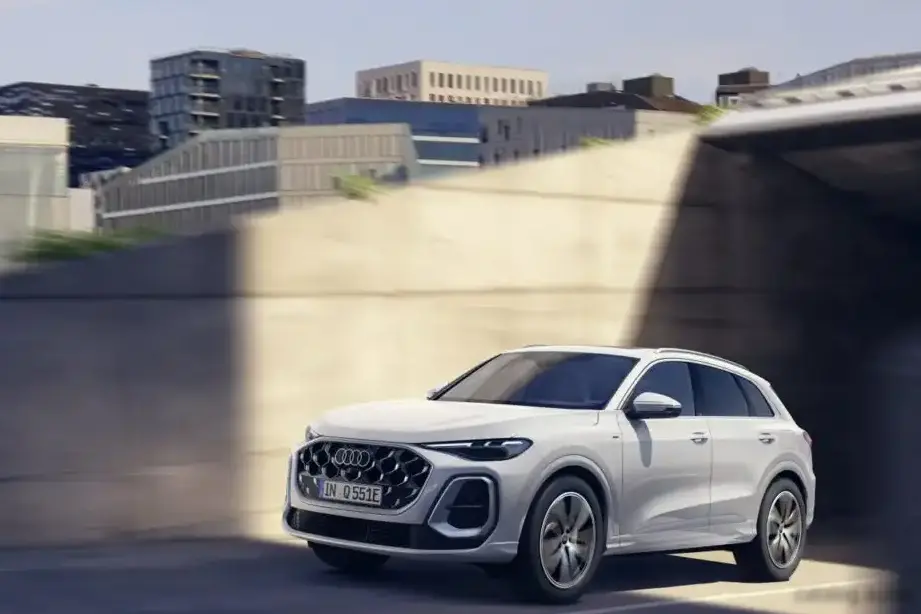
The Audi Q5 III (GU) 2.0 TFSI e-hybrid quattro ultra, introduced in June 2025, is a significant iteration of Audi’s best-selling Q5 SUV. This model falls within the third generation (GU) of the Q5, which utilizes the MLB Evo platform. The “e-hybrid” designation signifies its plug-in hybrid powertrain, combining a gasoline engine with an electric motor and battery pack. The “quattro ultra” indicates a sophisticated all-wheel-drive system optimized for efficiency. Positioned as a mid-to-high trim level, this variant caters to buyers seeking a blend of performance, luxury, and reduced environmental impact. It directly addresses the growing demand for electrified vehicles in the premium SUV segment.
Powertrain & Engine Architecture
At the heart of the Q5 III 2.0 TFSI e-hybrid is a 1,984 cc (121.07 cu. in.) turbocharged four-cylinder gasoline engine, specifically the EA888 family. This engine produces 252 horsepower at 5,000-6,500 rpm and 380 Nm (280.27 lb.-ft.) of torque between 1,600 and 4,500 rpm. It features direct fuel injection and a sophisticated turbocharger with an intercooler to enhance power and efficiency. The engine utilizes a DOHC valvetrain with four valves per cylinder. Coupled with this is a 143 hp electric motor integrated between the engine and the seven-speed S tronic dual-clutch transmission. The combined system output reaches 367 horsepower and 500 Nm (368.78 lb.-ft.) of torque. The 25.9 kWh (gross) / 20.7 kWh (net) lithium-ion battery pack is located under the trunk floor, providing an all-electric range of 81-92 km (50.33 – 57.17 mi) according to WLTP standards. The S tronic transmission offers quick and smooth gear changes, contributing to both performance and efficiency.
Driving Characteristics
The Q5 III 2.0 TFSI e-hybrid quattro ultra delivers a refined and responsive driving experience. The instant torque from the electric motor provides brisk acceleration, especially in electric mode. The combined output of 367 hp allows for a 0-60 mph time of approximately 4.8 seconds. The S tronic transmission’s gear ratios are optimized for both fuel efficiency and performance. In hybrid mode, the vehicle seamlessly switches between electric and gasoline power, prioritizing electric operation whenever possible. The quattro all-wheel-drive system provides excellent traction and stability in various driving conditions. Compared to the standard Q5 2.0 TFSI, the e-hybrid offers a quieter and more refined driving experience, particularly in electric mode. While slightly heavier due to the battery pack, the weight distribution is well-balanced, minimizing any noticeable handling differences.
Equipment & Trim Levels
The 2.0 TFSI e-hybrid quattro ultra trim typically includes a high level of standard equipment. This generally encompasses Audi’s virtual cockpit digital instrument cluster, a large touchscreen infotainment system with navigation, premium leather upholstery, heated front seats, a panoramic sunroof, and a suite of advanced driver-assistance systems (ADAS) such as adaptive cruise control, lane-keeping assist, and automatic emergency braking. Optional extras often include upgraded sound systems, massaging seats, and various cosmetic enhancements. The interior design emphasizes luxury and technology, with high-quality materials and a user-friendly interface.
Chassis & Braking
The Q5 III utilizes an independent multi-link suspension setup for both the front and rear axles, providing a comfortable and controlled ride. A transverse stabilizer bar is included on both axles to reduce body roll during cornering. The braking system features ventilated discs on all four wheels, with 360 mm discs at the front and 350 mm discs at the rear, providing ample stopping power. The ABS (Anti-lock braking system) is standard, along with electronic brake-force distribution and brake assist. The chassis is tuned to balance comfort and handling, offering a composed ride quality without sacrificing agility.
Market Reception & Comparison
The Audi Q5 III 2.0 TFSI e-hybrid quattro ultra has been generally well-received by automotive critics. Reviewers praise its refined driving experience, impressive fuel economy, and generous standard equipment. Compared to other Q5 trims, the e-hybrid offers significantly improved fuel efficiency and the ability to drive in all-electric mode, making it an attractive option for environmentally conscious buyers. However, the higher price point and slightly reduced trunk space (due to the battery pack) are noted drawbacks. Compared to competitors like the BMW X5 xDrive45e and the Volvo XC60 Recharge, the Q5 e-hybrid offers a competitive blend of performance, luxury, and efficiency.
Legacy
The Audi Q5 III 2.0 TFSI e-hybrid quattro ultra represents a key step in Audi’s electrification strategy. The powertrain, while relatively new, is expected to demonstrate good long-term reliability, benefiting from Audi’s established engineering expertise. The combination of a proven gasoline engine and a robust electric motor and battery system should provide years of dependable service. In the used car market, these models are likely to hold their value well, particularly as demand for plug-in hybrid vehicles continues to grow. The integration of advanced technology and a focus on sustainability position this variant as a significant player in the premium SUV segment.