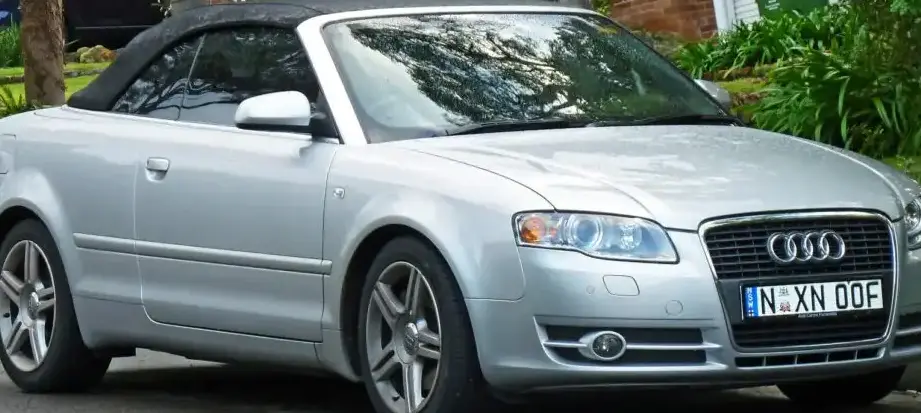
The Audi A4 Cabriolet (B7 8H) 2.0 TDI, produced from 2006 to 2008, represented a compelling entry point into Audi’s premium open-top market. Positioned within the B7 generation of the A4 Cabriolet – itself based on the Volkswagen Group’s PL45 (also known as 1HX0/A3) platform – this variant offered a blend of diesel efficiency, respectable performance, and the prestige associated with the Audi brand. It served as a more economical alternative to the petrol-powered A4 Cabriolet models, appealing to buyers prioritizing fuel economy and lower running costs without sacrificing the open-air driving experience. This model was primarily sold in the European market, where diesel engines held a significant market share.
Technical Specifications
| Brand | Audi |
| Model | A4 |
| Generation | A4 Cabriolet (B7 8H) |
| Type (Engine) | 2.0 TDI (140 Hp) |
| Start of production | 2006 |
| End of production | 2008 |
| Powertrain Architecture | Internal Combustion engine |
| Body type | Cabriolet |
| Seats | 4 |
| Doors | 2 |
| Fuel consumption (urban) | 8.4 l/100 km (28 US mpg, 33.6 UK mpg, 11.9 km/l) |
| Fuel consumption (extra urban) | 5.3 l/100 km (44.4 US mpg, 53.3 UK mpg, 18.9 km/l) |
| Fuel consumption (combined) | 6.4 l/100 km (36.8 US mpg, 44.1 UK mpg, 15.6 km/l) |
| CO2 emissions | 172 g/km |
| Fuel Type | Diesel |
| Acceleration 0 – 100 km/h | 9.7 sec |
| Acceleration 0 – 62 mph | 9.7 sec |
| Acceleration 0 – 60 mph | 9.2 sec |
| Maximum speed | 212 km/h (131.73 mph) |
| Emission standard | Euro 4 |
| Weight-to-power ratio | 11.4 kg/Hp, 87.5 Hp/tonne |
| Weight-to-torque ratio | 5 kg/Nm, 200 Nm/tonne |
| Power | 140 Hp @ 4000 rpm |
| Power per litre | 71.1 Hp/l |
| Torque | 320 Nm @ 1750 rpm (236.02 lb.-ft. @ 1750 rpm) |
| Engine layout | Front, Longitudinal |
| Engine Model/Code | EA188 / BLB |
| Engine displacement | 1968 cm3 (120.09 cu. in.) |
| Number of cylinders | 4 |
| Engine configuration | Inline |
| Cylinder Bore | 81 mm (3.19 in.) |
| Piston Stroke | 95.5 mm (3.76 in.) |
| Compression ratio | 18:1 |
| Number of valves per cylinder | 4 |
| Fuel injection system | Pump-nozzle (Unit Injector) |
| Engine aspiration | Turbocharger, Intercooler |
| Valvetrain | OHC |
| Engine oil capacity | 3.8 l (4.02 US qt | 3.34 UK qt) |
| Coolant | 8 l (8.45 US qt | 7.04 UK qt) |
| Kerb Weight | 1600 kg (3527.4 lbs.) |
| Max. weight | 1980 kg (4365.15 lbs.) |
| Max load | 380 kg (837.76 lbs.) |
| Trunk (boot) space – minimum | 246 l (8.69 cu. ft.) |
| Trunk (boot) space – maximum | 315 l (11.12 cu. ft.) |
| Fuel tank capacity | 70 l (18.49 US gal | 15.4 UK gal) |
| Permitted trailer load with brakes (8%) | 1800 kg (3968.32 lbs.) |
| Permitted trailer load with brakes (12%) | 1600 kg (3527.4 lbs.) |
| Permitted trailer load without brakes | 750 kg (1653.47 lbs.) |
| Permitted towbar download | 80 kg (176.37 lbs.) |
| Length | 4573 mm (180.04 in.) |
| Width | 1777 mm (69.96 in.) |
| Height | 1391 mm (54.76 in.) |
| Wheelbase | 2650 mm (104.33 in.) |
| Front track | 1522 mm (59.92 in.) |
| Rear (Back) track | 1518 mm (59.76 in.) |
| Drag coefficient (Cd) | 0.30 |
| Minimum turning circle (turning diameter) | 11.1 m (36.42 ft.) |
| Drivetrain Architecture | The Internal combustion engine (ICE) drives the front wheels of the vehicle. |
| Drive wheel | Front wheel drive |
| Number of gears and type of gearbox | 6 gears, manual transmission |
| Front suspension | Independent multi-link suspension |
| Rear suspension | Independent multi-link suspension |
| Front brakes | Ventilated discs |
| Rear brakes | Disc |
| Assisting systems | ABS (Anti-lock braking system) |
| Steering type | Steering rack and pinion |
| Power steering | Hydraulic Steering |
| Tires size | 205/55 R16 |
| Wheel rims size | 7J x 16 |
INTRODUCTION
The Audi A4 Cabriolet (B7 8H) 2.0 TDI, launched in 2006 and continuing through 2008, was a key variant in Audi’s open-top lineup. It slotted into the range as a more fuel-efficient alternative to the petrol engines, offering a balance between performance and economy. The B7 generation A4 Cabriolet, built on the PL45 platform, benefited from refinements over its predecessor, including improved chassis rigidity and updated styling. The 2.0 TDI engine, a cornerstone of Volkswagen Group’s diesel strategy, provided a torquey and relatively economical power source for the convertible.
Powertrain & Engine Architecture
At the heart of the A4 Cabriolet 2.0 TDI lies the EA188 engine family, specifically the BLB engine code. This is a 1.968-liter, inline-four cylinder diesel engine. The BLB utilizes a pump-nozzle (unit injector) fuel injection system, a technology known for its precision and efficiency in delivering fuel directly into the combustion chamber. The engine features an overhead camshaft (OHC) valvetrain operating four valves per cylinder. A turbocharger with an intercooler is employed to boost power and torque, providing 140 horsepower at 4000 rpm and a substantial 320 Nm (236 lb-ft) of torque from as low as 1750 rpm. The engine’s longitudinal mounting allowed for front-wheel drive configuration. The 6-speed manual transmission was standard, providing a good balance between fuel efficiency and driver engagement.
Driving Characteristics
The 2.0 TDI engine, coupled with the 6-speed manual gearbox, delivered a respectable driving experience. While not overtly sporty, the engine’s strong low-end torque made it well-suited for everyday driving and overtaking maneuvers. Acceleration from 0-100 km/h (0-62 mph) took approximately 9.7 seconds, and top speed was rated at 212 km/h (131.73 mph). Compared to the more powerful petrol variants, the 2.0 TDI offered a more relaxed and refined driving experience, prioritizing fuel economy over outright performance. The gear ratios were tuned to maximize fuel efficiency while still providing adequate acceleration in most driving situations. The manual transmission allowed for greater driver control, but the engine’s torque characteristics meant that frequent downshifts weren’t always necessary.
Equipment & Trim Levels
The A4 Cabriolet 2.0 TDI typically came with a reasonable level of standard equipment. This included features like air conditioning, power windows, central locking, and an audio system. Interior upholstery was generally cloth, although leather options were available as upgrades. Dashboard trim could vary depending on the specific package chosen. Optional extras included features like automatic climate control, a premium sound system, heated seats, and parking sensors. The trim level often dictated the availability of these options, with higher trims offering more standard features and a wider range of customization possibilities.
Chassis & Braking
The A4 Cabriolet B7 featured an independent multi-link suspension system at both the front and rear, providing a comfortable ride and good handling characteristics. The front suspension utilized coil springs and shock absorbers, while the rear suspension incorporated a more complex multi-link design to optimize wheel control and minimize body roll. Braking duties were handled by ventilated discs at the front and solid discs at the rear, equipped with an Anti-lock Braking System (ABS) as standard. The hydraulic power steering provided a responsive and precise steering feel. The chassis was reinforced compared to the previous generation to enhance rigidity, which is crucial for a convertible body style.
Market Reception & Comparison
The Audi A4 Cabriolet 2.0 TDI was generally well-received by automotive critics, particularly for its fuel efficiency and refined driving experience. It offered a compelling alternative to petrol-powered convertibles, especially in Europe where diesel fuel was more affordable and readily available. Compared to the higher-output petrol variants, the 2.0 TDI was seen as a more sensible choice for drivers prioritizing economy and practicality. However, some critics noted that the engine lacked the outright performance of its petrol counterparts. Fuel economy figures of around 6.4 l/100 km (36.8 US mpg) were considered excellent for a vehicle of its class. Reliability was generally good, although, like all diesel engines, it was susceptible to issues related to the fuel injection system and turbocharger if not properly maintained.
Legacy
The Audi A4 Cabriolet 2.0 TDI (B7 8H) has proven to be a relatively durable and reliable vehicle in the used car market. The EA188 engine, while not without its potential issues, is generally considered robust when properly maintained. Common maintenance items include regular oil changes, filter replacements, and inspection of the turbocharger and fuel injection system. Today, these vehicles represent an affordable entry point into Audi ownership, offering a stylish and comfortable open-top driving experience. However, potential buyers should be aware of the age-related wear and tear associated with any vehicle of this vintage, and a thorough inspection by a qualified mechanic is always recommended.