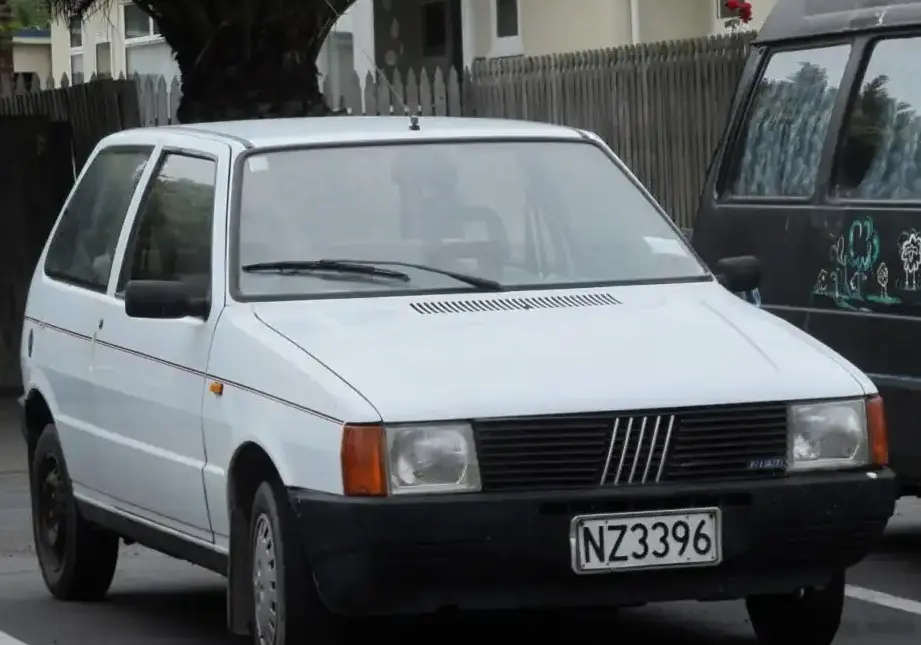
The Fiat Uno 1.9 D, produced from 1995 to 2002, represents a significant iteration of Fiat’s popular supermini, the Uno. This variant, equipped with a 1.9-liter diesel engine producing 60 horsepower, was primarily aimed at the European market, particularly those seeking an economical and practical city car. It occupied a position as the entry-level diesel offering within the Uno range, slotting below more powerful diesel versions and alongside the gasoline-powered models. The Uno, in its various forms, was a cornerstone of Fiat’s sales success throughout the 1990s, and the 1.9 D model specifically catered to buyers prioritizing fuel efficiency and low running costs.
Technical Specifications
| Brand | Fiat |
| Model | UNO |
| Generation | UNO |
| Type (Engine) | 1.9 D (60 Hp) |
| Start of production | 1995 year |
| End of production | 2002 year |
| Powertrain Architecture | Internal Combustion engine |
| Body type | Hatchback |
| Seats | 5 |
| Doors | 3-5 |
| Fuel consumption (urban) | 6 l/100 km (39.2 US mpg, 47.1 UK mpg, 16.7 km/l) |
| Fuel consumption (extra urban) | 4.4 l/100 km (53.5 US mpg, 64.2 UK mpg, 22.7 km/l) |
| Fuel consumption (combined) | 6.2 l/100 km (37.9 US mpg, 45.6 UK mpg, 16.1 km/l) |
| Fuel Type | Diesel |
| Acceleration 0 – 100 km/h | 15.9 sec |
| Acceleration 0 – 62 mph | 15.9 sec |
| Acceleration 0 – 60 mph | 15.1 sec |
| Maximum speed | 157 km/h (97.56 mph) |
| Weight-to-power ratio | 14.8 kg/Hp, 67.8 Hp/tonne |
| Weight-to-torque ratio | 8.2 kg/Nm, 122 Nm/tonne |
| Power | 60 Hp @ 4400 rpm |
| Power per litre | 31.1 Hp/l |
| Torque | 108 Nm @ 2500 rpm (79.66 lb.-ft. @ 2500 rpm) |
| Engine layout | Front, Transverse |
| Engine Model/Code | 149 B5.046 |
| Engine displacement | 1929 cm3 (117.71 cu. in.) |
| Number of cylinders | 4 |
| Engine configuration | Inline |
| Cylinder Bore | 82.6 mm (3.25 in.) |
| Piston Stroke | 90 mm (3.54 in.) |
| Compression ratio | 20:1 |
| Number of valves per cylinder | 2 |
| Fuel injection system | Precombustion chamber injection |
| Engine aspiration | Naturally aspirated engine |
| Engine oil capacity | 4.1 l (4.33 US qt | 3.61 UK qt) |
| Coolant | 8 l (8.45 US qt | 7.04 UK qt) |
| Kerb Weight | 885 kg (1951.09 lbs.) |
| Max. weight | 1320 kg (2910.1 lbs.) |
| Max load | 435 kg (959.01 lbs.) |
| Trunk (boot) space – minimum | 270 l (9.53 cu. ft.) |
| Trunk (boot) space – maximum | 970 l (34.26 cu. ft.) |
| Fuel tank capacity | 40 l (10.57 US gal | 8.8 UK gal) |
| Length | 3690 mm (145.28 in.) |
| Width | 1560 mm (61.42 in.) |
| Height | 1420 mm (55.91 in.) |
| Wheelbase | 2360 mm (92.91 in.) |
| Front track | 1340 mm (52.76 in.) |
| Rear (Back) track | 1300 mm (51.18 in.) |
| Minimum turning circle | 9.8 m (32.15 ft.) |
| Drivetrain Architecture | The Internal combustion engine (ICE) drives the front wheels of the vehicle. |
| Drive wheel | Front wheel drive |
| Number of gears and type of gearbox | 5 gears, manual transmission |
| Front suspension | Coil spring |
| Rear suspension | Coil spring |
| Front brakes | Disc |
| Rear brakes | Drum |
| Steering type | Steering rack and pinion |
| Power steering | Hydraulic Steering |
| Tires size | 155/70 R13 |
Introduction
The Fiat Uno 1.9 D, launched in 1995, was a key component of Fiat’s strategy to offer affordable and fuel-efficient transportation to the European market. Built on the 1HX0/A3 platform, the Uno was already well-established as a popular choice for first-time car buyers and those seeking a practical urban vehicle. The introduction of the 1.9-liter diesel engine broadened the Uno’s appeal, providing a compelling alternative to gasoline-powered models, particularly in countries with higher diesel fuel taxes. This variant was available in both three-door and five-door body styles, catering to different customer preferences.
Powertrain & Engine Architecture
The heart of the Uno 1.9 D is the 149 B5.046 engine, a 1929cc inline-four cylinder diesel. This engine utilizes a precombustion chamber injection system, a common technology for diesel engines of that era. This system involves injecting fuel into a precombustion chamber, where it partially ignites before entering the main combustion chamber, promoting more complete combustion and reducing emissions. The engine features two valves per cylinder and a relatively high compression ratio of 20:1, contributing to its efficiency. The 1.9 D produced 60 horsepower at 4400 rpm and 108 Nm (79.66 lb.-ft.) of torque at 2500 rpm. The engine was typically paired with a five-speed manual transmission, optimized for maximizing fuel economy and providing adequate performance for city driving. While an automatic transmission was available on some Uno models, it was not commonly offered with the 1.9 D engine due to the inherent limitations of early automatic transmissions in handling diesel torque.
Driving Characteristics
The Uno 1.9 D’s driving experience was characterized by its practicality and fuel efficiency rather than outright performance. Acceleration was modest, taking approximately 15.9 seconds to reach 62 mph, and the top speed was around 97.56 mph. However, the engine’s torque delivery made it surprisingly capable in urban environments, providing sufficient power for navigating traffic and climbing hills. The five-speed manual transmission allowed drivers to optimize engine speed for fuel economy or performance. Compared to the gasoline-powered Uno models, the 1.9 D offered significantly better fuel economy, making it an attractive option for high-mileage drivers. Compared to higher-output diesel versions of the Uno, the 1.9 D felt less strained at highway speeds, but lacked the extra punch for quicker overtaking maneuvers.
Equipment & Trim Levels
The Uno 1.9 D was typically offered in relatively basic trim levels, reflecting its position as an entry-level model. Standard equipment generally included cloth upholstery, a basic dashboard layout, and manual windows and door locks. Power steering was often an optional extra. Higher trim levels might have included features such as central locking, electric windows, and a more sophisticated radio. Interior space was adequate for a supermini, comfortably accommodating five passengers. The rear seats could be folded down to increase cargo capacity, providing versatility for carrying larger items.
Chassis & Braking
The Uno 1.9 D featured a simple yet effective chassis design. Front suspension utilized coil springs, while the rear suspension also employed coil springs. The front brakes were disc brakes, providing adequate stopping power, while the rear brakes were drum brakes, a cost-saving measure common in this class of vehicle. The steering system was a rack and pinion setup with hydraulic power steering available as an option. Tire size was typically 155/70 R13. The suspension was tuned for comfort and ride quality, prioritizing a smooth ride over sporty handling.
Market Reception & Comparison
The Fiat Uno 1.9 D was generally well-received by critics and consumers alike, particularly for its fuel efficiency and low running costs. It was often praised as a practical and reliable city car. Compared to other superminis of the time, such as the Peugeot 205 and Renault Clio, the Uno 1.9 D offered a competitive price point and excellent fuel economy. However, it was often criticized for its basic interior and modest performance. Compared to the gasoline-powered Uno models, the 1.9 D offered significantly better fuel economy, but at the cost of some refinement and performance. The 1.9 D was a popular choice for fleet operators and private buyers seeking an economical and dependable vehicle.
Legacy
The Fiat Uno 1.9 D has proven to be a remarkably durable and reliable vehicle. Many examples are still on the road today, testament to the robustness of its engine and simple mechanical design. While finding parts can become increasingly challenging, the 1.9 diesel engine is known for its longevity and relatively low maintenance requirements. In the used car market, the Uno 1.9 D remains an affordable and practical option for those seeking a basic and economical vehicle. Its enduring popularity is a reflection of its original design brief: to provide affordable and reliable transportation to the masses.