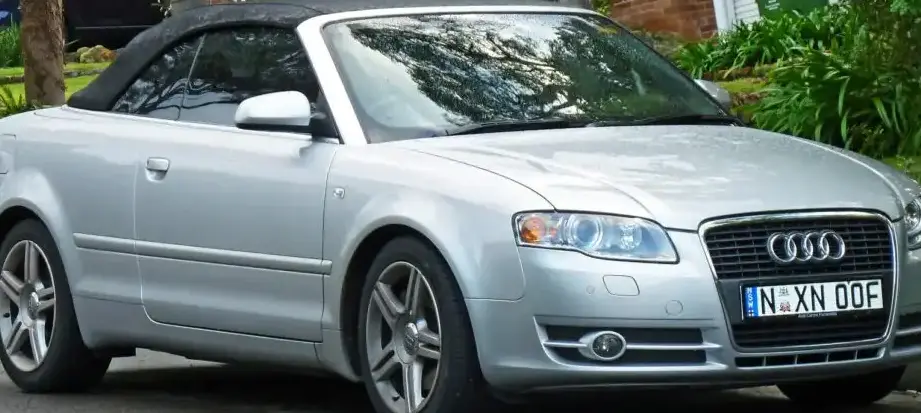
The Audi A4 Cabriolet (B7 8H) 2.5 TDI V6, produced from 2005 to 2008, represented a compelling blend of open-air motoring and diesel efficiency within the premium compact segment. Positioned as a mid-range offering in the B7 Cabriolet lineup, it slotted between the more affordable 1.8T petrol variants and the higher-performance 3.0 TDI. This model catered to buyers seeking a sophisticated convertible experience without sacrificing fuel economy or everyday usability. It was primarily sold in the European market, where diesel engines held a significant market share and were favored for long-distance touring.
Technical Specifications
| Brand | Audi |
| Model | A4 |
| Generation | A4 Cabriolet (B7 8H) |
| Type (Engine) | 2.5 TDI V6 (163 Hp) |
| Start of production | 2005 |
| End of production | 2008 |
| Powertrain Architecture | Internal Combustion engine |
| Body type | Cabriolet |
| Seats | 4 |
| Doors | 2 |
| Fuel consumption (urban) | 10 l/100 km (23.5 US mpg, 28.2 UK mpg, 10 km/l) |
| Fuel consumption (extra urban) | 5.7 l/100 km (41.3 US mpg, 49.6 UK mpg, 17.5 km/l) |
| Fuel consumption (combined) | 7.2 l/100 km (32.7 US mpg, 39.2 UK mpg, 13.9 km/l) |
| CO2 emissions | 194 g/km |
| Fuel Type | Diesel |
| Acceleration 0 – 100 km/h | 9.7 sec |
| Acceleration 0 – 62 mph | 9.7 sec |
| Acceleration 0 – 60 mph | 9.2 sec |
| Maximum speed | 225 km/h (139.81 mph) |
| Emission standard | Euro 4 |
| Weight-to-power ratio | 10.4 kg/Hp, 96.4 Hp/tonne |
| Weight-to-torque ratio | 4.8 kg/Nm, 207.1 Nm/tonne |
| Power | 163 Hp @ 4000 rpm |
| Power per litre | 65.3 Hp/l |
| Torque | 350 Nm @ 1500-3000 rpm (258.15 lb.-ft. @ 1500-3000 rpm) |
| Engine layout | Front, Longitudinal |
| Engine Model/Code | BDG |
| Engine displacement | 2496 cm3 (152.32 cu. in.) |
| Number of cylinders | 6 |
| Engine configuration | V-engine |
| Cylinder Bore | 78.3 mm (3.08 in.) |
| Piston Stroke | 86.4 mm (3.4 in.) |
| Compression ratio | 18:1 |
| Number of valves per cylinder | 4 |
| Fuel injection system | Direct injection |
| Engine aspiration | Turbocharger, Intercooler |
| Valvetrain | DOHC |
| Engine oil capacity | 5.5 l (5.81 US qt | 4.84 UK qt) |
| Coolant | 12 l (12.68 US qt | 10.56 UK qt) |
| Kerb Weight | 1690 kg (3725.81 lbs.) |
| Max. weight | 2170 kg (4784.03 lbs.) |
| Max load | 480 kg (1058.22 lbs.) |
| Trunk (boot) space – minimum | 246 l (8.69 cu. ft.) |
| Trunk (boot) space – maximum | 315 l (11.12 cu. ft.) |
| Fuel tank capacity | 70 l (18.49 US gal | 15.4 UK gal) |
| Permitted trailer load with brakes (8%) | 1800 kg (3968.32 lbs.) |
| Permitted trailer load with brakes (12%) | 1600 kg (3527.4 lbs.) |
| Permitted trailer load without brakes | 750 kg (1653.47 lbs.) |
| Permitted towbar download | 80 kg (176.37 lbs.) |
| Length | 4573 mm (180.04 in.) |
| Width | 1777 mm (69.96 in.) |
| Height | 1391 mm (54.76 in.) |
| Wheelbase | 2654 mm (104.49 in.) |
| Front track | 1523 mm (59.96 in.) |
| Rear (Back) track | 1523 mm (59.96 in.) |
| Drag coefficient (Cd) | 0.30 |
| Minimum turning circle (turning diameter) | 11.1 m (36.42 ft.) |
| Drivetrain Architecture | The Internal combustion engine (ICE) drives the front wheels of the vehicle. |
| Drive wheel | Front wheel drive |
| Number of gears and type of gearbox | 6 gears, manual transmission |
| Front suspension | Independent multi-link suspension |
| Rear suspension | Independent multi-link suspension |
| Front brakes | Ventilated discs |
| Rear brakes | Disc |
| Assisting systems | ABS (Anti-lock braking system) |
| Steering type | Steering rack and pinion |
| Power steering | Hydraulic Steering |
| Tires size | 215/55 R16 |
| Wheel rims size | 7J x 16 |
INTRODUCTION
The Audi A4 Cabriolet (B7 8H) 2.5 TDI V6, launched in 2005, was a key component of Audi’s second-generation A4 Cabriolet range. Built on the Volkswagen Group’s PL45 (B7) platform – shared with the Audi A4 saloon and estate, as well as the VW Passat – it offered a more refined and luxurious open-top experience compared to its predecessor. The 2.5 TDI V6 engine, identified by the BDG engine code, was a popular choice for European buyers prioritizing fuel efficiency and torque. This variant aimed to provide a balance between performance and economy, making it suitable for both city driving and long-distance journeys.
Powertrain & Engine Architecture
The heart of the A4 Cabriolet 2.5 TDI V6 is the BDG engine, a 2.5-liter V6 diesel engine. This engine utilizes common rail direct injection, delivering fuel directly into the combustion chamber at extremely high pressure. This technology, coupled with a variable geometry turbocharger (VGT) and intercooler, optimizes combustion efficiency and boosts power output. The engine features a double overhead camshaft (DOHC) valvetrain with four valves per cylinder, further enhancing its breathing and performance. The engine produces 163 horsepower at 4000 rpm and a substantial 350 Nm (258 lb-ft) of torque between 1500 and 3000 rpm. The engine is longitudinally mounted, driving the front wheels through a six-speed manual transmission. While an automatic transmission was available on other A4 models, the 2.5 TDI V6 was primarily offered with the manual gearbox in many European markets.
Driving Characteristics
The 2.5 TDI V6-powered A4 Cabriolet offered a relaxed and refined driving experience. The abundant low-end torque made it effortless to accelerate from a standstill or overtake at highway speeds. While not a sports car, the engine provided sufficient power for spirited driving, with a 0-60 mph time of around 9.2 seconds and a top speed of 139.81 mph. The six-speed manual transmission allowed drivers to effectively manage the engine’s powerband, while the relatively long gearing contributed to improved fuel economy. Compared to the 1.8T petrol variants, the 2.5 TDI V6 offered significantly more torque and better fuel efficiency, but lacked the higher-revving character and outright acceleration of the petrol engine. It also felt less responsive than the more powerful 3.0 TDI models.
Equipment & Trim Levels
The A4 Cabriolet 2.5 TDI V6 typically came equipped with a generous level of standard features. These included climate control, power windows and mirrors, a CD stereo system, and alloy wheels. Interior upholstery was typically cloth or leather, with options for different color schemes. Common optional extras included a premium sound system, navigation system, heated seats, and parking sensors. Trim levels varied slightly depending on the market, but generally followed a progressive structure, with higher trims offering more luxurious appointments and additional features. The 2.5 TDI V6 often sat in a mid-range position, offering a good balance of features and price.
Chassis & Braking
The A4 Cabriolet’s chassis featured independent multi-link suspension at both the front and rear, providing a comfortable and controlled ride. The front suspension utilized coil springs and shock absorbers, while the rear suspension incorporated a more complex multi-link design to minimize body roll and enhance handling. Braking duties were handled by ventilated discs at the front and solid discs at the rear, equipped with ABS (Anti-lock Braking System) as standard. The steering was a rack-and-pinion system with hydraulic power assistance, offering precise and responsive steering feel. The car’s weight of approximately 1690 kg (3725.81 lbs) was relatively well-distributed, contributing to balanced handling characteristics.
Market Reception & Comparison
The Audi A4 Cabriolet 2.5 TDI V6 was generally well-received by automotive critics. It was praised for its refined ride, comfortable interior, and fuel-efficient engine. However, some reviewers noted that the engine could be somewhat noisy compared to petrol alternatives. Compared to the 1.8T petrol version, the 2.5 TDI V6 offered superior fuel economy and torque, making it a more practical choice for long-distance driving. Against the 3.0 TDI, it offered a lower price point but lacked the extra performance. The 2.5 TDI V6 proved to be a popular choice for buyers seeking a premium convertible with a focus on efficiency and usability.
Legacy
The BDG 2.5 TDI V6 engine, while generally reliable, is known to require regular maintenance, particularly regarding the fuel injection system and turbocharger. Proper servicing, including regular oil changes and filter replacements, is crucial for ensuring long-term reliability. Today, the A4 Cabriolet 2.5 TDI V6 represents a relatively affordable entry point into Audi convertible ownership. Well-maintained examples are still sought after by enthusiasts who appreciate the engine’s torque and fuel efficiency. However, potential buyers should be aware of the age-related issues common to older diesel engines, such as injector wear and potential turbocharger problems. The car remains a stylish and capable open-top tourer, offering a unique blend of German engineering and diesel practicality.