Technical Specifications
| Brand | Audi |
| Model | Q5 |
| Generation | Q5 III Sportback (GU) |
| Type (Engine) | 2.0 TFSI (299 Hp) e-hybrid quattro ultra S tronic |
| Start of production | June, 2025 |
| Powertrain Architecture | PHEV (Plug-in Hybrid Electric Vehicle) |
| Body type | SUV |
| Seats | 5 |
| Doors | 5 |
| Combined fuel consumption (WLTP) | 2.5-8.2 l/100 km |
| Combined fuel consumption (US mpg) | 94.1 – 28.7 |
| Combined fuel consumption (UK mpg) | 113 – 34.4 |
| Combined fuel consumption (km/l) | 40 – 12.2 |
| CO2 emissions (WLTP) | 56-75 g/km |
| Fuel Type | Petrol / electricity |
| Acceleration 0 – 100 km/h | 6.2 sec |
| Acceleration 0 – 62 mph | 6.2 sec |
| Acceleration 0 – 60 mph | 5.9 sec |
| Maximum speed | 250 km/h (155.34 mph) |
| Emission standard | Euro 6e |
| Weight-to-power ratio | 7.2 kg/Hp, 139.1 Hp/tonne |
| Weight-to-torque ratio | 4.8 kg/Nm, 209.3 Nm/tonne |
| Gross battery capacity | 25.9 kWh |
| Net (usable) battery capacity | 20.7 kWh |
| Battery voltage | 400 V |
| Battery technology | Lithium-ion (Li-Ion) |
| Battery location | Under the trunk |
| Recuperation output | 88 kW |
| All-electric range (WLTP) | 82-100 km (50.95 – 62.14 mi) |
| Average Energy consumption (WLTP) | 15.5-16.8 kWh/100 km (24.94 – 27.04 kWh/100 mi) |
| Average Energy consumption (MPGe) | 135 – 125 |
| Average Energy consumption (km/kWh) | 6.5 – 6 |
| Average Energy consumption (mi/kWh) | 4 – 3.7 |
| Max speed (electric) | 140 km/h (86.99 mph) |
| Electric motor power | 143 Hp |
| Electric motor Torque | 350 Nm (258.15 lb.-ft.) |
| Electric motor location | Between the combustion engine and the transmission |
| Electric motor type | Synchronous |
| System power | 299 Hp |
| System torque | 450 Nm (331.9 lb.-ft.) |
| Power | 252 Hp @ 5000-6000 rpm |
| Power per litre | 127 Hp/l |
| Torque | 380 Nm @ 1600-4500 rpm (280.27 lb.-ft. @ 1600-4500 rpm) |
| Engine layout | Front, Longitudinal |
| Engine displacement | 1984 cm3 (121.07 cu. in.) |
| Number of cylinders | 4 |
| Engine configuration | Inline |
| Cylinder Bore | 82.5 mm (3.25 in.) |
| Piston Stroke | 92.8 mm (3.65 in.) |
| Compression ratio | 10.5:1 |
| Number of valves per cylinder | 4 |
| Fuel injection system | Direct injection |
| Engine aspiration | Turbocharger, Intercooler |
| Valvetrain | DOHC |
| Engine oil capacity | 6 l (6.34 US qt | 5.28 UK qt) |
| Coolant | 20.1 l (21.24 US qt | 17.69 UK qt) |
| Kerb Weight | 2150 kg (4739.94 lbs.) |
| Max. weight | 2735 kg (6029.64 lbs.) |
| Max load | 585 kg (1289.7 lbs.) |
| Trunk (boot) space – minimum | 433 l (15.29 cu. ft.) |
| Trunk (boot) space – maximum | 1300 l (45.91 cu. ft.) |
| Fuel tank capacity | 55 l (14.53 US gal | 12.1 UK gal) |
| Max. roof load | 50 kg (110.23 lbs.) |
| Permitted trailer load with brakes (8%) | 2000 kg (4409.25 lbs.) |
| Permitted trailer load with brakes (12%) | 2000 kg (4409.25 lbs.) |
| Permitted trailer load without brakes | 750 kg (1653.47 lbs.) |
| Permitted towbar download | 100 kg (220.46 lbs.) |
| Length | 4717 mm (185.71 in.) |
| Width | 1900 mm (74.8 in.) |
| Width including mirrors | 2155 mm (84.84 in.) |
| Height | 1622-1657 mm (63.86 – 65.24 in.) |
| Wheelbase | 2820 mm (111.02 in.) |
| Front track | 1621 mm (63.82 in.) |
| Rear (Back) track | 1613 mm (63.5 in.) |
| Front overhang | 936 mm (36.85 in.) |
| Rear overhang | 961 mm (37.83 in.) |
| Drag coefficient (Cd) | 0.31 |
| Minimum turning circle (turning diameter) | 12 m (39.37 ft.) |
| Approach angle | 17.1° |
| Departure angle | 24.7° |
| Drivetrain Architecture | The Internal combustion engine (ICE) and the electric motor permanently drive the front wheels of the vehicle, capable of running in full electric or mixed mode, and if necessary through the electrically or mechanically controlled clutch, the rear wheels are driven. |
| Drive wheel | All wheel drive (4×4) |
| Number of gears and type of gearbox | 7 gears, automatic transmission S tronic |
| Front suspension | Independent multi-link suspension, Transverse stabilizer |
| Rear suspension | Independent multi-link suspension, Transverse stabilizer |
| Front brakes | Ventilated discs, 360 mm |
| Rear brakes | Ventilated discs, 330 mm |
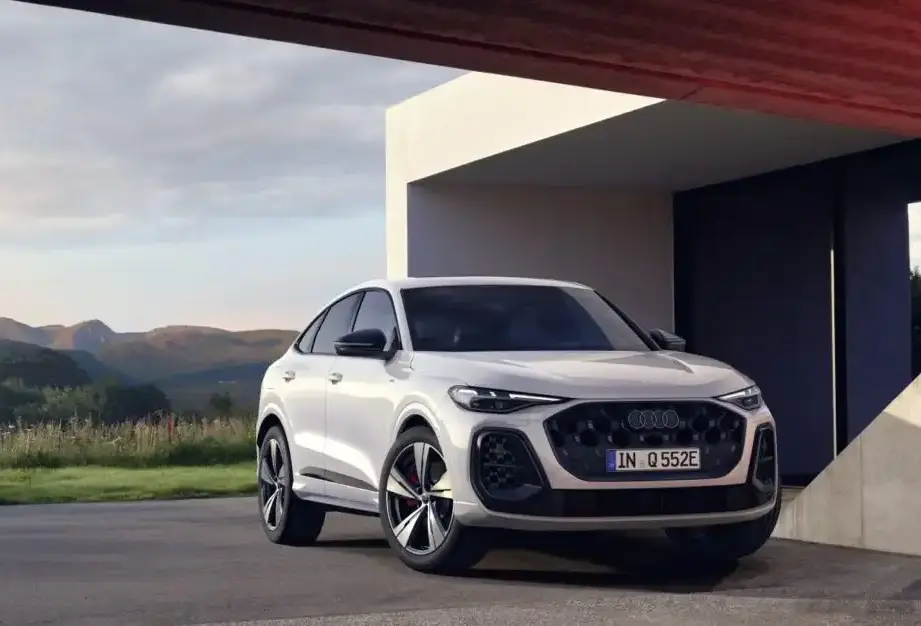
The Audi Q5 III Sportback 2.0 TFSI e-hybrid quattro ultra S tronic is a five-door SUV that debuted in June 2025 as part of Audi’s ongoing electrification strategy. It builds upon the foundation of the Q5 Sportback (GU) model, offering a compelling blend of performance and efficiency. The “e-hybrid” designation signifies its plug-in hybrid powertrain, allowing for all-electric driving for a considerable range. The “quattro ultra” system optimizes all-wheel drive engagement for improved fuel economy. This variant is positioned as a mid-to-upper trim level within the Q5 Sportback range, appealing to buyers who prioritize environmental consciousness without sacrificing the luxury and driving dynamics expected from the Audi brand.
Powertrain & Engine Architecture
At the heart of the Q5 III Sportback 2.0 TFSI e-hybrid lies a 1984cc (121.07 cu. in.) turbocharged four-cylinder gasoline engine, utilizing engine codes consistent with the latest generation of Audi’s TFSI engines. This engine produces 252 horsepower at 5000-6000 rpm and 380 Nm (280.27 lb.-ft.) of torque between 1600-4500 rpm. It utilizes direct fuel injection and a sophisticated turbocharger with an intercooler to maximize power and efficiency. The engine features a DOHC valvetrain with four valves per cylinder. Integrated with this engine is a 143 hp electric motor, powered by a 25.9 kWh (gross) / 20.7 kWh (net) lithium-ion battery pack located under the trunk floor. The electric motor delivers 350 Nm (258.15 lb.-ft.) of torque. The combined system output is 299 horsepower and 450 Nm (331.9 lb.-ft.) of torque. Power is delivered to all four wheels via Audi’s seven-speed S tronic dual-clutch automatic transmission. This transmission is known for its quick and smooth shifts, contributing to both performance and efficiency. The S tronic transmission is electronically controlled and adapts to driving conditions for optimal gear selection.
Driving Characteristics
The Q5 III Sportback 2.0 TFSI e-hybrid offers a refined and versatile driving experience. In all-electric mode, the vehicle provides near-silent acceleration and a range of 82-100 km (50.95 – 62.14 mi), making it suitable for daily commutes and urban driving. When the battery is depleted or when more power is demanded, the gasoline engine seamlessly kicks in, providing a combined output of 299 hp. The 0-60 mph acceleration time is approximately 5.9 seconds. The S tronic transmission ensures responsive shifts, and the quattro all-wheel-drive system provides excellent traction in various weather conditions. Compared to the standard Q5 2.0 TFSI, the e-hybrid variant offers a more relaxed and refined driving experience, particularly in electric mode. Compared to higher-performance Q5 variants (like those with the 3.0 TFSI V6), the 2.0 TFSI e-hybrid prioritizes efficiency over outright speed, but still delivers ample power for most driving situations.
Equipment & Trim Levels
The Q5 III Sportback 2.0 TFSI e-hybrid typically comes well-equipped as standard. Features include Audi’s virtual cockpit digital instrument cluster, a touchscreen infotainment system with navigation, Apple CarPlay and Android Auto compatibility, leather upholstery, heated front seats, and a panoramic sunroof. Safety features include Audi pre sense basic, lane departure warning, and automatic emergency braking. Optional extras include adaptive cruise control, a premium sound system, and various interior trim upgrades. The specific trim level dictates the availability of certain features, with higher trims offering more luxurious appointments and advanced technology.
Chassis & Braking
The Q5 III Sportback features an independent multi-link suspension at both the front and rear axles, providing a comfortable and controlled ride. A transverse stabilizer bar is fitted to both axles to reduce body roll during cornering. The braking system consists of ventilated discs on all four wheels, with 360mm discs at the front and 330mm discs at the rear. ABS (Anti-lock braking system) is standard, along with electronic brake-force distribution and brake assist. The suspension is tuned to balance comfort and handling, providing a stable and predictable driving experience.
Market Reception & Comparison
The Audi Q5 III Sportback 2.0 TFSI e-hybrid has been generally well-received by automotive critics, praised for its fuel efficiency, refined driving experience, and luxurious interior. Compared to other PHEV SUVs in its class, the Q5 e-hybrid offers a competitive electric range and a well-integrated hybrid system. Its fuel economy figures of 2.5-8.2 l/100 km (94.1 – 28.7 US mpg) are significantly better than those of the non-hybrid Q5 models. However, some critics have noted that the battery pack reduces trunk space compared to the standard Q5 Sportback. Reliability is expected to be on par with other Audi models, with the hybrid system potentially requiring specialized maintenance.
Legacy
The Q5 III Sportback 2.0 TFSI e-hybrid represents Audi’s commitment to electrification and sustainable mobility. The powertrain is expected to be reliable, benefiting from Audi’s extensive experience with both TFSI engines and hybrid technology. In the used car market, these models are likely to hold their value well, particularly as demand for PHEV vehicles continues to grow. The integration of a plug-in hybrid system into the popular Q5 Sportback platform broadens its appeal to a wider range of buyers, solidifying its position as a leading contender in the luxury compact SUV segment.