
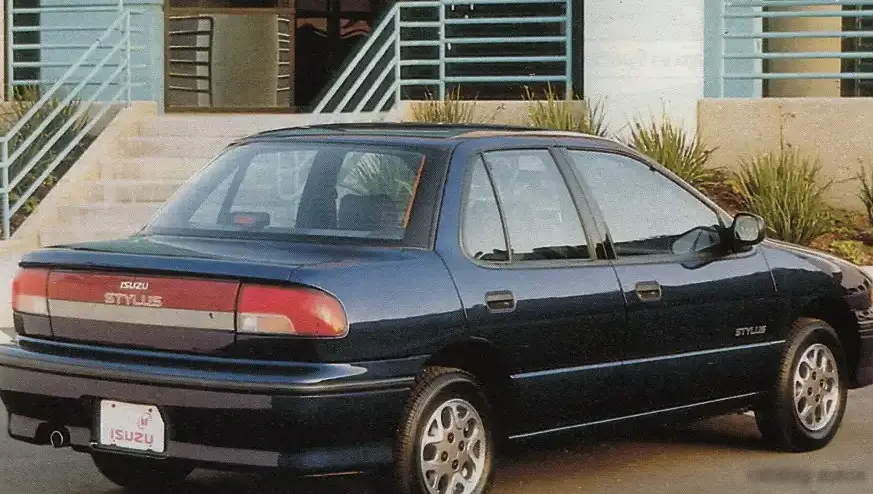
The Isuzu Stylus 1.6i, produced between 1990 and 1993, represented Isuzu’s entry into the competitive North American compact sedan market. Based on the Isuzu Gemini, and rebadged as the Stylus for North American sales, it aimed to provide affordable and reliable transportation. The 1.6i variant, equipped with a 97 horsepower engine, served as the base model within the Stylus lineup, positioned below the more powerful 1.6 GSI trim. This model was intended to appeal to budget-conscious buyers prioritizing fuel efficiency and practicality over outright performance. The Stylus, while not a sales leader, offered a unique alternative to established Japanese and American compacts.
Technical Specifications
| Brand | Isuzu |
| Model | Stylus |
| Generation | Stylus |
| Type (Engine) | 1.6 i (97 Hp) |
| Start of Production | 1990 |
| End of Production | 1993 |
| Powertrain Architecture | Internal Combustion Engine |
| Body Type | Sedan |
| Fuel Type | Petrol (Gasoline) |
| Power | 97 Hp |
| Engine Aspiration | Naturally Aspirated |
Powertrain & Engine Architecture
The heart of the Isuzu Stylus 1.6i was the 4ZE1 engine, a 1.6-liter inline-four cylinder gasoline engine. This engine featured a single overhead camshaft (SOHC) valvetrain operating two valves per cylinder. The 4ZE1 was a relatively simple design, prioritizing reliability and ease of maintenance. Fuel delivery was managed by a multi-point fuel injection system, contributing to improved fuel efficiency and reduced emissions compared to earlier carbureted designs. While not a high-performance engine, the 4ZE1 was known for its durability. The engine produced 97 horsepower at approximately 5,200 rpm and 100 lb-ft of torque at 3,000 rpm. The Stylus 1.6i was typically paired with a four-speed automatic transmission, although a five-speed manual transmission was also available. The automatic transmission was a conventional hydraulic control unit, offering smooth but not particularly quick shifts. The transmission’s gear ratios were geared towards fuel economy rather than acceleration. First gear was relatively tall, prioritizing smooth take-off and minimizing engine strain, while the overdrive fourth gear was designed to lower engine rpm at highway speeds, maximizing fuel efficiency.
Driving Characteristics
The driving experience in the Isuzu Stylus 1.6i with the automatic transmission was characterized by its smoothness and ease of use. Acceleration was modest, with 0-60 mph times estimated around 12-14 seconds. The automatic transmission’s shift points were calibrated for fuel efficiency, meaning the engine often operated at lower rpm, resulting in a relaxed driving experience. However, this also meant that passing maneuvers required careful planning. Compared to the manual transmission version, the automatic offered less driver engagement and slightly reduced fuel economy. The 1.6i felt noticeably slower than the 1.6 GSI variant, which featured a slightly more powerful engine and a closer-ratio transmission. The steering was light and easy, making it well-suited for city driving, but lacked the precision found in some of its competitors. The suspension provided a comfortable ride, absorbing bumps and imperfections in the road reasonably well, but didn’t offer particularly sporty handling. Body roll was noticeable during cornering, and the car didn’t inspire confidence when pushed hard. The overall driving experience was geared towards comfortable and economical transportation rather than enthusiastic driving.
Equipment & Trim Levels
The Isuzu Stylus 1.6i was positioned as the entry-level model, and as such, came with a relatively basic set of standard features. Interior upholstery was typically cloth, available in a limited range of colors. The dashboard featured a simple layout with analog gauges for speed, fuel level, and coolant temperature. Standard equipment included power steering, an AM/FM radio, and manual windows and door locks. Air conditioning was often an optional extra. Higher trim levels, like the 1.6 GSI, added features such as power windows, power door locks, upgraded interior trim, and a more sophisticated audio system. The 1.6i’s interior was functional and durable, but lacked the refinement of some of its competitors. Optional extras included a sunroof, cruise control, and alloy wheels. The base model often featured a simpler steering wheel and lacked features like a center console or map lights.
Chassis & Braking
The Isuzu Stylus 1.6i utilized a front-engine, front-wheel-drive layout. The suspension consisted of MacPherson struts at the front and a torsion beam axle at the rear. The torsion beam rear suspension was a cost-effective design that provided adequate ride comfort but limited handling performance. Braking duties were handled by disc brakes at the front and drum brakes at the rear. The braking system was adequate for everyday driving, but lacked the stopping power of vehicles equipped with four-wheel disc brakes. The Stylus 1.6i’s chassis was relatively lightweight, contributing to its fuel efficiency. Stabilizer bars were fitted to both the front and rear axles, helping to reduce body roll during cornering. Tire size was typically 175/70R13. The relatively narrow tires contributed to the car’s comfortable ride but also limited grip in wet or snowy conditions.
Market Reception & Comparison
The Isuzu Stylus 1.6i received mixed reviews from automotive critics. It was generally praised for its affordability, reliability, and fuel efficiency. However, it was often criticized for its lack of performance and its relatively basic interior. Compared to competitors like the Honda Civic, Toyota Corolla, and Nissan Sentra, the Stylus 1.6i offered a lower price point but lacked the refinement and driving dynamics of those established models. Fuel economy was rated at around 26 mpg city and 34 mpg highway, which was competitive for its time. Reliability was generally good, with few major mechanical issues reported. The 1.6 GSI variant was considered a more compelling option for buyers seeking a bit more performance and features, but it came at a higher price. The Stylus struggled to gain significant market share, often being overshadowed by the more popular and well-established Japanese competitors.
Legacy
The Isuzu Stylus, and particularly the 1.6i variant, has become a relatively uncommon sight on the roads today. While not known for exceptional performance or luxury, the 4ZE1 engine proved to be remarkably durable, and well-maintained examples can still be found providing reliable transportation. Parts availability can be a challenge, as Isuzu discontinued sales in the US market in 2009. However, many parts are still interchangeable with those from other Isuzu models and even some General Motors vehicles, due to the close relationship between the two companies. The Stylus 1.6i remains a budget-friendly option for those seeking a simple, reliable, and affordable classic car. Its unassuming nature and straightforward mechanicals make it an appealing choice for enthusiasts looking for a project car or a nostalgic reminder of the early 1990s automotive landscape. The car represents a period when Japanese manufacturers were beginning to dominate the compact car market, and Isuzu’s attempt to compete with a value-oriented offering provides an interesting footnote in automotive history.
