Technical Specifications
| Brand | Honda |
| Model | Jazz |
| Generation | Jazz (AA) |
| Type (Engine) | 1.2 (45 Hp) |
| Start of production | January, 1984 |
| End of production | December, 1986 |
| Powertrain Architecture | Internal Combustion engine |
| Body type | Hatchback |
| Seats | 5 |
| Doors | 3 |
| Fuel consumption (urban) | 6.3 l/100 km (37.3 US mpg, 44.8 UK mpg, 15.9 km/l) |
| Fuel consumption (extra urban) | 5.3 l/100 km (44.4 US mpg, 53.3 UK mpg, 18.9 km/l) |
| Fuel Type | Petrol (Gasoline) |
| Acceleration 0 – 100 km/h | 16.5 sec |
| Acceleration 0 – 62 mph | 16.5 sec |
| Acceleration 0 – 60 mph | 15.7 sec |
| Maximum speed | 135 km/h (83.89 mph) |
| Weight-to-power ratio | 14.8 kg/Hp, 67.4 Hp/tonne |
| Weight-to-torque ratio | 8.1 kg/Nm, 122.8 Nm/tonne |
| Power | 45 Hp @ 4500 rpm |
| Power per litre | 36.6 Hp/l |
| Torque | 82 Nm @ 2500 rpm (60.48 lb.-ft. @ 2500 rpm) |
| Engine layout | Front, Transverse |
| Engine Model/Code | ER |
| Engine displacement | 1231 cm3 (75.12 cu. in.) |
| Number of cylinders | 4 |
| Engine configuration | Inline |
| Cylinder Bore | 66 mm (2.6 in.) |
| Piston Stroke | 90 mm (3.54 in.) |
| Compression ratio | 10.2:1 |
| Number of valves per cylinder | 2 |
| Fuel injection system | Carburettor |
| Engine aspiration | Naturally aspirated engine |
| Valvetrain | SOHC |
| Engine oil capacity | 3.5 l (3.7 US qt | 3.08 UK qt) |
| Coolant | 4.3 l (4.54 US qt | 3.78 UK qt) |
| Kerb Weight | 668 kg (1472.69 lbs.) |
| Max. weight | 1070 kg (2358.95 lbs.) |
| Max load | 402 kg (886.26 lbs.) |
| Fuel tank capacity | 41 l (10.83 US gal | 9.02 UK gal) |
| Max. roof load | 40 kg (88.18 lbs.) |
| Length | 3380 mm (133.07 in.) |
| Width | 1570 mm (61.81 in.) |
| Height | 1470 mm (57.87 in.) |
| Wheelbase | 2220 mm (87.4 in.) |
| Front track | 1370 mm (53.94 in.) |
| Rear track | 1370 mm (53.94 in.) |
| Drag coefficient (Cd) | 0.4 |
| Minimum turning circle | 9.8 m (32.15 ft.) |
| Drivetrain Architecture | The Internal combustion engine (ICE) drives the front wheels of the vehicle. |
| Drive wheel | Front wheel drive |
| Number of gears | 4 gears, manual transmission |
| Front suspension | Independent, type McPherson with coil spring and anti-roll bar |
| Rear suspension | Independent coil spring |
| Front brakes | Disc |
| Rear brakes | Drum |
| Steering type | Steering rack and pinion |
| Wheel rims size | 4J x 12 |
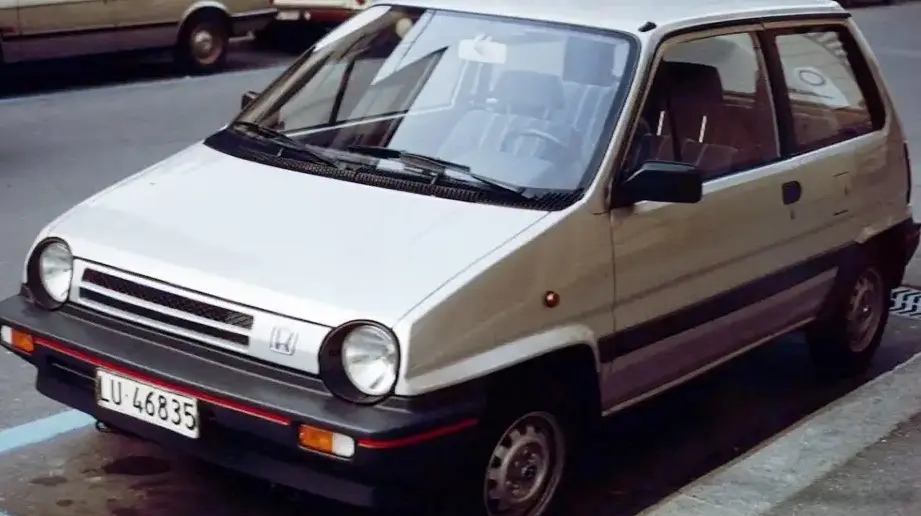
The Honda Jazz (AA), introduced in January 1984 and produced through December 1986, represents the first generation of Honda’s globally successful supermini. This initial iteration, primarily aimed at the Japanese domestic market (JDM) and select export markets, laid the foundation for the Jazz’s reputation for practicality, fuel efficiency, and innovative space utilization. The AA series, built on Honda’s small car platform, was a significant departure from the company’s larger offerings, focusing on affordability and ease of driving. The 1.2-liter, 45 horsepower variant occupied the entry-level position in the Jazz lineup, offering a basic but reliable transportation solution.
Powertrain & Engine Architecture
The heart of the Jazz AA 1.2 was the ER series engine, a 1231cc inline-four cylinder unit. This engine, a staple in several Honda models of the era, was characterized by its simplicity and durability. It employed a single overhead camshaft (SOHC) valvetrain with two valves per cylinder. Fuel delivery was managed by a carburetor, a common feature for vehicles of this period, rather than fuel injection. The carburetor system, while less precise than modern fuel injection, contributed to the engine’s straightforward maintenance requirements. The engine produced 45 horsepower at 4500 rpm and 82 Nm (60.48 lb-ft) of torque at 2500 rpm. This power was transmitted to the front wheels through a four-speed manual transmission, the only transmission option available for this specific variant. The engine’s transverse mounting maximized interior space within the compact Jazz chassis.
Driving Characteristics
The 1.2-liter Jazz AA, with its modest 45 horsepower, was not designed for spirited performance. Acceleration was leisurely, taking approximately 16.5 seconds to reach 62 mph (100 km/h). Its primary strength lay in its fuel efficiency and ease of driving in urban environments. The four-speed manual transmission offered a reasonable spread of gears, but required frequent shifting to maintain momentum, especially when encountering hills or overtaking. Compared to potential future higher-output versions, or even contemporary competitors with larger engines, the 1.2L Jazz prioritized economy over outright speed. The relatively light weight of the vehicle (668 kg / 1472.69 lbs) helped to mitigate the lack of power to some extent, making it feel more nimble than its specifications might suggest.
Equipment & Trim Levels
The 1.2-liter Jazz AA was positioned as the entry-level model, and as such, featured a relatively basic level of equipment. Standard features typically included cloth upholstery, a simple dashboard layout with analog gauges, and basic exterior trim. Power steering and air conditioning were not typically included as standard equipment, and were often unavailable even as options on this base model. The focus was on providing functional transportation at an affordable price point. Interior space, however, was a key selling point, with Honda’s clever packaging maximizing room for passengers and cargo within the small footprint of the vehicle.
Chassis & Braking
The Jazz AA utilized a McPherson strut independent suspension system at the front, providing a comfortable ride quality. The rear suspension employed an independent coil spring setup. Braking duties were handled by disc brakes at the front and drum brakes at the rear. This configuration was typical for vehicles in this class during the 1980s. The steering system was a rack and pinion type, offering reasonably precise steering feel. The relatively narrow tires (4J x 12) contributed to the car’s fuel efficiency but limited grip during cornering.
Market Reception & Comparison
The Honda Jazz AA 1.2 was generally well-received as a practical and economical city car. Critics praised its fuel efficiency, spacious interior, and ease of driving. However, the limited power output was a common criticism, particularly for drivers accustomed to larger or more powerful vehicles. Compared to other small cars of the era, such as the Toyota Starlet or Nissan Micra, the Jazz offered a compelling combination of features and affordability. Its fuel economy was competitive, and its reliability was generally considered to be above average.
Legacy
The Honda Jazz AA 1.2, while not a performance icon, played a crucial role in establishing the Jazz nameplate as a leader in the supermini segment. The ER engine proved to be a durable and reliable powerplant, and many examples remain on the road today. In the used car market, these early Jazz models are appreciated by enthusiasts for their simplicity, affordability, and classic Honda engineering. While maintenance may require sourcing parts specific to the 1980s, the inherent reliability of the engine and chassis makes them relatively easy to keep running. The AA generation laid the groundwork for the subsequent generations of the Jazz, which have continued to build on its reputation for practicality, fuel efficiency, and innovative design.