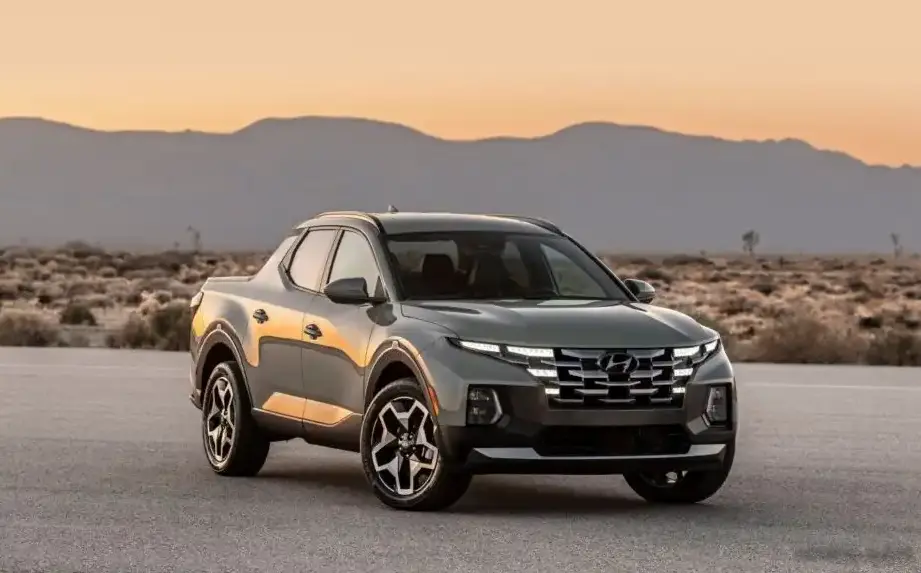
The Hyundai Santa Cruz 2.5 Turbo GDI MPI with HTRAC All-Wheel Drive and a Dual Clutch Transmission (DCT) represents the top-tier performance offering within the first generation (2021-2024) of Hyundai’s compact pickup truck. Introduced in June 2021, the Santa Cruz aimed to carve out a unique niche in the American market – a Sport Adventure Vehicle, blending the practicality of a pickup with the comfort and features of a crossover SUV. This 281 horsepower variant, positioned as the premium trim, was designed to appeal to buyers seeking a more engaging driving experience and increased capability compared to the base 2.5-liter naturally aspirated engine. It was discontinued in March 2024 with the introduction of the second generation model.
Technical Specifications
| Brand | Hyundai |
| Model | Santa Cruz |
| Generation | Santa Cruz (First Generation) |
| Type (Engine) | 2.5 Turbo GDI MPI (281 Hp) HTRAC AWD DCT |
| Start of production | June, 2021 |
| End of production | March, 2024 |
| Powertrain Architecture | Internal Combustion engine |
| Body type | Pick-up |
| Seats | 5 |
| Doors | 4 |
| Fuel consumption (economy) – urban (EPA) | 12.4 l/100 km (19 US mpg, 22.8 UK mpg, 8.1 km/l) |
| Fuel consumption (economy) – extra urban (EPA) | 8.7 l/100 km (27 US mpg, 32.5 UK mpg, 11.5 km/l) |
| Fuel consumption (economy) – combined (EPA) | 10.7 l/100 km (22 US mpg, 26.4 UK mpg, 9.3 km/l) |
| Fuel Type | Petrol (Gasoline) |
| Emission standard | ULEV |
| Weight-to-power ratio | 6.8 kg/Hp, 147.8 Hp/tonne |
| Weight-to-torque ratio | 4.5 kg/Nm, 222 Nm/tonne |
| Power | 281 Hp @ 5800 rpm |
| Power per litre | 112.5 Hp/l |
| Torque | 422 Nm @ 1700-4000 rpm (311.25 lb.-ft. @ 1700-4000 rpm) |
| Engine layout | Front, Transverse |
| Engine Model/Code | Smartstream / G4KP |
| Engine displacement | 2497 cm3 (152.38 cu. in.) |
| Number of cylinders | 4 |
| Engine configuration | Inline |
| Cylinder Bore | 88.5 mm (3.48 in.) |
| Piston Stroke | 101.5 mm (4 in.) |
| Compression ratio | 10.5:1 |
| Number of valves per cylinder | 4 |
| Fuel injection system | Direct injection and Multi-port manifold injection |
| Engine aspiration | Turbocharger, Intercooler |
| Valvetrain | DOHC, CVVT |
| Engine oil capacity | 5.8 l (6.13 US qt | 5.1 UK qt) |
| Coolant | 8.63 l (9.12 US qt | 7.59 UK qt) |
| Kerb Weight | 1901-1913 kg (4190.99 – 4217.44 lbs.) |
| Max. weight | 2600 kg (5732.02 lbs.) |
| Max load | 687-699 kg (1514.58 – 1541.03 lbs.) |
| Trunk (boot) space – maximum | 765 l (27.02 cu. ft.) |
| Fuel tank capacity | 67 l (17.7 US gal | 14.74 UK gal) |
| Max. roof load | 100 kg (220.46 lbs.) |
| Permitted trailer load with brakes (12%) | 2268 kg (5000.08 lbs.) |
| Permitted trailer load without brakes | 750 kg (1653.47 lbs.) |
| Length | 4971 mm (195.71 in.) |
| Width | 1905 mm (75 in.) |
| Height | 1694 mm (66.69 in.) |
| Wheelbase | 3005 mm (118.31 in.) |
| Front track | 1643 mm (64.69 in.) |
| Rear (Back) track | 1648 mm (64.88 in.) |
| Ride height (ground clearance) | 218 mm (8.58 in.) |
| Drag coefficient (Cd) | 0.37 |
| Minimum turning circle (turning diameter) | 12.1 m (39.7 ft.) |
| Approach angle | 17.5° |
| Departure angle | 23.2° |
| Ramp-over (brakeover) angle | 18.6° |
| Drivetrain Architecture | The Internal combustion engine (ICE) drives the front wheels permanently, and the rear wheels are driven through an electrically or mechanically operated clutch if necessary. |
| Drive wheel | All wheel drive (4×4) |
| Number of gears and type of gearbox | 8 gears, automatic transmission DCT |
| Front suspension | Independent type McPherson |
| Rear suspension | Independent multi-link suspension |
| Front brakes | Ventilated discs, 325×30 mm |
| Rear brakes | Disc, 325×12 mm |
| Assisting systems | ABS (Anti-lock braking system) |
| Steering type | Steering rack and pinion |
| Power steering | Electric Steering |
| Tires size | 245/60 R18; 245/50 R20 |
| Wheel rims size | 7.5J x 18; 7.5J x 20 |
Powertrain & Engine Architecture
At the heart of the Santa Cruz 2.5 Turbo is Hyundai’s Smartstream G4KP 2.5-liter inline-four cylinder engine. This engine utilizes a combination of Gasoline Direct Injection (GDI) and Multi-Port Fuel Injection (MPI) technologies. GDI provides precise fuel delivery for improved efficiency and power, while MPI assists during cold starts and low-load conditions for reduced emissions. The engine is turbocharged, with an integrated intercooler to manage intake air temperature, boosting output to 281 horsepower and 311 lb-ft of torque. The engine features a Double Overhead Camshaft (DOHC) valvetrain with Continuously Variable Valve Timing (CVVT) on both intake and exhaust sides, optimizing engine breathing across the rev range. The engine is transversely mounted in the front of the vehicle.
The powertrain is paired with an 8-speed Dual Clutch Transmission (DCT). DCTs offer faster and smoother gear changes compared to traditional automatic transmissions, contributing to a more responsive driving experience. The HTRAC All-Wheel Drive system is a key component, employing an electronically controlled multi-plate clutch to distribute torque between the front and rear axles. This system can seamlessly transition between front-wheel drive for fuel efficiency and all-wheel drive for enhanced traction in various conditions.
Driving Characteristics
The 2.5 Turbo Santa Cruz delivers a noticeably more spirited driving experience than the base engine. The readily available torque, peaking from 1700-4000 rpm, provides strong acceleration in everyday driving situations and makes overtaking maneuvers effortless. The DCT contributes to quick and precise shifts, enhancing the feeling of responsiveness. While not a dedicated off-road vehicle, the HTRAC AWD system provides confident traction on gravel, dirt, and in inclement weather. The 8-speed DCT is tuned for a balance between performance and fuel economy, with gear ratios optimized for both acceleration and highway cruising. Compared to the base engine, the 2.5 Turbo offers a more refined and engaging driving experience, albeit with a slight trade-off in fuel economy.
Equipment & Trim Levels
The 2.5 Turbo trim typically came standard with a comprehensive list of features, including leather upholstery, a larger touchscreen infotainment system (typically 10.25 inches), a premium sound system, heated and ventilated front seats, a panoramic sunroof, and a suite of advanced driver-assistance systems (ADAS) such as adaptive cruise control, lane-keeping assist, and blind-spot monitoring. Optional extras included a tow package, premium paint colors, and upgraded wheels. The interior design focused on a modern and upscale aesthetic, with high-quality materials and a user-friendly layout.
Chassis & Braking
The Santa Cruz utilizes a unibody construction, contributing to its relatively light weight and agile handling. The front suspension features an independent McPherson strut design, while the rear suspension employs an independent multi-link setup. This configuration provides a comfortable ride and good handling characteristics. Braking duties are handled by ventilated discs at the front and solid discs at the rear. The braking system is equipped with ABS (Anti-lock Braking System) and electronic brake-force distribution (EBD) for enhanced safety.
Market Reception & Comparison
The Santa Cruz 2.5 Turbo was generally well-received by automotive critics, who praised its stylish design, comfortable ride, and strong performance. However, some reviewers noted that its cargo bed was relatively small compared to traditional pickup trucks. Compared to the base 2.5-liter engine, the Turbo offered a significant performance upgrade, but at a higher price point. Fuel economy was slightly lower with the Turbo, but the added power and refinement were considered worthwhile by many buyers. It competed with other compact crossovers and smaller pickup trucks, such as the Honda Ridgeline and Ford Maverick.
Legacy
The Hyundai Santa Cruz 2.5 Turbo GDI MPI HTRAC AWD DCT represents a significant step forward for Hyundai in the American market, demonstrating the brand’s ability to create innovative and appealing vehicles. While long-term reliability data is still emerging, Hyundai’s reputation for building durable and dependable vehicles suggests that this powertrain should prove to be relatively reliable. On the used car market, these models hold their value well, appealing to buyers seeking a unique and versatile vehicle with a blend of style, performance, and practicality. The first generation Santa Cruz established a new segment and paved the way for future iterations of this Sport Adventure Vehicle.