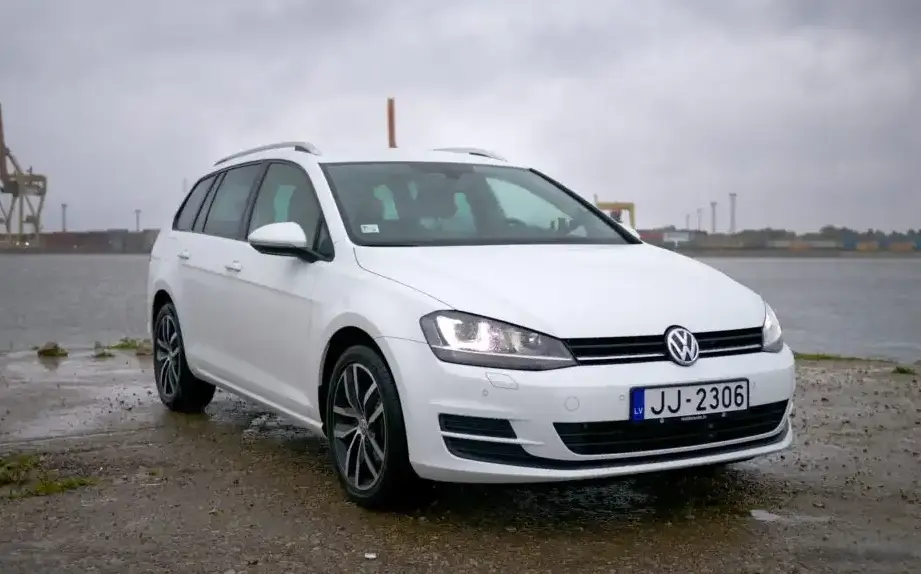
The Volkswagen Golf VII Variant 1.6 TDI (110 hp) DSG was a popular configuration of Volkswagen’s seventh-generation Golf estate, produced from June 2013 to April 2017. Positioned as a fuel-efficient and practical option within the Golf VII Variant lineup, it catered to buyers seeking a balance between economy, space, and ease of driving. This variant occupied a mid-range position, slotting below the more powerful petrol and diesel options, and above the base-level trims. It was primarily marketed in Europe, where the compact estate segment held significant appeal, offering a compelling alternative to larger, more expensive vehicles.
Technical Specifications
| Brand | Volkswagen |
| Model | Golf |
| Generation | Golf VII Variant |
| Type (Engine) | 1.6 TDI (110 Hp) DSG |
| Start of production | June, 2013 |
| End of production | April, 2017 |
| Powertrain Architecture | Internal Combustion engine |
| Body type | Station wagon (estate) |
| Seats | 5 |
| Doors | 5 |
| Fuel consumption (urban) | 4.6 – 4.5 l/100 km (51.1 – 52.3 US mpg, 61.4 – 62.8 UK mpg, 21.7 – 22.2 km/l) |
| Fuel consumption (extra urban) | 3.8 – 3.7 l/100 km (61.9 – 63.6 US mpg, 74.3 – 76.3 UK mpg, 26.3 – 27 km/l) |
| Fuel consumption (combined) | 4.1 – 4.0 l/100 km (57.4 – 58.8 US mpg, 68.9 – 70.6 UK mpg, 24.4 – 25 km/l) |
| CO2 emissions | 106 – 104 g/km |
| Fuel Type | Diesel |
| Acceleration 0 – 100 km/h | 11 sec |
| Acceleration 0 – 62 mph | 11 sec |
| Acceleration 0 – 60 mph | 10.5 sec |
| Maximum speed | 196 km/h (121.79 mph) |
| Emission standard | Euro 6 |
| Weight-to-power ratio | 12.2 kg/Hp, 82.3 Hp/tonne |
| Weight-to-torque ratio | 5.3 kg/Nm, 187 Nm/tonne |
| Power | 110 Hp @ 3200-4000 rpm |
| Power per litre | 68.8 Hp/l |
| Torque | 250 Nm @ 1500-3000 rpm (184.39 lb.-ft. @ 1500-3000 rpm) |
| Engine layout | Front, Transverse |
| Engine Model/Code | CRKB, CXXB |
| Engine displacement | 1598 cm3 (97.52 cu. in.) |
| Number of cylinders | 4 |
| Engine configuration | Inline |
| Number of valves per cylinder | 4 |
| Fuel injection system | Diesel Commonrail |
| Engine aspiration | Turbocharger, Intercooler |
| Engine oil capacity | 4.7 l (4.97 US qt | 4.14 UK qt) |
| Kerb Weight | 1337 kg (2947.58 lbs.) |
| Max. weight | 1940 kg (4276.97 lbs.) |
| Max load | 603 kg (1329.39 lbs.) |
| Trunk (boot) space – minimum | 605 l (21.37 cu. ft.) |
| Trunk (boot) space – maximum | 1620 l (57.21 cu. ft.) |
| Fuel tank capacity | 50 l (13.21 US gal | 11 UK gal) |
| Max. roof load | 75 kg (165.35 lbs.) |
| Permitted trailer load with brakes (8%) | 1800 kg (3968.32 lbs.) |
| Permitted trailer load with brakes (12%) | 1500 kg (3306.93 lbs.) |
| Permitted trailer load without brakes | 700 kg (1543.24 lbs.) |
| Permitted towbar download | 80 kg (176.37 lbs.) |
| Length | 4562 mm (179.61 in.) |
| Width | 1799 mm (70.83 in.) |
| Width including mirrors | 2027 mm (79.8 in.) |
| Height | 1481 mm (58.31 in.) |
| Wheelbase | 2635 mm (103.74 in.) |
| Front track | 1549 mm (60.98 in.) |
| Rear (Back) track | 1520 mm (59.84 in.) |
| Ride height (ground clearance) | 140 mm (5.51 in.) |
| Minimum turning circle (turning diameter) | 10.9 m (35.76 ft.) |
| Drivetrain Architecture | The Internal combustion engine (ICE) drives the front wheels of the vehicle. |
| Drive wheel | Front wheel drive |
| Number of gears and type of gearbox | 7 gears, automatic transmission DSG |
| Front brakes | Ventilated discs |
| Rear brakes | Disc |
| Assisting systems | ABS (Anti-lock braking system) |
| Steering type | Steering rack and pinion |
| Power steering | Electric Steering |
| Tires size | 195/65 R15; 205/55 R16 |
| Wheel rims size | 6J x 15; 6.5J x 16 |
INTRODUCTION
The Volkswagen Golf VII Variant 1.6 TDI (110 hp) DSG, launched in mid-2013, was a key component of Volkswagen’s strategy to offer a diverse range of Golf estate models. Built on the MQB (Modular Transverse Matrix) platform – specifically the 1HX0/A3 variant – it shared its underpinnings with other VW Group vehicles like the Audi A3 and SEAT Leon ST. The ‘Variant’ designation signified the estate body style, offering increased cargo capacity compared to the standard hatchback. This particular engine and transmission combination was designed to appeal to buyers prioritizing fuel efficiency and comfortable, effortless driving.
Powertrain & Engine Architecture
At the heart of this Golf Variant lay the 1.6-liter, four-cylinder diesel engine, identified by engine codes CRKB and CXXB. This engine was a member of Volkswagen’s common rail diesel family, utilizing direct injection technology to optimize combustion. The engine featured a turbocharger with an intercooler, enhancing power output and efficiency. The common rail system, operating at high pressure, allowed for precise fuel delivery and reduced emissions. The engine produced 110 horsepower at 3200-4000 rpm and 250 Nm (184 lb-ft) of torque between 1500-3000 rpm. Paired with this engine was the 7-speed dual-clutch transmission (DSG), offering smooth and rapid gear changes. The DSG transmission, known for its efficiency and responsiveness, contributed to the vehicle’s overall fuel economy and driving experience.
Driving Characteristics
The 1.6 TDI with the DSG transmission delivered a comfortable and refined driving experience. While not particularly sporty, it provided adequate performance for everyday driving situations. Acceleration from 0-62 mph took approximately 11 seconds, and the top speed was 196 km/h (122 mph). The DSG transmission intelligently selected gears to maintain optimal engine speed, resulting in smooth acceleration and efficient cruising. Compared to the more powerful 2.0 TDI variants, the 1.6 TDI felt less eager to accelerate, but its lower weight and efficient engine contributed to superior fuel economy. The gear ratios were tuned for economy, with taller gearing in higher gears to reduce engine revs at highway speeds. The steering was light and precise, making it easy to maneuver in urban environments.
Equipment & Trim Levels
The Golf VII Variant 1.6 TDI DSG typically came equipped with a respectable level of standard features. These included air conditioning, electric windows, central locking, a multi-function steering wheel, and an infotainment system with a touchscreen display. Safety features such as ABS, ESP (Electronic Stability Program), and multiple airbags were also standard. Interior upholstery was typically cloth, with options for higher-grade materials available. Common optional extras included alloy wheels, parking sensors, a navigation system, and upgraded audio systems. Trim levels varied depending on the market, but generally offered progressive upgrades in terms of comfort and convenience features.
Chassis & Braking
The Golf VII Variant featured a MacPherson strut front suspension and a multi-link rear suspension, providing a comfortable ride and good handling characteristics. The suspension was tuned to prioritize comfort, but still offered a reasonable level of control in corners. The braking system consisted of ventilated discs on the front wheels and solid discs on the rear. ABS (Anti-lock Braking System) was standard, enhancing braking performance and stability. The chassis was designed to accommodate the increased weight of the estate body style while maintaining the Golf’s renowned handling balance.
Market Reception & Comparison
The Golf VII Variant 1.6 TDI DSG was generally well-received by automotive critics. It was praised for its fuel efficiency, comfortable ride, and practical interior space. However, some reviewers noted that the engine lacked the outright performance of the more powerful diesel options. Compared to the 2.0 TDI models, the 1.6 TDI offered significantly better fuel economy, but at the expense of acceleration. Against competitors like the Ford Focus Estate and Opel Astra Sports Tourer, the Golf Variant 1.6 TDI DSG held its own, offering a well-rounded package with a reputation for reliability and build quality.
Legacy
The 1.6 TDI engine, while not known for being a powerhouse, proved to be relatively reliable in the Golf VII Variant. The DSG transmission, when properly maintained, also offered good longevity. In the used car market, these models continue to be popular due to their fuel efficiency and practicality. However, potential buyers should be aware of the importance of regular DSG servicing, as neglected transmissions can be prone to issues. Overall, the Golf VII Variant 1.6 TDI DSG remains a sensible and economical choice for those seeking a versatile and reliable estate car.