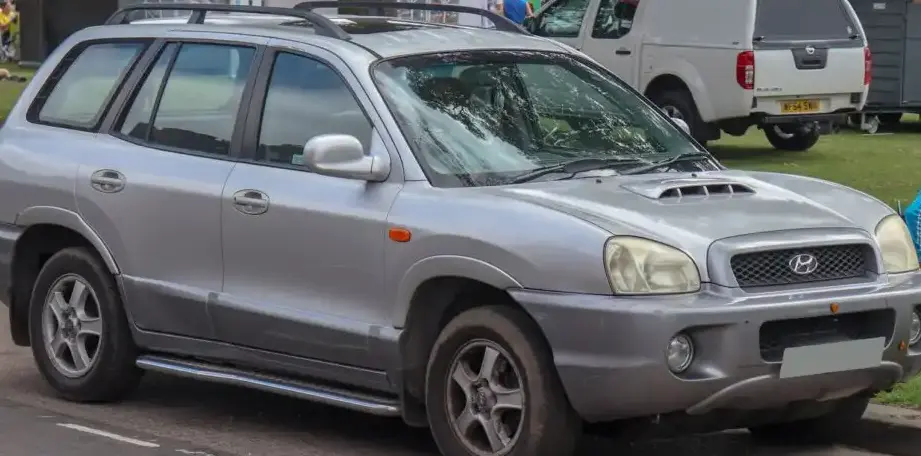
The Hyundai Santa Fe I (SM) 2.0 CRDi 4WD Automatic, produced between 2001 and 2006, represented Hyundai’s initial foray into the burgeoning compact SUV market. This variant, powered by the D4EA 2.0-liter turbocharged diesel engine and paired with a four-speed automatic transmission, was positioned as a mid-range offering within the first-generation Santa Fe lineup (designated SM). It aimed to provide a balance between fuel efficiency, all-weather capability with its four-wheel-drive system, and the convenience of an automatic gearbox, appealing to families and drivers seeking a practical and comfortable SUV. The Santa Fe SM was built on Hyundai’s 1HX0 platform, shared with the Kia Carnival/Sedona, and marked a significant step forward for the Korean automaker in terms of design, build quality, and overall refinement.
Technical Specifications
| Brand | Hyundai |
| Model | Santa Fe |
| Generation | Santa Fe I (SM) |
| Type (Engine) | 2.0 CRDi 4WD (113 Hp) Automatic |
| Start of production | 2001 |
| End of production | 2006 |
| Powertrain Architecture | Internal Combustion engine |
| Body type | SUV |
| Seats | 5 |
| Doors | 5 |
| Fuel consumption (urban) | 11.8 l/100 km (19.9 US mpg, 23.9 UK mpg, 8.5 km/l) |
| Fuel consumption (extra urban) | 7.7 l/100 km (30.5 US mpg, 36.7 UK mpg, 13 km/l) |
| Fuel consumption (combined) | 9.2 l/100 km (25.6 US mpg, 30.7 UK mpg, 10.9 km/l) |
| Fuel Type | Diesel |
| Acceleration 0 – 100 km/h | 14.9 sec |
| Acceleration 0 – 62 mph | 14.9 sec |
| Acceleration 0 – 60 mph | 14.2 sec |
| Maximum speed | 160 km/h (99.42 mph) |
| Weight-to-power ratio | 16.3 kg/Hp, 61.2 Hp/tonne |
| Weight-to-torque ratio | 7.9 kg/Nm, 127.4 Nm/tonne |
| Power | 113 Hp @ 4000 rpm |
| Power per litre | 56.8 Hp/l |
| Torque | 235 Nm @ 1800 rpm (173.33 lb.-ft. @ 1800 rpm) |
| Engine layout | Front, Transverse |
| Engine Model/Code | D / D4EA |
| Engine displacement | 1991 cm3 (121.5 cu. in.) |
| Number of cylinders | 4 |
| Engine configuration | Inline |
| Cylinder Bore | 83 mm (3.27 in.) |
| Piston Stroke | 92 mm (3.62 in.) |
| Compression ratio | 17.7:1 |
| Number of valves per cylinder | 4 |
| Fuel injection system | Diesel Commonrail |
| Engine aspiration | Turbocharger, Intercooler |
| Valvetrain | OHC |
| Engine oil capacity | 5.9 l (6.23 US qt | 5.19 UK qt) |
| Coolant | 8.7 l (9.19 US qt | 7.65 UK qt) |
| Kerb Weight | 1845 kg (4067.53 lbs.) |
| Max. weight | 2380 kg (5247 lbs.) |
| Max load | 535 kg (1179.47 lbs.) |
| Trunk (boot) space – minimum | 850 l (30.02 cu. ft.) |
| Trunk (boot) space – maximum | 2100 l (74.16 cu. ft.) |
| Fuel tank capacity | 65 l (17.17 US gal | 14.3 UK gal) |
| Length | 4500 mm (177.17 in.) |
| Width | 1820 mm (71.65 in.) |
| Height | 1730 mm (68.11 in.) |
| Wheelbase | 2620 mm (103.15 in.) |
| Front track | 1540 mm (60.63 in.) |
| Rear (Back) track | 1540 mm (60.63 in.) |
| Drive wheel | All wheel drive (4×4) |
| Number of gears and type of gearbox | 4 gears, automatic transmission |
| Front suspension | Wishbone |
| Rear suspension | Coil spring |
| Front brakes | Ventilated discs |
| Rear brakes | Disc |
| Assisting systems | ABS (Anti-lock braking system) |
| Steering type | Steering rack and pinion |
| Power steering | Hydraulic Steering |
| Tires size | 225/70 R16 |
| Wheel rims size | 16 |
Powertrain & Engine Architecture
The heart of the Santa Fe 2.0 CRDi Automatic is the Hyundai D4EA engine, a 1.991-liter inline-four cylinder diesel. This engine utilizes a second-generation common rail direct injection system, delivering fuel at extremely high pressures for improved combustion efficiency and reduced emissions. The D4EA is equipped with a turbocharger and intercooler, boosting power output to 113 horsepower at 4,000 rpm and 235 Nm (173 lb-ft) of torque at 1,800 rpm. The engine features an overhead camshaft (OHC) valvetrain with four valves per cylinder. The four-speed automatic transmission, while providing convenience, was a relatively conventional unit for its time. It wasn’t known for particularly quick shifts or advanced features, but it offered smooth operation and reliability. The transmission’s gear ratios were tuned for fuel economy and everyday drivability rather than outright performance.
Driving Characteristics
The 2.0 CRDi Automatic Santa Fe offered a comfortable, if not particularly exhilarating, driving experience. Acceleration from 0-60 mph took around 14.2 seconds, and top speed was limited to 99.42 mph. The automatic transmission, while smooth, did detract from the engine’s available torque, resulting in a slightly sluggish response compared to the manual transmission versions. The four-wheel-drive system provided enhanced traction in slippery conditions, making it a capable all-weather vehicle. The suspension was tuned for comfort, absorbing bumps and imperfections in the road reasonably well. However, this did result in some body roll during cornering. Overall, the driving experience was geared towards practicality and ease of use rather than sporty handling.
Equipment & Trim Levels
The 2.0 CRDi 4WD Automatic trim typically included standard features such as air conditioning, power windows and locks, a basic audio system, and ABS brakes. Interior upholstery was usually cloth, with a relatively simple dashboard layout. Optional extras included alloy wheels, a sunroof, upgraded audio systems, and leather upholstery. The Santa Fe aimed to provide a good level of equipment for its price point, competing with other compact SUVs like the Honda CR-V and Toyota RAV4.
Chassis & Braking
The Santa Fe I utilized a front independent wishbone suspension and a rear coil spring suspension. The four-wheel-drive system employed a viscous coupling to distribute torque between the front and rear axles as needed. Braking duties were handled by ventilated discs at the front and solid discs at the rear. The ABS system provided enhanced braking control in emergency situations. The chassis was designed to provide a comfortable ride and stable handling, prioritizing practicality over sporty dynamics.
Market Reception & Comparison
The Hyundai Santa Fe I was generally well-received by critics as a competent and affordable SUV. The 2.0 CRDi Automatic variant was praised for its fuel efficiency and comfortable ride, but criticized for its relatively slow acceleration. Compared to the higher-output 2.4-liter gasoline engine and the more powerful 2.0 CRDi with a manual transmission, the 113 hp automatic version was considered the entry-level option. It offered a more economical choice for buyers who prioritized fuel economy and convenience over performance. Reliability was generally good, although some owners reported minor issues with the automatic transmission over time.
Legacy
The Hyundai Santa Fe I (SM) 2.0 CRDi 4WD Automatic played a crucial role in establishing Hyundai as a serious contender in the SUV market. While the four-speed automatic transmission is now considered dated, the D4EA engine proved to be a durable and reliable unit. Today, these vehicles can be found on the used car market at affordable prices. They represent a practical and economical option for buyers seeking a capable all-weather SUV, but potential buyers should be aware of the age-related maintenance requirements and the possibility of transmission issues. The Santa Fe I laid the foundation for the continued success of the Santa Fe line, which has evolved into a popular and well-regarded SUV family.