
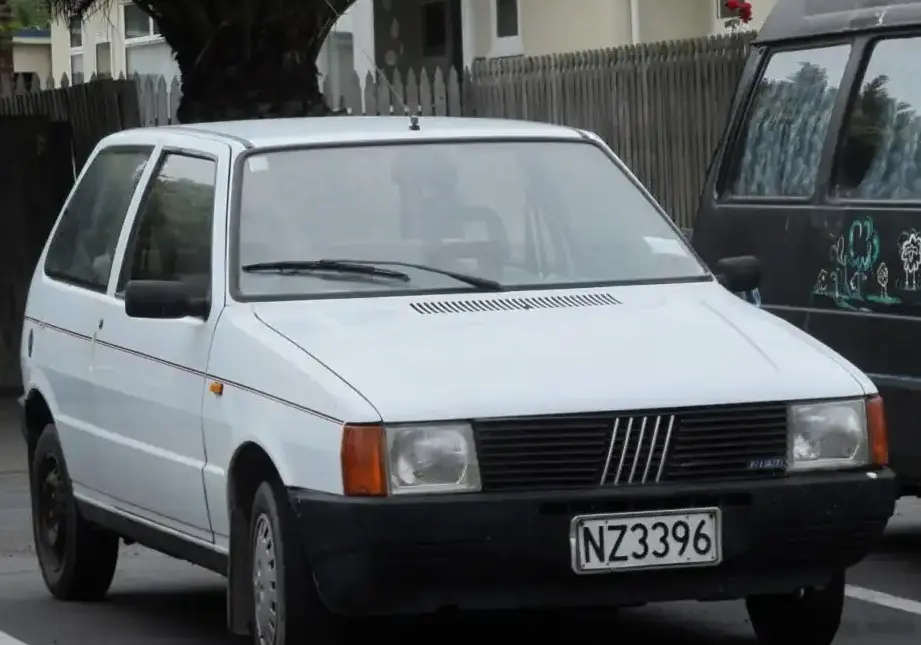
The Fiat UNO (146A) 1.4 i, producing 71 horsepower, was a mainstay of the Fiat lineup from 1995 to 2002. Positioned as an affordable and practical city car, it represented a key offering in the supermini segment, particularly in European and South American markets. The 146A series, launched in 1993, was a significant redesign of the original UNO, offering improved safety, comfort, and styling. The 1.4 i variant, with its relatively modest power output and typically paired with a manual transmission (though an automatic was available in some markets), served as a popular entry point into the UNO range, appealing to budget-conscious buyers and those prioritizing fuel efficiency over outright performance.
Technical Specifications
| Brand | Fiat |
| Model | UNO |
| Generation | UNO (146A) |
| Type (Engine) | 1.4 i (71 Hp) |
| Start of production | 1995 year |
| End of production | 2002 year |
| Powertrain Architecture | Internal Combustion engine |
| Body type | Hatchback |
| Seats | 5 |
| Doors | 3-5 |
| Fuel consumption (urban) | 9.4 l/100 km (25 US mpg, 30.1 UK mpg, 10.6 km/l) |
| Fuel consumption (extra urban) | 5.6 l/100 km (42 US mpg, 50.4 UK mpg, 17.9 km/l) |
| Fuel consumption (combined) | 7.2 l/100 km (32.7 US mpg, 39.2 UK mpg, 13.9 km/l) |
| Fuel Type | Petrol (Gasoline) |
| Acceleration 0 – 100 km/h | 12.4 sec |
| Acceleration 0 – 62 mph | 12.4 sec |
| Acceleration 0 – 60 mph | 11.8 sec |
| Maximum speed | 165 km/h (102.53 mph) |
| Weight-to-power ratio | 11.6 kg/Hp, 86.1 Hp/tonne |
| Weight-to-torque ratio | 7.6 kg/Nm, 130.9 Nm/tonne |
| Power | 71 Hp @ 6000 rpm |
| Power per litre | 51.7 Hp/l |
| Torque | 108 Nm @ 3000 rpm (79.66 lb.-ft. @ 3000 rpm) |
| Engine layout | Front, Transverse |
| Engine Model/Code | 160 A1.048 |
| Engine displacement | 1372 cm3 (83.72 cu. in.) |
| Number of cylinders | 4 |
| Engine configuration | Inline |
| Cylinder Bore | 80.5 mm (3.17 in.) |
| Piston Stroke | 67.4 mm (2.65 in.) |
| Compression ratio | 9.2:1 |
| Number of valves per cylinder | 2 |
| Fuel injection system | Multi-port manifold injection |
| Engine aspiration | Naturally aspirated engine |
| Engine oil capacity | 4.1 l (4.33 US qt | 3.61 UK qt) |
| Coolant capacity | 6 l (6.34 US qt | 5.28 UK qt) |
| Kerb Weight | 825 kg (1818.81 lbs.) |
| Max. weight | 1270 kg (2799.87 lbs.) |
| Max load | 445 kg (981.06 lbs.) |
| Trunk (boot) space – minimum | 270 l (9.53 cu. ft.) |
| Trunk (boot) space – maximum | 970 l (34.26 cu. ft.) |
| Fuel tank capacity | 40 l (10.57 US gal | 8.8 UK gal) |
| Length | 3690 mm (145.28 in.) |
| Width | 1560 mm (61.42 in.) |
| Height | 1420 mm (55.91 in.) |
| Wheelbase | 2360 mm (92.91 in.) |
| Front track | 1340 mm (52.76 in.) |
| Rear (Back) track | 1300 mm (51.18 in.) |
| Minimum turning circle | 9.8 m (32.15 ft.) |
| Drivetrain Architecture | Front wheel drive |
| Number of gears and type of gearbox | 5 gears, manual transmission |
| Front suspension | Coil spring |
| Rear suspension | Coil spring |
| Front brakes | Disc |
| Rear brakes | Drum |
| Steering type | Steering rack and pinion |
| Power steering | Hydraulic Steering |
| Tires size | 155/70 R13 |
Powertrain & Engine Architecture
The heart of the UNO 1.4 i was the 160 A1.048 engine, a naturally aspirated, inline-four cylinder gasoline engine displacing 1372cc. This engine featured a relatively simple design, utilizing a single overhead camshaft (SOHC) operating two valves per cylinder. Fuel delivery was managed by a multi-port fuel injection system, a step up from the carburetor systems found in earlier UNO models. The 9.2:1 compression ratio was typical for the era, balancing performance and fuel efficiency. While not a particularly powerful engine, it was known for its durability and relatively low maintenance requirements. The engine was transversely mounted, driving the front wheels. The five-speed manual transmission was the most common pairing, offering a reasonable spread of gears for city and highway driving. A three-speed automatic transmission was offered in some markets, but it significantly impacted acceleration and fuel economy.
Driving Characteristics
The 71 horsepower and 108 Nm (79.66 lb-ft) of torque produced by the 1.4 i engine translated to modest, but adequate, performance. Acceleration from 0-60 mph took around 11.8 seconds, and top speed was approximately 102.53 mph. The car felt best suited to urban environments, where its nimble handling and compact size were advantageous. The manual transmission allowed for a more engaging driving experience and better control over the engine’s power, while the automatic, though convenient, felt sluggish in comparison. Gear ratios were geared towards fuel economy, meaning the engine often needed to be revved to access its peak power. Compared to higher-spec UNO variants, such as those equipped with the 1.6-liter engine, the 1.4 i felt noticeably slower, particularly when fully loaded or tackling inclines.
Equipment & Trim Levels
The UNO 1.4 i typically came with a fairly basic level of equipment, reflecting its position as an entry-level model. Standard features generally included power steering, central locking, and a basic stereo system. Interior upholstery was typically cloth, and the dashboard featured a simple, functional design. Optional extras included air conditioning, electric windows, and upgraded audio systems. Higher trim levels, such as the “S” variant, added features like alloy wheels, body-colored bumpers, and more comfortable seats. Safety features were limited by the standards of the time, typically consisting of seatbelts and a basic braking system.
Chassis & Braking
The UNO 146A utilized a relatively simple chassis design, featuring coil spring suspension at both the front and rear. The front suspension employed MacPherson struts, while the rear utilized a twist beam setup. This configuration provided a comfortable ride, but handling was not particularly sporty. Braking was typically accomplished with disc brakes at the front and drum brakes at the rear. The braking system was adequate for the car’s weight and performance, but lacked the sophistication of more modern systems. Stabilizer bars were often omitted on base models, further contributing to a less precise handling feel.
Market Reception & Comparison
The Fiat UNO 1.4 i was generally well-received as an affordable and reliable city car. Critics praised its fuel efficiency and practicality, but noted its lack of power and refinement. Compared to other superminis of the era, such as the Peugeot 206 or the Renault Clio, the UNO felt somewhat dated in terms of styling and technology. However, its lower price point made it an attractive option for budget-conscious buyers. The 1.4 i variant offered a better balance of performance and economy than the smaller 1.0-liter engine, but lacked the punch of the 1.6-liter. Reliability was generally good, although the drum brakes on the rear could require more frequent maintenance than disc brakes.
Legacy
The Fiat UNO 1.4 i remains a popular choice among classic car enthusiasts and those seeking an affordable and reliable used car. The 160 A1.048 engine is known for its durability, and parts are generally readily available. While not a particularly exciting car to drive, its simplicity and practicality have ensured its continued relevance. The UNO played a significant role in democratizing car ownership in many countries, and the 1.4 i variant represents a sweet spot in the range, offering a good balance of affordability, fuel efficiency, and usability. Today, well-maintained examples are becoming increasingly collectible, representing a nostalgic reminder of a simpler era in automotive history.

