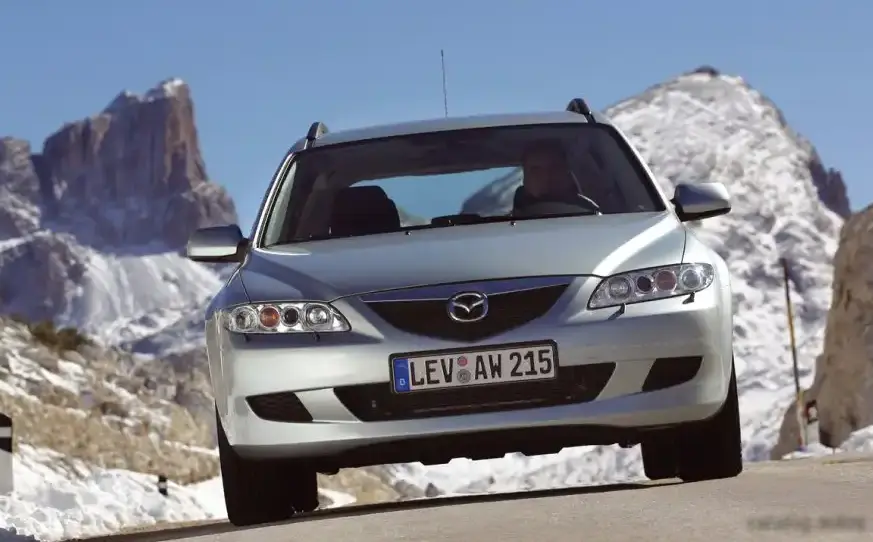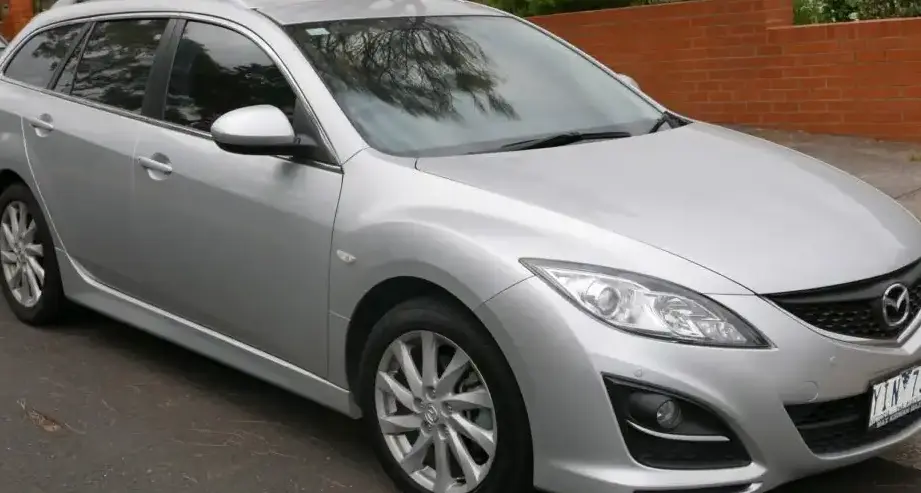
The Mazda 6 II Combi (GH series, post-facelift 2010) 2.2 CD, producing 129 horsepower, represents a significant offering within Mazda’s European and global lineup during its 2010-2012 production run. This variant of the second-generation Mazda 6, a station wagon (estate) body style, was designed to appeal to buyers seeking a balance of practicality, fuel efficiency, and reasonable performance. It occupied a mid-range position within the 6 Combi portfolio, slotting between the lower-powered 2.0-liter gasoline and diesel options and the higher-output 2.5-liter gasoline engine. The facelifted GH series, introduced in 2010, brought revised styling, improved interior materials, and updated technology compared to the original GH generation launched in 2008.
Technical Specifications
| Brand | Mazda |
| Model | 6 |
| Generation | 6 II Combi (GH, facelift 2010) |
| Type (Engine) | 2.2 CD (129 Hp) |
| Start of production | 2010 |
| End of production | 2012 |
| Powertrain Architecture | Internal Combustion engine |
| Body type | Station wagon (estate) |
| Seats | 5 |
| Doors | 5 |
| Fuel consumption (urban) | 6.6 l/100 km (35.6 US mpg, 42.8 UK mpg, 15.2 km/l) |
| Fuel consumption (extra urban) | 4.4 l/100 km (53.5 US mpg, 64.2 UK mpg, 22.7 km/l) |
| Fuel consumption (combined) | 5.2 l/100 km (45.2 US mpg, 54.3 UK mpg, 19.2 km/l) |
| CO2 emissions | 139 g/km |
| Fuel Type | Diesel |
| Acceleration 0 – 100 km/h | 10.9 sec |
| Acceleration 0 – 62 mph | 10.9 sec |
| Acceleration 0 – 60 mph | 10.4 sec |
| Maximum speed | 193 km/h (119.92 mph) |
| Emission standard | Euro 5 |
| Weight-to-power ratio | 11.3 kg/Hp |
| Weight-to-torque ratio | 4.3 kg/Nm |
| Power | 129 Hp @ 3500 rpm |
| Torque | 340 Nm @ 1800 rpm (250.77 lb.-ft. @ 1800 rpm) |
| Engine layout | Front, Transverse |
| Engine displacement | 2183 cm3 (133.21 cu. in.) |
| Number of cylinders | 4 |
| Engine configuration | Inline |
| Cylinder Bore | 86 mm (3.39 in.) |
| Piston Stroke | 94 mm (3.7 in.) |
| Compression ratio | 16.3:1 |
| Number of valves per cylinder | 4 |
| Fuel injection system | Diesel Commonrail |
| Engine aspiration | Turbocharger, Intercooler |
| Valvetrain | DOHC |
| Engine oil capacity | 4.7 l (4.97 US qt | 4.14 UK qt) |
| Coolant capacity | 9 l (9.51 US qt | 7.92 UK qt) |
| Kerb Weight | 1456 kg (3209.93 lbs.) |
| Max. weight | 2135 kg (4706.87 lbs.) |
| Max load | 679 kg (1496.94 lbs.) |
| Trunk (boot) space – minimum | 519 l (18.33 cu. ft.) |
| Trunk (boot) space – maximum | 1751 l (61.84 cu. ft.) |
| Fuel tank capacity | 64 l (16.91 US gal | 14.08 UK gal) |
| Max. roof load | 100 kg (220.46 lbs.) |
| Permitted trailer load with brakes (12%) | 1400 kg (3086.47 lbs.) |
| Length | 4785 mm (188.39 in.) |
| Width | 1795 mm (70.67 in.) |
| Height | 1490 mm (58.66 in.) |
| Wheelbase | 2725 mm (107.28 in.) |
| Front track | 1550-1570 mm (61.02 – 61.81 in.) |
| Rear track | 1550-1570 mm (61.02 – 61.81 in.) |
| Ride height (ground clearance) | 165 mm (6.5 in.) |
| Minimum turning circle | 11.8 m (38.71 ft.) |
| Drivetrain | Front wheel drive |
| Number of gears | 6 |
| Gearbox type | Manual transmission |
| Front suspension | Double wishbone, Transverse stabilizer |
| Rear suspension | Independent multi-link suspension, Transverse stabilizer |
| Front brakes | Ventilated discs, 299 mm |
| Rear brakes | Disc, 280 mm |
| Assisting systems | ABS (Anti-lock braking system) |
| Steering type | Steering rack and pinion |
| Power steering | Electric Steering |
| Tires size | 205/60 R16; 215/50 R17; 225/45 R18 |
| Wheel rims size | 6.5J x 16; 7J x 17; 7.5J x 18 |
Powertrain & Engine Architecture
The heart of this Mazda 6 variant is the 2.2-liter four-cylinder diesel engine, typically identified by engine codes such as SHHP. This engine is a common-rail direct injection (CDI) diesel, utilizing a high-pressure fuel system for optimized combustion. The engine features a turbocharger with an intercooler to enhance power output and efficiency. The DOHC (Double Overhead Camshaft) valvetrain, with four valves per cylinder, contributes to improved breathing and overall engine performance. The 16.3:1 compression ratio is typical for a diesel engine, maximizing thermal efficiency. The engine’s design prioritized torque delivery at lower RPMs, making it well-suited for everyday driving and hauling loads. The 6-speed manual transmission was the standard offering, providing a good balance between fuel economy and driver control.
Driving Characteristics
The 129 hp 2.2 CD with a manual transmission in the Mazda 6 Combi offered a practical and reasonably engaging driving experience. Acceleration from 0-60 mph took around 10.4 seconds, which was adequate for most driving situations but not particularly sporty. The engine’s strong low-end torque (340 Nm or 250 lb-ft) made it easy to navigate city streets and maintain comfortable cruising speeds on the highway. Compared to the higher-output gasoline engines, the diesel offered significantly better fuel economy, but lacked the same level of responsiveness. The manual gearbox was well-matched to the engine’s characteristics, with gear ratios designed to maximize fuel efficiency and provide sufficient power for overtaking maneuvers. The driving experience was generally comfortable, thanks to the well-tuned suspension, but the added weight of the diesel engine and the front-wheel-drive configuration could result in some understeer during spirited cornering.
Equipment & Trim Levels
The 2.2 CD variant of the Mazda 6 Combi typically came equipped with a respectable level of standard features. These included air conditioning, power windows and mirrors, a CD/MP3 stereo system, and ABS brakes. Higher trim levels, such as the ‘Sport’ or ‘Luxury’ models, added features like alloy wheels, a sunroof, leather upholstery, automatic climate control, and a more advanced audio system. Optional extras included navigation systems, parking sensors, and xenon headlights. Interior upholstery was typically cloth on the base models, with leather options available on higher trims. The dashboard layout was functional and well-designed, with a focus on ergonomics and ease of use.
Chassis & Braking
The Mazda 6 Combi featured a front-wheel-drive layout with a MacPherson strut front suspension and a multi-link rear suspension. This suspension setup provided a good balance between ride comfort and handling. The front suspension incorporated a transverse stabilizer bar to reduce body roll. Braking duties were handled by ventilated discs at the front and solid discs at the rear, with ABS (Anti-lock Braking System) as standard. The braking system was generally effective, providing adequate stopping power for everyday driving. The chassis was designed to provide a stable and predictable driving experience, with a focus on safety and comfort.
Market Reception & Comparison
The Mazda 6 II Combi 2.2 CD was generally well-received by automotive critics. It was praised for its fuel efficiency, spacious interior, and comfortable ride. However, some critics noted that the engine could be somewhat noisy and lacked the refinement of some of its competitors. Compared to other trims in the Mazda 6 lineup, the 2.2 CD offered a compelling value proposition for buyers prioritizing fuel economy and practicality. It was a popular choice for families and individuals who frequently traveled long distances. Against competitors like the Ford Mondeo, Volkswagen Passat, and Opel/Vauxhall Insignia, the Mazda 6 Combi 2.2 CD held its own, offering a distinctive blend of style, performance, and value.
Legacy
The Mazda 6 II Combi 2.2 CD has proven to be a relatively reliable powertrain in the long term. The 2.2-liter diesel engine is known for its durability, provided it is properly maintained. Common issues include diesel particulate filter (DPF) clogging, particularly on vehicles that are primarily used for short trips. Regular servicing, including oil changes and DPF regeneration, is essential to ensure the longevity of the engine. In the used car market, this variant of the Mazda 6 Combi remains a popular choice, offering a good balance of practicality, fuel efficiency, and affordability. Its reputation for reliability and its spacious interior make it a compelling option for buyers seeking a versatile and dependable station wagon.