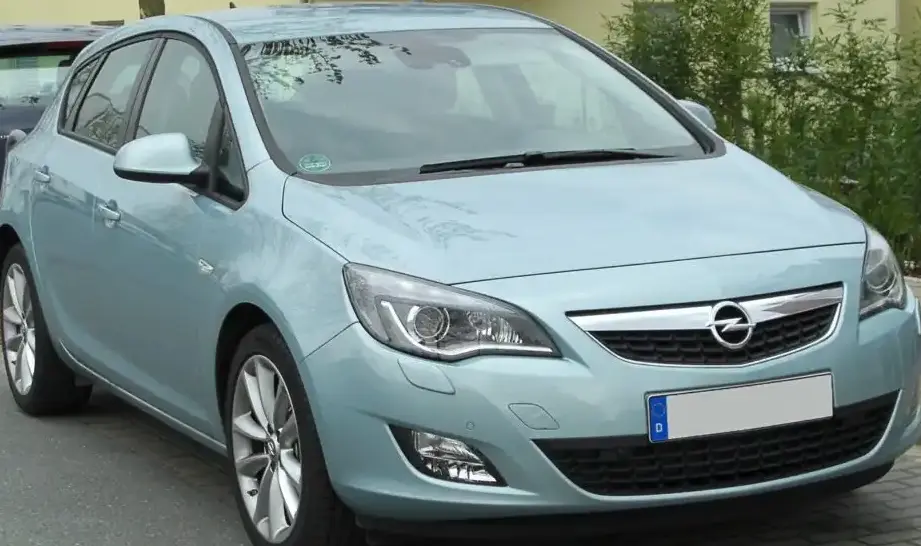
The Opel Astra J 1.6 Turbo, producing 180 horsepower, was a significant variant within the Astra J generation (2009-2015), representing a performance-oriented option in the compact hatchback segment. Introduced as part of the J series, which utilized the General Motors Delta II platform, this model aimed to bridge the gap between the more economical base engines and the higher-performance OPC (Vauxhall/Opel Performance Centre) version. Production of this specific configuration ran from 2009 to 2012, establishing itself as a popular choice for drivers seeking a balance of efficiency and spirited driving.
Technical Specifications
| Brand | Opel |
| Model | Astra |
| Generation | Astra J |
| Type (Engine) | 1.6 Turbo (180 Hp) |
| Start of production | 2009 |
| End of production | 2012 |
| Powertrain Architecture | Internal Combustion engine |
| Body type | Hatchback |
| Seats | 5 |
| Doors | 5 |
| Fuel consumption (urban) | 8.9 l/100 km (26.4 US mpg) |
| Fuel consumption (extra urban) | 5.6 l/100 km (42 US mpg) |
| Fuel consumption (combined) | 6.8 l/100 km (34.6 US mpg) |
| CO2 emissions | 160 g/km |
| Fuel Type | Petrol (Gasoline) |
| Acceleration 0 – 100 km/h | 8.3 sec |
| Acceleration 0 – 62 mph | 8.3 sec |
| Acceleration 0 – 60 mph | 7.9 sec |
| Maximum speed | 220 km/h (136.7 mph) |
| Emission standard | Euro 5 |
| Weight-to-power ratio | 7.2 kg/Hp |
| Weight-to-torque ratio | 5.6 kg/Nm |
| Power | 180 Hp @ 5500 rpm |
| Torque | 230 Nm @ 2200-5400 rpm (169.64 lb.-ft.) |
| Engine layout | Front, Transverse |
| Engine Model/Code | A16LET |
| Engine displacement | 1598 cm3 (97.52 cu. in.) |
| Number of cylinders | 4 |
| Engine configuration | Inline |
| Cylinder Bore | 79 mm (3.11 in.) |
| Piston Stroke | 81.5 mm (3.21 in.) |
| Compression ratio | 8.8:1 |
| Number of valves per cylinder | 4 |
| Fuel injection system | Multi-port manifold injection |
| Engine aspiration | Turbocharger, Intercooler |
| Engine oil capacity | 4.5 l (4.76 US qt | 3.96 UK qt) |
| Coolant | 5.6 l (5.92 US qt | 4.93 UK qt) |
| Kerb Weight | 1298 kg (2861.6 lbs.) |
| Max. weight | 1870 kg (4122.64 lbs.) |
| Max load | 572 kg (1261.04 lbs.) |
| Trunk (boot) space – minimum | 370 l (13.07 cu. ft.) |
| Trunk (boot) space – maximum | 1235 l (43.61 cu. ft.) |
| Fuel tank capacity | 56 l (14.79 US gal | 12.32 UK gal) |
| Length | 4419 mm (173.98 in.) |
| Width | 1814 mm (71.42 in.) |
| Width including mirrors | 2013 mm (79.25 in.) |
| Height | 1510 mm (59.45 in.) |
| Wheelbase | 2685 mm (105.71 in.) |
| Front track | 1541 mm (60.67 in.) |
| Rear (Back) track | 1551 mm (61.06 in.) |
| Ride height (ground clearance) | 160 mm (6.3 in.) |
| Drag coefficient (Cd) | 0.31 |
| Minimum turning circle | 11.4 m (37.4 ft.) |
| Drivetrain Architecture | Front wheel drive |
| Number of gears | 6 |
| Type of gearbox | Manual transmission |
| Front brakes | Ventilated discs |
| Rear brakes | Disc |
| Tires size | 225/50 R17 |
| Wheel rims size | 17 |
Introduction
The Astra J 1.6 Turbo represented a sweet spot in the Astra J lineup for many European buyers. It offered a noticeable performance upgrade over the base 1.4-liter engines, without the higher running costs and insurance premiums associated with the more powerful OPC model. Positioned as a mid-range offering, it appealed to drivers who desired a responsive and enjoyable driving experience for daily commutes and occasional longer journeys. The Astra J itself was a crucial model for Opel, aiming to modernize the brand’s image and compete effectively with rivals like the Volkswagen Golf, Ford Focus, and Peugeot 308.
Powertrain & Engine Architecture
At the heart of the Astra J 1.6 Turbo lies the A16LET engine, a 1.6-liter inline-four cylinder gasoline engine equipped with a turbocharger and intercooler. This engine is part of Opel’s ‘Family 1’ engine family. The A16LET utilizes multi-point fuel injection and a single overhead camshaft (SOHC) valvetrain with four valves per cylinder. The turbocharger, a key component, provides a significant boost in power and torque compared to naturally aspirated engines of similar displacement. The engine’s electronic control unit (ECU) carefully manages fuel delivery, ignition timing, and turbo boost to optimize performance and efficiency. The 180 horsepower output is achieved at 5500 rpm, while the peak torque of 230 Nm (169.64 lb-ft) is available from 2200 to 5400 rpm, providing a broad and usable powerband. This engine was paired with a six-speed manual transmission, offering precise gear changes and enhancing driver engagement.
Driving Characteristics
The Astra J 1.6 Turbo delivered a noticeably more engaging driving experience than its lower-powered siblings. The turbocharger provides a surge of power during acceleration, making overtaking maneuvers and merging onto highways effortless. While not a sports car, the 180 hp engine provided brisk acceleration, achieving 0-60 mph in around 7.9 seconds. The six-speed manual transmission allowed drivers to keep the engine in its optimal powerband, maximizing performance. The gear ratios were well-chosen, providing a balance between acceleration and fuel efficiency. Compared to the base 1.4-liter models, the 1.6 Turbo felt significantly more responsive and capable. However, it didn’t quite match the raw power and sharper handling of the OPC version.
Equipment & Trim Levels
The Astra J 1.6 Turbo was typically offered in several trim levels, including Essentia, Sport, and Cosmo. Standard equipment often included air conditioning, power windows, central locking, and a basic audio system. Higher trim levels, such as the Cosmo, added features like alloy wheels, a more advanced infotainment system, automatic climate control, and parking sensors. Optional extras included a panoramic sunroof, leather upholstery, and a navigation system. Interior upholstery was typically cloth on the lower trims, with leather options available on higher-spec models. The dashboard layout was modern and functional, with a focus on ergonomics and ease of use.
Chassis & Braking
The Astra J 1.6 Turbo utilized a MacPherson strut front suspension and a torsion beam rear suspension. This setup provided a good balance between ride comfort and handling. The chassis was relatively lightweight, contributing to the car’s agility. The braking system consisted of ventilated discs on the front wheels and solid discs on the rear wheels. Anti-lock Braking System (ABS) was standard, enhancing safety and control during emergency braking. The steering was precise and responsive, providing good feedback to the driver. Stabilizer bars were fitted to both the front and rear axles to reduce body roll during cornering.
Market Reception & Comparison
The Astra J 1.6 Turbo was generally well-received by automotive critics. It was praised for its responsive engine, comfortable ride, and well-equipped interior. Fuel economy was also a strong point, with combined fuel consumption figures around 34.6 US mpg. Compared to rivals like the Volkswagen Golf 1.4 TSI, the Astra J 1.6 Turbo offered a similar level of performance and efficiency, often at a slightly lower price point. However, some critics noted that the interior materials weren’t quite as premium as those found in the Golf. Reliability was generally good, although some owners reported minor issues with the turbocharger and fuel injection system.
Legacy
The Opel Astra J 1.6 Turbo remains a popular choice in the used car market today. The A16LET engine is known for its durability and relatively low maintenance costs, provided it has been properly maintained. Parts availability is generally good, and the car’s relatively simple mechanical design makes it accessible for DIY repairs. While not a collector’s item, the Astra J 1.6 Turbo represents a solid and reliable compact hatchback that offers a good balance of performance, efficiency, and practicality. Its enduring appeal lies in its ability to provide an enjoyable driving experience without breaking the bank.