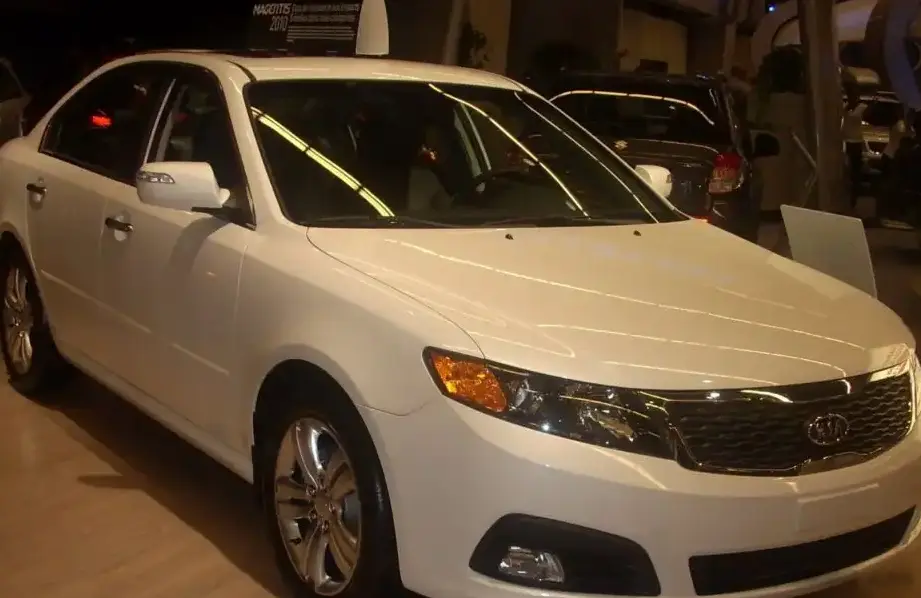
The Kia Magentis, known as the Kia Optima in some markets, represented a significant step forward for the Korean automaker in the mid-size sedan segment. Introduced in 2000, the first generation Magentis (designated the Magentis I) aimed to offer a compelling blend of value, features, and styling. Production of this initial iteration continued through 2005. The 2.0-liter, 136 horsepower automatic variant occupied a central position in the Magentis lineup, offering a balance between performance and affordability, targeting buyers seeking a comfortable and practical family sedan. It was positioned above the base 1.8L models and below the more powerful 2.5L V6 options.
Technical Specifications
| Brand | Kia |
| Model | Magentis |
| Generation | Magentis I |
| Type (Engine) | 2.0 (136 Hp) Automatic |
| Start of production | 2000 year |
| End of production | 2005 year |
| Powertrain Architecture | Internal Combustion engine |
| Body type | Sedan |
| Seats | 5 |
| Doors | 4 |
| Fuel consumption (economy) – urban | 13.1 l/100 km (18 US mpg, 21.6 UK mpg, 7.6 km/l) |
| Fuel consumption (economy) – extra urban | 7.1 l/100 km (33.1 US mpg, 39.8 UK mpg, 14.1 km/l) |
| Fuel consumption (economy) – combined | 9.3 l/100 km (25.3 US mpg, 30.4 UK mpg, 10.8 km/l) |
| CO2 emissions | 216 g/km |
| Fuel Type | Petrol (Gasoline) |
| Acceleration 0 – 100 km/h | 11.9 sec |
| Acceleration 0 – 62 mph | 11.9 sec |
| Acceleration 0 – 60 mph | 11.3 sec |
| Maximum speed | 195 km/h (121.17 mph) |
| Emission standard | Euro 3 |
| Weight-to-power ratio | 11 kg/Hp, 91.3 Hp/tonne |
| Weight-to-torque ratio | 8.3 kg/Nm, 120.8 Nm/tonne |
| Power | 136 Hp @ 5500 rpm |
| Power per litre | 68.1 Hp/l |
| Torque | 180 Nm @ 4500 rpm (132.76 lb.-ft. @ 4500 rpm) |
| Engine layout | Front, Transverse |
| Engine Model/Code | Sirius II / G4JP |
| Engine displacement | 1997 cm3 (121.86 cu. in.) |
| Number of cylinders | 4 |
| Engine configuration | Inline |
| Cylinder Bore | 85 mm (3.35 in.) |
| Piston Stroke | 88 mm (3.46 in.) |
| Compression ratio | 10:1 |
| Number of valves per cylinder | 4 |
| Fuel injection system | Multi-port manifold injection |
| Engine aspiration | Naturally aspirated engine |
| Valvetrain | DOHC |
| Engine oil capacity | 4.3 l (4.54 US qt | 3.78 UK qt) |
| Coolant | 5.5 l (5.81 US qt | 4.84 UK qt) |
| Kerb Weight | 1490 kg (3284.89 lbs.) |
| Max. weight | 1985 kg (4376.18 lbs.) |
| Max load | 495 kg (1091.29 lbs.) |
| Trunk (boot) space – minimum | 479 l (16.92 cu. ft.) |
| Trunk (boot) space – maximum | 810 l (28.6 cu. ft.) |
| Fuel tank capacity | 65 l (17.17 US gal | 14.3 UK gal) |
| Max. roof load | 100 kg (220.46 lbs.) |
| Permitted trailer load with brakes (12%) | 1700 kg (3747.86 lbs.) |
| Permitted trailer load without brakes | 750 kg (1653.47 lbs.) |
| Length | 4730 mm (186.22 in.) |
| Width | 1820 mm (71.65 in.) |
| Height | 1410 mm (55.51 in.) |
| Wheelbase | 2700 mm (106.3 in.) |
| Front track | 1540 mm (60.63 in.) |
| Rear (Back) track | 1520 mm (59.84 in.) |
| Minimum turning circle (turning diameter) | 11.60 m (38.06 ft.) |
| Drivetrain Architecture | The Internal combustion engine (ICE) drives the front wheels of the vehicle. |
| Drive wheel | Front wheel drive |
| Number of gears and type of gearbox | 4 gears, automatic transmission |
| Front suspension | Double wishbone |
| Rear suspension | Independent multi-link suspension |
| Front brakes | Ventilated discs |
| Rear brakes | Disc |
| Assisting systems | ABS (Anti-lock braking system) |
| Steering type | Steering rack and pinion |
| Power steering | Hydraulic Steering |
| Tires size | 205/60 R15 |
| Wheel rims size | 15 |
Powertrain & Engine Architecture
The heart of the Magentis 2.0 Automatic is the Kia Sirius II engine, internally designated G4JP. This 1.997-liter inline-four cylinder engine utilizes a naturally aspirated configuration and a multi-port fuel injection system. The engine produces 136 horsepower at 5500 rpm and 180 Nm (132.76 lb-ft) of torque at 4500 rpm. It features a double overhead camshaft (DOHC) valvetrain with four valves per cylinder, contributing to its relatively efficient operation. The engine’s 10:1 compression ratio strikes a balance between power and fuel economy. Paired with this engine is a four-speed automatic transmission, a common choice for this class of vehicle at the time. This transmission was designed for smooth shifts and ease of use, prioritizing comfort over outright performance.
Driving Characteristics
The 2.0-liter automatic Magentis offered a comfortable, if not particularly sporty, driving experience. Acceleration from 0-60 mph took around 11.3 seconds, and top speed was rated at 195 km/h (121.17 mph). The four-speed automatic transmission, while providing smooth shifts, lacked the responsiveness of a manual gearbox or more modern automatic transmissions with additional gears. Power delivery was adequate for everyday driving, but overtaking maneuvers required careful planning. Compared to the base 1.8L models, the 2.0L offered noticeably more power, making it better suited for highway driving and carrying a full load of passengers. However, it didn’t possess the punch of the optional 2.5L V6 engine. The gear ratios were tuned for fuel efficiency and cruising comfort, rather than aggressive acceleration.
Equipment & Trim Levels
The 2.0-liter automatic Magentis typically came standard with features such as air conditioning, power windows and locks, and an AM/FM radio with a cassette player. Higher trim levels offered upgrades like alloy wheels, a sunroof, and upgraded interior upholstery. Interior materials were generally durable but not luxurious. Optional extras included a CD player, cruise control, and a more advanced sound system. The dashboard layout was functional and straightforward, prioritizing ease of use over aesthetic flair.
Chassis & Braking
The Magentis I utilized a front-wheel-drive layout with a double wishbone suspension in the front and an independent multi-link suspension in the rear. This suspension setup aimed to provide a comfortable ride while maintaining reasonable handling characteristics. Braking duties were handled by ventilated discs in the front and solid discs in the rear. An Anti-lock Braking System (ABS) was standard, enhancing safety. The steering was rack and pinion with hydraulic power assistance, providing a reasonably light and responsive feel.
Market Reception & Comparison
The Kia Magentis 2.0 Automatic was generally well-received by critics as a value-oriented option in the mid-size sedan segment. It offered a good level of equipment for its price, and the 2.0-liter engine provided adequate performance for most drivers. Fuel economy was average for its class, with combined figures around 9.3 l/100 km (25.3 US mpg). Compared to competitors like the Honda Accord and Toyota Camry, the Magentis lacked the refinement and brand recognition of those established players. However, it offered a more affordable alternative. Compared to the 1.8L Magentis, the 2.0L offered a noticeable performance improvement, while the 2.5L V6 provided significantly more power but at the cost of increased fuel consumption.
Legacy
The Kia Magentis I, particularly the 2.0-liter automatic variant, has proven to be a relatively reliable vehicle in the used car market. The Sirius II engine is known for its durability, and the four-speed automatic transmission, while not cutting-edge, is generally dependable. Common issues include wear and tear on suspension components and potential for oil leaks as the vehicle ages. Today, these vehicles are often found as affordable transportation options, appreciated for their practicality and low running costs. While not a collector’s item, the Magentis I represents an important milestone in Kia’s evolution as a global automaker, demonstrating the brand’s commitment to offering competitive vehicles at accessible price points.