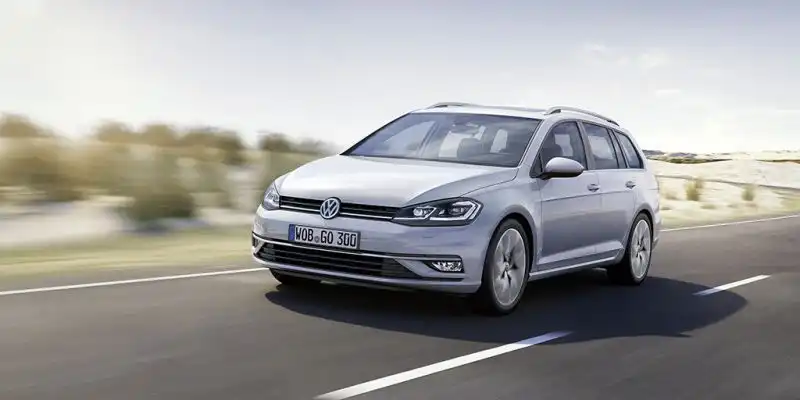
The Volkswagen Golf VII Variant 1.4 TSI (125 hp) represents a compelling blend of practicality and efficiency within the seventh generation Golf lineup. Introduced with the 2017 facelift, this variant – a station wagon (estate) body style – aimed to provide a versatile option for families and individuals needing increased cargo capacity without sacrificing the Golf’s renowned driving experience. Production continued through March 2018, positioning it as a mid-cycle offering within the broader Golf VII range, built on the Volkswagen Group’s MQB platform (A7 iteration). This specific engine and transmission combination occupied a middle ground in the Golf VII Variant lineup, offering a balance between performance, fuel economy, and price.
Technical Specifications
| Brand | Volkswagen |
| Model | Golf |
| Generation | Golf VII Variant (facelift 2017) |
| Type (Engine) | 1.4 TSI (125 Hp) |
| Start of production | 2017 |
| End of production | March, 2018 |
| Powertrain Architecture | Internal Combustion engine |
| Body type | Station wagon (estate) |
| Seats | 5 |
| Doors | 5 |
| Fuel consumption (urban) | 6.9-7.0 l/100 km (34.1 – 33.6 US mpg, 40.9 – 40.4 UK mpg, 14.5 – 14.3 km/l) |
| Fuel consumption (extra urban) | 4.4-4.5 l/100 km (53.5 – 52.3 US mpg, 64.2 – 62.8 UK mpg, 22.7 – 22.2 km/l) |
| Fuel consumption (combined) | 5.3-5.4 l/100 km (44.4 – 43.6 US mpg, 53.3 – 52.3 UK mpg, 18.9 – 18.5 km/l) |
| CO2 emissions | 123-125 g/km |
| Fuel Type | Petrol (Gasoline) |
| Acceleration 0 – 100 km/h | 9.5 sec |
| Acceleration 0 – 62 mph | 9.5 sec |
| Acceleration 0 – 60 mph | 9 sec (Calculated) |
| Maximum speed | 205 km/h (127.38 mph) |
| Emission standard | Euro 6 |
| Weight-to-power ratio | 9.9 kg/Hp, 100.7 Hp/tonne |
| Weight-to-torque ratio | 6.2 kg/Nm, 161.2 Nm/tonne |
| Power | 125 Hp @ 5000-6000 rpm |
| Power per litre | 89.6 Hp/l |
| Torque | 200 Nm @ 1400-4000 rpm (147.51 lb.-ft. @ 1400-4000 rpm) |
| Engine layout | Front, Transverse |
| Engine Model/Code | CZCA |
| Engine displacement | 1395 cm3 (85.13 cu. in.) |
| Number of cylinders | 4 |
| Engine configuration | Inline |
| Number of valves per cylinder | 4 |
| Fuel injection system | Direct injection |
| Engine aspiration | Turbocharger, Intercooler |
| Engine oil capacity | 4 l (4.23 US qt | 3.52 UK qt) |
| Kerb Weight | 1241 kg (2735.94 lbs.) |
| Max. weight | 1850 kg (4078.55 lbs.) |
| Max load | 609 kg (1342.62 lbs.) |
| Trunk (boot) space – minimum | 605 l (21.37 cu. ft.) |
| Trunk (boot) space – maximum | 1620 l (57.21 cu. ft.) |
| Fuel tank capacity | 50 l (13.21 US gal | 11 UK gal) |
| Max. roof load | 75 kg (165.35 lbs.) |
| Permitted trailer load with brakes (8%) | 1700 kg (3747.86 lbs.) |
| Permitted trailer load with brakes (12%) | 1400 kg (3086.47 lbs.) |
| Permitted trailer load without brakes | 680 kg (1499.14 lbs.) |
| Permitted towbar download | 80 kg (176.37 lbs.) |
| Length | 4567 mm (179.8 in.) |
| Width | 1799 mm (70.83 in.) |
| Width including mirrors | 2027 mm (79.8 in.) |
| Height | 1515 mm (59.65 in.) |
| Wheelbase | 2620 mm (103.15 in.) |
| Front track | 1549 mm (60.98 in.) |
| Rear (Back) track | 1520 mm (59.84 in.) |
| Ride height (ground clearance) | 140 mm (5.51 in.) |
| Minimum turning circle | 10.9 m (35.76 ft.) |
| Drivetrain Architecture | Front wheel drive |
| Number of gears and type of gearbox | 6 gears, manual transmission |
| Front brakes | Ventilated discs |
| Rear brakes | Disc |
| Assisting systems | ABS (Anti-lock braking system) |
| Steering type | Steering rack and pinion |
| Power steering | Electric Steering |
| Tires size | 205/55 R16 |
| Wheel rims size | 6.5 J x 16 |
INTRODUCTION
The Golf VII Variant 1.4 TSI (125 hp) arrived as part of the facelifted seventh-generation Golf range in 2017. The Golf VII, launched in 2012, had already proven a massive success, building on the Golf’s reputation for quality, practicality, and driving enjoyment. The facelift brought subtle styling revisions, upgraded infotainment systems, and importantly, revised engine options. The Variant (estate) body style offered 605 liters of boot space (expanding to 1620 liters with the rear seats folded), making it a popular choice for families and those requiring additional cargo room. This 1.4 TSI 125 hp variant was positioned as a mainstream offering, appealing to buyers seeking a balance between fuel efficiency and reasonable performance. It sat below the more powerful 1.8 TSI and diesel options in the lineup.
Powertrain & Engine Architecture
At the heart of the Golf VII Variant 1.4 TSI (125 hp) lies the Volkswagen Group’s CZCA engine code. This 1.4-liter, inline-four cylinder engine utilizes direct fuel injection and a turbocharger with an intercooler to deliver a respectable 125 horsepower at 5000-6000 rpm and 200 Nm (147.51 lb.-ft.) of torque between 1400-4000 rpm. The engine employs a timing chain for durability. The direct injection system precisely meters fuel into the combustion chambers, optimizing combustion efficiency and reducing emissions. The turbocharger provides a boost in power, compensating for the relatively small displacement. This particular variant was typically paired with a six-speed manual transmission, although a seven-speed dual-clutch DSG automatic was also available as an option. The engine’s layout is front-transverse, meaning it’s mounted sideways in the engine bay and drives the front wheels.
Driving Characteristics
The 1.4 TSI (125 hp) Golf VII Variant offered a comfortable and refined driving experience. While not overtly sporty, it provided sufficient power for everyday driving and highway cruising. Acceleration from 0-100 km/h (0-62 mph) took around 9.5 seconds. The turbocharger provides a noticeable boost in power during acceleration, but it’s not as dramatic as in the higher-output TSI engines. The six-speed manual transmission offered precise shifts, while the optional DSG automatic provided smooth and quick gear changes. Compared to the more powerful 1.8 TSI, the 1.4 TSI felt less eager to rev and required more downshifting when overtaking. However, the 1.4 TSI’s lighter weight and lower power output resulted in slightly better fuel economy. The suspension provided a good balance between comfort and handling, absorbing bumps and imperfections in the road while maintaining a stable and controlled feel.
Equipment & Trim Levels
The Golf VII Variant 1.4 TSI (125 hp) typically came equipped with a respectable level of standard features. These included air conditioning, power windows, power mirrors, a touchscreen infotainment system with Bluetooth connectivity, and alloy wheels. Higher trim levels offered additional features such as automatic climate control, a larger touchscreen display, navigation system, parking sensors, and adaptive cruise control. Interior upholstery was typically cloth, with leather options available as an upgrade. Dashboard configuration was consistent across the range, featuring a clean and modern design. Optional extras included a panoramic sunroof, upgraded sound system, and various driver assistance systems.
Chassis & Braking
The Golf VII Variant’s chassis featured independent suspension at the front (MacPherson strut) and a multi-link rear suspension, providing a comfortable ride and good handling characteristics. The braking system consisted of ventilated discs at the front and solid discs at the rear. Anti-lock Braking System (ABS) was standard, enhancing braking performance and stability. The steering system was a rack-and-pinion type with electric power assistance, providing precise and responsive steering feel. The 1.4 TSI variant, due to its lower weight, often featured slightly smaller brake rotors compared to the higher-performance models.
Market Reception & Comparison
The Golf VII Variant 1.4 TSI (125 hp) was generally well-received by automotive critics. It was praised for its practicality, fuel efficiency, and comfortable ride. However, some critics noted that the engine could feel underpowered when fully loaded or when tackling steep hills. Compared to the 1.8 TSI variant, the 1.4 TSI offered better fuel economy but less performance. The 1.8 TSI was favored by drivers seeking a more engaging driving experience. The diesel variants (like the 1.6 TDI and 2.0 TDI) offered even better fuel economy but came with a higher purchase price and potential concerns about diesel emissions.
Legacy
The Volkswagen Golf VII Variant 1.4 TSI (125 hp) has proven to be a reliable and durable vehicle. The CZCA engine, while not without its minor issues (such as potential carbon buildup on the intake valves), is generally considered to be a robust and long-lasting unit. In the used car market, these models represent a good value proposition, offering a practical and efficient option for buyers seeking a versatile station wagon. Regular maintenance, including oil changes and timely servicing, is crucial to ensure the longevity of the engine and other components. The Golf VII Variant continues to be a popular choice among used car buyers, thanks to its reputation for quality, reliability, and practicality.