Technical Specifications
| Brand | Citroen |
| Model | Jumpy |
| Generation | Jumpy II Multispace |
| Type | 2.0 16V (140 Hp) L1 9 Seat |
| Start of production | 2007 |
| End of production | 2010 |
| Powertrain Architecture | Internal Combustion engine |
| Body type | Minivan |
| Seats | 8-9 |
| Doors | 4 |
| Fuel consumption (urban) | 13.3 l/100 km (17.7 US mpg, 21.2 UK mpg, 7.5 km/l) |
| Fuel consumption (extra urban) | 8.2 l/100 km (28.7 US mpg, 34.4 UK mpg, 12.2 km/l) |
| Fuel consumption (combined) | 10.1 l/100 km (23.3 US mpg, 28 UK mpg, 9.9 km/l) |
| CO2 emissions | 241 g/km |
| Fuel Type | Petrol (Gasoline) |
| Acceleration 0 – 100 km/h | 13.4 sec |
| Acceleration 0 – 62 mph | 13.4 sec |
| Acceleration 0 – 60 mph | 12.7 sec |
| Maximum speed | 165 km/h (102.53 mph) |
| Emission standard | Euro 4 |
| Weight-to-power ratio | 12.9 kg/Hp, 77.3 Hp/tonne |
| Weight-to-torque ratio | 10.1 kg/Nm, 99.4 Nm/tonne |
| Power | 140 Hp @ 6000 rpm |
| Power per litre | 70.1 Hp/l |
| Torque | 180 Nm @ 2500 rpm (132.76 lb.-ft. @ 2500 rpm) |
| Engine layout | Front, Transverse |
| Engine Model/Code | RFH EW10A |
| Engine displacement | 1997 cm3 (121.86 cu. in.) |
| Number of cylinders | 4 |
| Engine configuration | Inline |
| Cylinder Bore | 85 mm (3.35 in.) |
| Piston Stroke | 88 mm (3.46 in.) |
| Number of valves per cylinder | 4 |
| Fuel injection system | Multi-port manifold injection |
| Engine aspiration | Naturally aspirated engine |
| Engine oil capacity | 5 l (5.28 US qt | 4.4 UK qt) |
| Kerb Weight | 1811 kg (3992.57 lbs.) |
| Max. weight | 2672 kg (5890.75 lbs.) |
| Max load | 861 kg (1898.18 lbs.) |
| Trunk (boot) space – minimum | 327 l (11.55 cu. ft.) |
| Trunk (boot) space – maximum | 3473 l (122.65 cu. ft.) |
| Fuel tank capacity | 80 l (21.13 US gal | 17.6 UK gal) |
| Max. roof load | 170 kg (374.79 lbs.) |
| Permitted trailer load with brakes (12%) | 2000 kg (4409.25 lbs.) |
| Permitted trailer load without brakes | 750 kg (1653.47 lbs.) |
| Permitted towbar download | 80 kg (176.37 lbs.) |
| Length | 4805 mm (189.17 in.) |
| Width | 1895 mm (74.61 in.) |
| Width with mirrors folded | 1986 mm (78.19 in.) |
| Width including mirrors | 2194 mm (86.38 in.) |
| Height | 1880 mm (74.02 in.) |
| Wheelbase | 3000 mm (118.11 in.) |
| Front track | 1562 mm (61.5 in.) |
| Rear (Back) track | 1596 mm (62.83 in.) |
| Front overhang | 975 mm (38.39 in.) |
| Rear overhang | 830 mm (32.68 in.) |
| Minimum turning circle | 12.2 m (40.03 ft.) |
| Drivetrain | Front wheel drive |
| Number of gears and type of gearbox | 5 gears, manual transmission |
| Front suspension | Independent, type McPherson with coil spring and anti-roll bar |
| Rear suspension | Semi-dependent beam with stabilizer lateral stability |
| Front brakes | Ventilated discs |
| Rear brakes | Disc |
| Assisting systems | ABS (Anti-lock braking system) |
| Steering type | Steering rack and pinion |
| Tires size | 215/60 R16 |
| Wheel rims size | 16 |
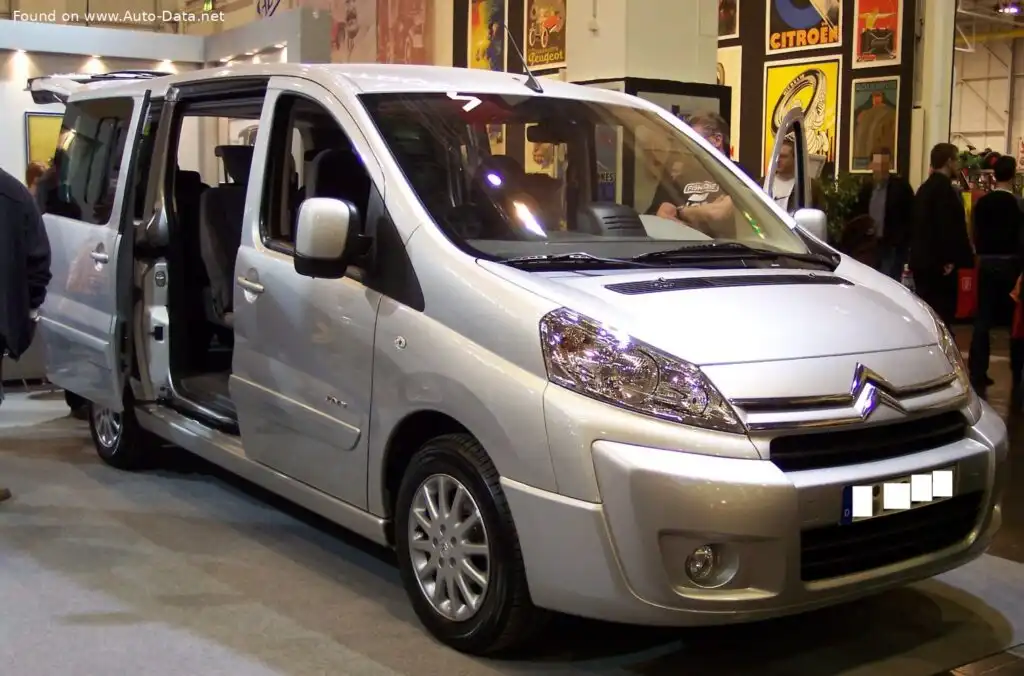
The Citroen Jumpy II Multispace 2.0 16V (140 hp) L1 9-Seat, produced between 2007 and 2010, was a versatile offering within the second generation of Citroen’s popular Jumpy line. Positioned as a mid-range trim within the Multispace variant – Citroen’s passenger-focused version of the Jumpy van – this configuration aimed to balance practicality, passenger capacity, and reasonable performance for family and shuttle service applications. It was primarily marketed in Europe, where multi-passenger vehicles of this type are common, offering a spacious alternative to larger MPVs or multiple standard cars. The Jumpy II, built on the PSA Peugeot Citroën EMP1 platform (shared with the Peugeot Expert and Fiat Scudo), provided a robust and adaptable base for a variety of commercial and passenger vehicle applications.
Powertrain & Engine Architecture
The heart of the Jumpy II Multispace 2.0 16V is the PSA EW10A engine, specifically the RFH variant. This 1997cc inline-four cylinder engine is a naturally aspirated unit featuring a multi-point fuel injection system. The ‘16V’ designation indicates the engine utilizes four valves per cylinder, enhancing breathing and contributing to its power output. The EW10A engine family is known for its relative simplicity and durability, though it isn’t particularly known for cutting-edge performance. The 140 hp output is achieved at 6000 rpm, while peak torque of 180 Nm (132.76 lb-ft) arrives at 2500 rpm. This engine was paired with a 5-speed manual transmission in this configuration, providing a balance between fuel economy and usability. The engine’s transverse mounting within the front-wheel-drive layout contributes to efficient packaging within the Jumpy’s front-end structure.
Driving Characteristics
The 140 hp 2.0L engine, coupled with the 5-speed manual transmission, delivers adequate, but not exhilarating, performance in the Jumpy II Multispace. Acceleration from 0-100 km/h (0-62 mph) takes approximately 13.4 seconds. The engine feels most comfortable in the mid-range, providing sufficient power for everyday driving and highway cruising when unladen. However, when fully loaded with passengers and luggage, the engine can feel strained, particularly on inclines. The 5-speed gearbox is well-matched to the engine’s characteristics, offering reasonable gear spacing. Compared to the diesel variants (like the 1.9 TDI or 2.0 HDi), the petrol engine is noticeably less torquey, requiring more frequent gear changes to maintain momentum. The manual transmission provides more driver engagement than an automatic would, but also demands more effort in stop-and-go traffic.
Equipment & Trim Levels
The L1 9-Seat trim level of the Jumpy II Multispace offered a fairly comprehensive equipment list for its time. Standard features typically included air conditioning, power steering, electric front windows, central locking, and an adjustable steering column. The interior was typically finished with durable cloth upholstery. The L1 designation refers to the vehicle’s length – the shorter of two available body lengths. Optional extras included rear parking sensors, upgraded audio systems, and alloy wheels. The 9-seat configuration involved a three-seat bench in the front row and two three-seat benches in the rear, offering flexible seating arrangements. The rear seats could be folded or removed to maximize cargo space.
Chassis & Braking
The Jumpy II Multispace utilizes an independent McPherson strut suspension setup at the front, providing a comfortable ride and predictable handling. The rear suspension employs a semi-dependent beam axle with a stabilizer bar, which helps to reduce body roll during cornering. Braking duties are handled by ventilated discs at the front and solid discs at the rear, equipped with an Anti-lock Braking System (ABS) as standard. The steering is rack and pinion, offering precise control. The relatively high curb weight of 1811 kg (3992.57 lbs) contributes to a stable feel on the road, but also impacts acceleration and braking performance.
Market Reception & Comparison
The Citroen Jumpy II Multispace 2.0 16V (140 hp) was generally well-received as a practical and spacious family vehicle. Critics praised its versatility, comfortable ride, and generous interior space. However, the petrol engine was often criticized for its relatively high fuel consumption compared to the diesel alternatives. The diesel models offered significantly better fuel economy and torque, making them more popular choices for long-distance travel and heavy loads. The petrol version appealed to buyers who preferred the smoother operation and quieter engine note of a gasoline engine, and who didn’t prioritize fuel efficiency as highly.
Legacy
The PSA EW10A engine, while not a performance icon, proved to be a reliable and durable powerplant when properly maintained. The Jumpy II Multispace, in general, has a reputation for being a robust and dependable vehicle. On the used car market, the 2.0 16V petrol version is less common than the diesel variants, and typically commands a lower price. Potential buyers should be aware of the potential for age-related issues, such as corrosion and wear on suspension components. However, with regular servicing and maintenance, these vehicles can continue to provide years of reliable service. The Jumpy II remains a popular choice for families and businesses seeking a spacious and versatile vehicle.