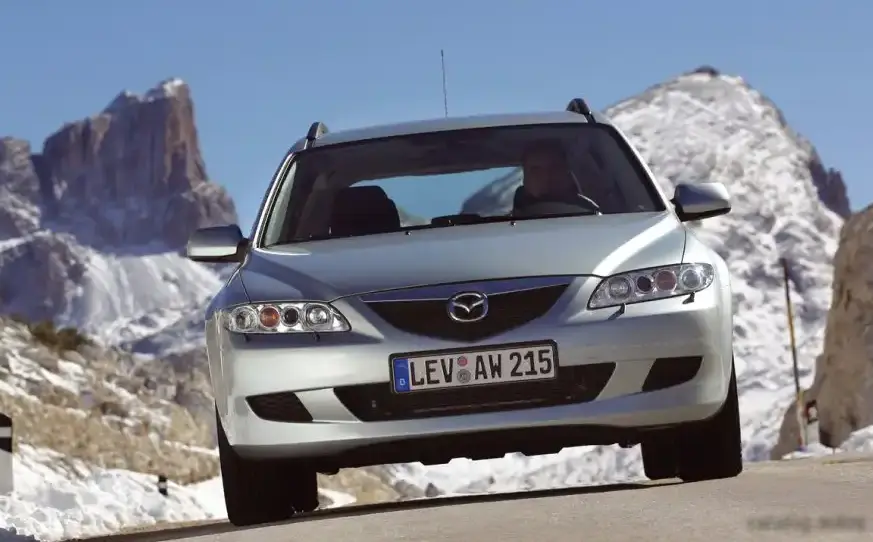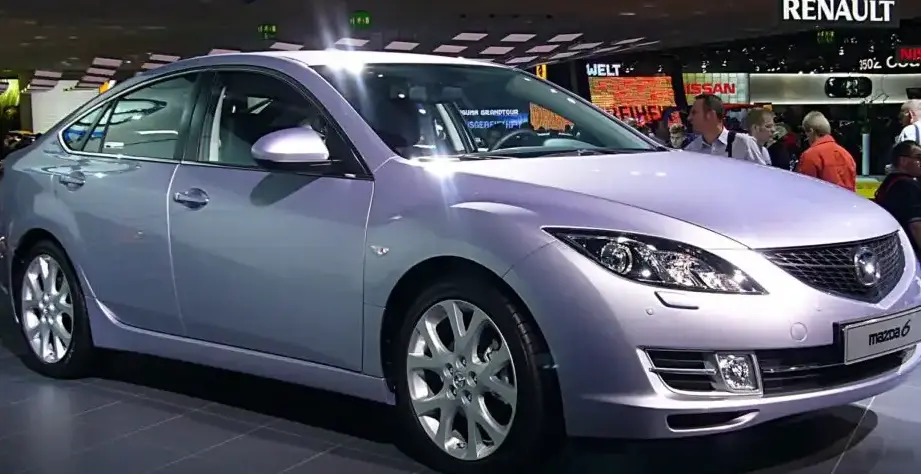
The Mazda 6 II Hatchback (GH) 2.0 CD, produced between 2007 and 2010, represented a significant offering in the European D-segment hatchback market. Positioned as a practical and stylish alternative to traditional saloons, the GH generation Mazda 6 aimed to blend sporty handling with family-friendly versatility. This specific 2.0 CD variant, equipped with a diesel engine producing 140 horsepower, served as a mid-range option within the broader Mazda 6 lineup, appealing to drivers seeking a balance between fuel efficiency and performance. It was a key model for Mazda in Europe, competing with vehicles like the Ford Focus, Volkswagen Golf, and Opel Astra.
Technical Specifications
| Brand | Mazda |
| Model | 6 |
| Generation | 6 II Hatchback (GH) |
| Type (Engine) | 2.0 CD (140 Hp) |
| Start of production | 2007 |
| End of production | 2010 |
| Powertrain Architecture | Internal Combustion engine |
| Body type | Hatchback |
| Seats | 5 |
| Doors | 5 |
| Fuel consumption (economy) – urban (NEDC) | 6.7 l/100 km (35.1 US mpg, 42.2 UK mpg, 14.9 km/l) |
| Fuel consumption (economy) – extra urban (NEDC) | 5 l/100 km (47 US mpg, 56.5 UK mpg, 20 km/l) |
| Fuel consumption (economy) – combined (NEDC) | 5.6 l/100 km (42 US mpg, 50.4 UK mpg, 17.9 km/l) |
| CO2 emissions (NEDC) | 147 g/km |
| Fuel Type | Diesel |
| Acceleration 0 – 100 km/h | 10.7 sec |
| Acceleration 0 – 62 mph | 10.7 sec |
| Acceleration 0 – 60 mph | 10.2 sec |
| Maximum speed | 201 km/h (124.9 mph) |
| Emission standard | Euro 4 |
| Weight-to-power ratio | 10.4 kg/Hp, 96.2 Hp/tonne |
| Weight-to-torque ratio | 4.4 kg/Nm, 226.8 Nm/tonne |
| Power | 140 Hp @ 3500 rpm |
| Power per litre | 70.1 Hp/l |
| Torque | 330 Nm @ 2000 rpm (243.4 lb.-ft. @ 2000 rpm) |
| Engine layout | Front, Transverse |
| Engine Model/Code | RF7J |
| Engine displacement | 1998 cm3 (121.93 cu. in.) |
| Number of cylinders | 4 |
| Engine configuration | Inline |
| Cylinder Bore | 86 mm (3.39 in.) |
| Piston Stroke | 86 mm (3.39 in.) |
| Compression ratio | 16.7:1 |
| Number of valves per cylinder | 4 |
| Fuel injection system | Diesel Commonrail |
| Engine aspiration | Turbocharger, Intercooler |
| Valvetrain | DOHC |
| Engine oil capacity | 4.1 l (4.33 US qt | 3.61 UK qt) |
| Coolant | 9 l (9.51 US qt | 7.92 UK qt) |
| Kerb Weight | 1455 kg (3207.73 lbs.) |
| Max. weight | 2075 kg (4574.59 lbs.) |
| Max load | 620 kg (1366.87 lbs.) |
| Trunk (boot) space – minimum | 510 l (18.01 cu. ft.) |
| Trunk (boot) space – maximum | 1702 l (60.11 cu. ft.) |
| Fuel tank capacity | 64 l (16.91 US gal | 14.08 UK gal) |
| Max. roof load | 100 kg (220.46 lbs.) |
| Permitted trailer load with brakes (8%) | 1800 kg (3968.32 lbs.) |
| Permitted trailer load with brakes (12%) | 1600 kg (3527.4 lbs.) |
| Permitted towbar download | 75 kg (165.35 lbs.) |
| Length | 4755 mm (187.2 in.) |
| Width | 1795 mm (70.67 in.) |
| Height | 1440 mm (56.69 in.) |
| Wheelbase | 2725 mm (107.28 in.) |
| Front track | 1550-1570 mm (61.02 – 61.81 in.) |
| Rear (Back) track | 1550-1570 mm (61.02 – 61.81 in.) |
| Ride height (ground clearance) | 165 mm (6.5 in.) |
| Minimum turning circle (turning diameter) | 11.4 m (37.4 ft.) |
| Drivetrain Architecture | The Internal combustion engine (ICE) drives the front wheels of the vehicle. |
| Drive wheel | Front wheel drive |
| Number of gears and type of gearbox | 6 gears, manual transmission |
| Front suspension | Double wishbone, Transverse stabilizer |
| Rear suspension | Independent multi-link suspension, Transverse stabilizer |
| Front brakes | Ventilated discs, 299 mm |
| Rear brakes | Disc, 280 mm |
| Assisting systems | ABS (Anti-lock braking system) |
| Steering type | Steering rack and pinion |
| Power steering | Electric Steering |
| Tires size | 205/60 R16; 215/50 R17; 225/45 R18 |
| Wheel rims size | 6.5J x 16; 7J x 17; 7.5J x 18 |
INTRODUCTION
The Mazda 6 II Hatchback (GH) 2.0 CD, launched in 2007, was a crucial part of Mazda’s strategy to broaden its appeal in the competitive European market. Building upon the success of the first-generation 6, the GH model offered a more refined driving experience, improved interior quality, and a wider range of engine options. The 2.0 CD variant, with its 140 horsepower diesel engine, was designed to provide a balance of performance and economy, targeting buyers who frequently undertake long journeys. It sat in the middle of the diesel range, offering more power than the lower-spec 1.6 CD models but remaining more affordable and fuel-efficient than the higher-output 2.2 CD versions.
Powertrain & Engine Architecture
The heart of the Mazda 6 2.0 CD is the RF7J engine, a 1998cc four-cylinder diesel. This engine utilizes a common-rail direct injection system, delivering fuel at extremely high pressure for improved combustion efficiency and reduced emissions. The RF7J features a single turbocharger with an intercooler, boosting power output and torque. The engine employs a double overhead camshaft (DOHC) valvetrain with four valves per cylinder, optimizing gas flow for enhanced performance. A compression ratio of 16.7:1 is typical for a diesel engine, contributing to its efficiency. The engine was designed to meet Euro 4 emission standards, incorporating a diesel particulate filter (DPF) to trap soot particles. The 6-speed manual transmission was standard, providing a good spread of ratios for both fuel economy and acceleration.
Driving Characteristics
The 140 horsepower and 330 Nm (243 lb-ft) of torque offered by the 2.0 CD engine provided adequate performance for everyday driving. Acceleration from 0-60 mph took around 10.2 seconds, and the car could reach a top speed of 124.9 mph. While not a particularly sporty setup, the engine delivered a usable amount of power for overtaking and highway cruising. The manual transmission allowed for precise gear changes, and the engine’s torque curve meant that strong acceleration was available from relatively low engine speeds. Compared to the more powerful 2.2 CD models, the 2.0 CD felt less strained during acceleration, but lacked the same outright punch. The 6-speed gearbox was well-matched to the engine’s characteristics, providing comfortable cruising at highway speeds.
Equipment & Trim Levels
The Mazda 6 2.0 CD typically came equipped with a reasonable level of standard equipment. This included air conditioning, electric front and rear windows, power-adjustable door mirrors, a CD stereo system, and alloy wheels. Higher trim levels, such as the ‘Sport’ or ‘Luxury’ variants, added features like climate control, a premium audio system, leather upholstery, and parking sensors. Optional extras included a sunroof, satellite navigation, and xenon headlights. Interior upholstery was typically cloth on the base models, with leather available on higher trims. The dashboard layout was functional and well-designed, with clear instrumentation and intuitive controls.
Chassis & Braking
The Mazda 6 II Hatchback featured a double wishbone front suspension and an independent multi-link rear suspension, providing a comfortable and controlled ride. A transverse stabilizer bar was fitted to both the front and rear axles to reduce body roll during cornering. The braking system consisted of ventilated discs on the front wheels and solid discs on the rear. Anti-lock Braking System (ABS) was standard, enhancing safety during emergency braking. The suspension setup was tuned to provide a balance between comfort and handling, making the car enjoyable to drive on a variety of road surfaces.
Market Reception & Comparison
The Mazda 6 2.0 CD was generally well-received by automotive critics. It was praised for its stylish design, comfortable interior, and refined driving experience. The 2.0 CD engine was considered a good compromise between performance and fuel economy. Compared to the 1.6 CD models, the 2.0 CD offered noticeably more power, making it a more suitable choice for drivers who frequently travel long distances. However, the 2.2 CD models provided even greater performance, albeit at a higher price and with slightly lower fuel economy. The Mazda 6 2.0 CD offered competitive fuel economy figures, averaging around 50.4 mpg (UK) or 42 mpg (US) in combined driving.
Legacy
The RF7J engine, while generally reliable, is known to require regular maintenance, particularly regarding the diesel particulate filter (DPF). Proper servicing and the use of high-quality diesel fuel are essential to prevent DPF blockages. The Mazda 6 II Hatchback (GH) 2.0 CD remains a popular choice in the used car market, offering a good balance of practicality, style, and affordability. Its reputation for reliability, combined with its comfortable driving experience, makes it a compelling option for buyers seeking a well-rounded family hatchback. Parts availability is generally good, and the car’s relatively simple mechanical design makes it relatively easy to maintain.