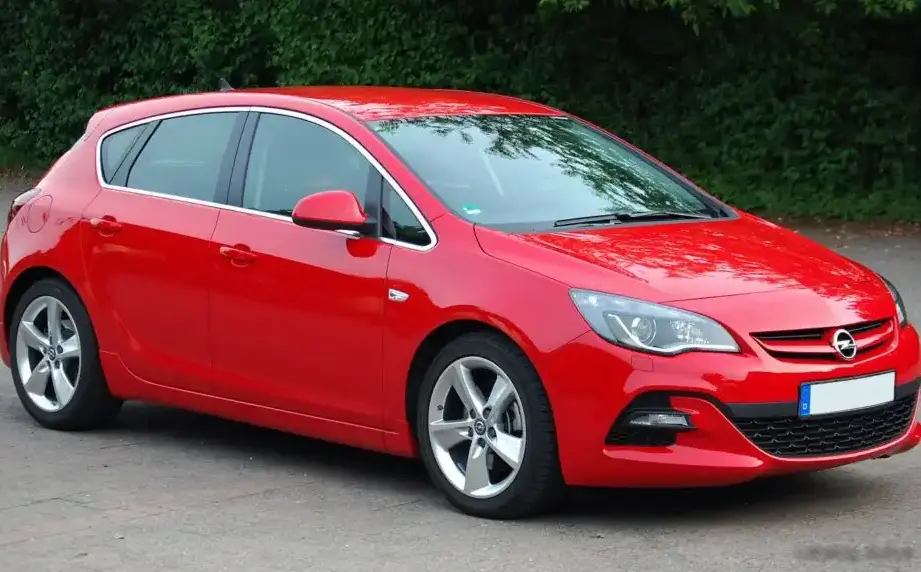
The Opel Astra J (facelift, introduced in 2012) 1.3 CDTI ecoFLEX, producing 95 horsepower, represented an entry-level diesel option within the broader Astra J range. Positioned as a fuel-efficient choice for European markets, this variant was primarily aimed at drivers prioritizing economy over outright performance. Production of this specific configuration spanned from 2012 to 2013, falling within the lifecycle of the J generation Astra, which utilized the General Motors Delta II platform. The “ecoFLEX” designation denoted Opel’s efforts to maximize fuel efficiency through various engineering tweaks.
Technical Specifications
| Brand | Opel |
| Model | Astra |
| Generation | Astra J (facelift 2012) |
| Type (Engine) | 1.3 CDTI (95 Hp) ecoFLEX |
| Start of production | 2012 |
| End of production | 2013 |
| Powertrain Architecture | Internal Combustion engine |
| Body type | Hatchback |
| Seats | 5 |
| Doors | 5 |
| Fuel consumption (urban) | 5.2 l/100 km (45.2 US mpg, 54.3 UK mpg, 19.2 km/l) |
| Fuel consumption (extra urban) | 3.5 l/100 km (67.2 US mpg, 80.7 UK mpg, 28.6 km/l) |
| Fuel consumption (combined) | 4.1 l/100 km (57.4 US mpg, 68.9 UK mpg, 24.4 km/l) |
| CO2 emissions | 109 g/km |
| Fuel Type | Diesel |
| Acceleration 0 – 100 km/h | 14.6 sec |
| Acceleration 0 – 62 mph | 14.6 sec |
| Acceleration 0 – 60 mph | 13.9 sec |
| Maximum speed | 174 km/h (108.12 mph) |
| Emission standard | Euro 5 |
| Weight-to-power ratio | 13.8 kg/Hp, 72.4 Hp/tonne |
| Weight-to-torque ratio | 6.9 kg/Nm, 144.7 Nm/tonne |
| Power | 95 Hp @ 4000 rpm |
| Power per litre | 76.1 Hp/l |
| Torque | 190 Nm @ 1750-3250 rpm (140.14 lb.-ft. @ 1750-3250 rpm) |
| Engine layout | Front, Transverse |
| Engine Model/Code | A13DTE |
| Engine displacement | 1248 cm3 (76.16 cu. in.) |
| Number of cylinders | 4 |
| Engine configuration | Inline |
| Cylinder Bore | 69.6 mm (2.74 in.) |
| Piston Stroke | 82 mm (3.23 in.) |
| Number of valves per cylinder | 4 |
| Fuel injection system | Diesel Commonrail |
| Engine aspiration | Turbocharger, Intercooler |
| Engine oil capacity | 3.5 l (3.7 US qt | 3.08 UK qt) |
| Coolant capacity | 6.8 l (7.19 US qt | 5.98 UK qt) |
| Kerb Weight | 1313 kg (2894.67 lbs.) |
| Max. weight | 1885 kg (4155.71 lbs.) |
| Max load | 572 kg (1261.04 lbs.) |
| Trunk (boot) space – minimum | 370 l (13.07 cu. ft.) |
| Trunk (boot) space – maximum | 1235 l (43.61 cu. ft.) |
| Fuel tank capacity | 56 l (14.79 US gal | 12.32 UK gal) |
| Max. roof load | 75 kg (165.35 lbs.) |
| Permitted trailer load with brakes (12%) | 1000 kg (2204.62 lbs.) |
| Permitted trailer load without brakes | 680 kg (1499.14 lbs.) |
| Length | 4419 mm (173.98 in.) |
| Width | 1814 mm (71.42 in.) |
| Width with mirrors folded | 1831 mm (72.09 in.) |
| Width including mirrors | 2013 mm (79.25 in.) |
| Height | 1510 mm (59.45 in.) |
| Wheelbase | 2685 mm (105.71 in.) |
| Front track | 1544 mm (60.79 in.) |
| Rear (Back) track | 1558 mm (61.34 in.) |
| Minimum turning circle | 11.4 m (37.4 ft.) |
| Drivetrain Architecture | Front wheel drive |
| Drive wheel | Front wheel drive |
| Number of gears and type of gearbox | 5 gears, manual transmission |
| Front brakes | Ventilated discs |
| Assisting systems | ABS (Anti-lock braking system) |
| Steering type | Steering rack and pinion |
| Power steering | Electric Steering |
| Tires size | 205/60 R16 |
| Wheel rims size | 16 |
Powertrain & Engine Architecture
The heart of this Astra J variant is the A13DTE engine, a 1.3-liter inline-four cylinder diesel. This engine is part of Opel/Vauxhall’s family of small-capacity diesel engines developed in collaboration with Fiat. It features a common rail direct injection system, delivering fuel at extremely high pressure for optimized combustion. A turbocharger with an intercooler is employed to boost power output and improve torque across a wider rev range. The engine utilizes four valves per cylinder and a single overhead camshaft. The 5-speed manual transmission was the standard offering, chosen for its efficiency and cost-effectiveness. The ecoFLEX models often featured slightly modified gear ratios to further enhance fuel economy.
Driving Characteristics
The 95 horsepower and 190 Nm (140 lb-ft) of torque produced by the 1.3 CDTI engine resulted in modest, but adequate, performance. Acceleration from 0-60 mph took around 13.9 seconds, and top speed was approximately 108 mph. The engine felt relatively strained when pushed hard, particularly when fully loaded or climbing hills. The manual transmission’s gear ratios were geared towards economy, meaning frequent downshifts were necessary for overtaking or maintaining speed on inclines. Compared to the more powerful 1.4 Turbo petrol or 1.7 CDTI diesel variants, the 1.3 CDTI offered a less engaging driving experience, but excelled in fuel efficiency.
Equipment & Trim Levels
The 1.3 CDTI ecoFLEX typically came with a base level of equipment, focusing on practicality and affordability. Standard features generally included air conditioning, electric front windows, a basic audio system with USB connectivity, and ABS brakes. Higher trim levels, such as ‘Enjoy’ or ‘Sport’, offered additional features like alloy wheels, cruise control, a more advanced infotainment system, and upgraded interior trim. Interior upholstery was typically cloth, and the dashboard featured a functional, if somewhat utilitarian, design. Options included parking sensors, a sunroof, and heated seats.
Chassis & Braking
The Astra J’s chassis featured a MacPherson strut front suspension and a torsion beam rear suspension. This setup provided a reasonable balance between ride comfort and handling. The 1.3 CDTI models typically used smaller diameter wheels (16-inch) with 205/60 R16 tires. Braking was handled by ventilated discs on the front wheels and drum brakes on the rear. ABS was standard, providing enhanced braking control in emergency situations. Stabilizer bars were fitted to both the front and rear axles to reduce body roll during cornering.
Market Reception & Comparison
The Astra J 1.3 CDTI ecoFLEX was generally well-received by critics for its exceptional fuel economy. It consistently achieved combined fuel consumption figures around 4.1 l/100 km (57.4 US mpg), making it one of the most economical cars in its class. However, its performance was often criticized as being underwhelming, particularly when compared to more powerful Astra variants. The 1.7 CDTI offered a noticeable improvement in performance with only a slight decrease in fuel economy, making it a popular alternative. The petrol-powered 1.4 Turbo provided a more responsive driving experience, but at the cost of increased fuel consumption. Reliability was generally good, although some owners reported issues with the diesel particulate filter (DPF) if the vehicle was primarily used for short journeys.
Legacy
The 1.3 CDTI engine, while not known for its excitement, proved to be a relatively durable and reliable unit. Used examples of the Astra J 1.3 CDTI ecoFLEX remain relatively affordable and continue to appeal to buyers seeking a fuel-efficient and practical hatchback. Regular maintenance, including timely oil changes and DPF servicing, is crucial for ensuring long-term reliability. The ecoFLEX models, in particular, are valued for their low running costs and environmental credentials, making them a sensible choice for budget-conscious drivers.