Technical Specifications
| Brand | Volkswagen |
| Model | Golf |
| Generation | Golf VII Variant (facelift 2017) |
| Type (Engine) | 1.4 TSI (150 Hp) DSG |
| Start of production | 2017 |
| End of production | 2018 |
| Powertrain Architecture | Internal Combustion engine |
| Body type | Station wagon (estate) |
| Seats | 5 |
| Doors | 5 |
| Fuel consumption (urban) | 6.2-6.3 l/100 km (37.9 – 37.3 US mpg, 45.6 – 44.8 UK mpg, 16.1 – 15.9 km/l) |
| Fuel consumption (extra urban) | 4.4-4.5 l/100 km (53.5 – 52.3 US mpg, 64.2 – 62.8 UK mpg, 22.7 – 22.2 km/l) |
| Fuel consumption (combined) | 5.0-5.1 l/100 km (47 – 46.1 US mpg, 56.5 – 55.4 UK mpg, 20 – 19.6 km/l) |
| CO2 emissions | 116-119 g/km |
| Fuel Type | Petrol (Gasoline) |
| Acceleration 0 – 100 km/h | 8.6 sec |
| Acceleration 0 – 62 mph | 8.6 sec |
| Acceleration 0 – 60 mph | 8.2 sec |
| Maximum speed | 218 km/h (135.46 mph) |
| Emission standard | Euro 6 |
| Weight-to-power ratio | 8.5 kg/Hp, 117 Hp/tonne |
| Weight-to-torque ratio | 5.1 kg/Nm, 195 Nm/tonne |
| Power | 150 Hp @ 5000-6000 rpm |
| Power per litre | 107.5 Hp/l |
| Torque | 250 Nm @ 1500-3500 rpm (184.39 lb.-ft. @ 1500-3500 rpm) |
| Engine layout | Front, Transverse |
| Engine Model/Code | CZDA |
| Engine displacement | 1395 cm3 (85.13 cu. in.) |
| Number of cylinders | 4 |
| Engine configuration | Inline |
| Number of valves per cylinder | 4 |
| Fuel injection system | Direct injection |
| Engine aspiration | Turbocharger, Intercooler |
| Engine oil capacity | 4 l (4.23 US qt | 3.52 UK qt) |
| Kerb Weight | 1282 kg (2826.33 lbs.) |
| Max. weight | 1890 kg (4166.74 lbs.) |
| Max load | 608 kg (1340.41 lbs.) |
| Trunk (boot) space – minimum | 605 l (21.37 cu. ft.) |
| Trunk (boot) space – maximum | 1620 l (57.21 cu. ft.) |
| Fuel tank capacity | 50 l (13.21 US gal | 11 UK gal) |
| Max. roof load | 75 kg (165.35 lbs.) |
| Permitted trailer load with brakes (8%) | 1700 kg (3747.86 lbs.) |
| Permitted trailer load with brakes (12%) | 1500 kg (3306.93 lbs.) |
| Permitted trailer load without brakes | 670 kg (1477.1 lbs.) |
| Permitted towbar download | 80 kg (176.37 lbs.) |
| Length | 4567 mm (179.8 in.) |
| Width | 1799 mm (70.83 in.) |
| Width including mirrors | 2027 mm (79.8 in.) |
| Height | 1515 mm (59.65 in.) |
| Wheelbase | 2620 mm (103.15 in.) |
| Front track | 1549 mm (60.98 in.) |
| Rear (Back) track | 1520 mm (59.84 in.) |
| Ride height (ground clearance) | 140 mm (5.51 in.) |
| Minimum turning circle (turning diameter) | 10.9 m (35.76 ft.) |
| Drivetrain Architecture | The Internal combustion engine (ICE) drives the front wheels of the vehicle. |
| Drive wheel | Front wheel drive |
| Number of gears and type of gearbox | 7 gears, automatic transmission DSG |
| Front brakes | Ventilated discs |
| Rear brakes | Disc |
| Assisting systems | ABS (Anti-lock braking system) |
| Steering type | Steering rack and pinion |
| Power steering | Electric Steering |
| Tires size | 205/55 R16 |
| Wheel rims size | 6.5 J x 16 |
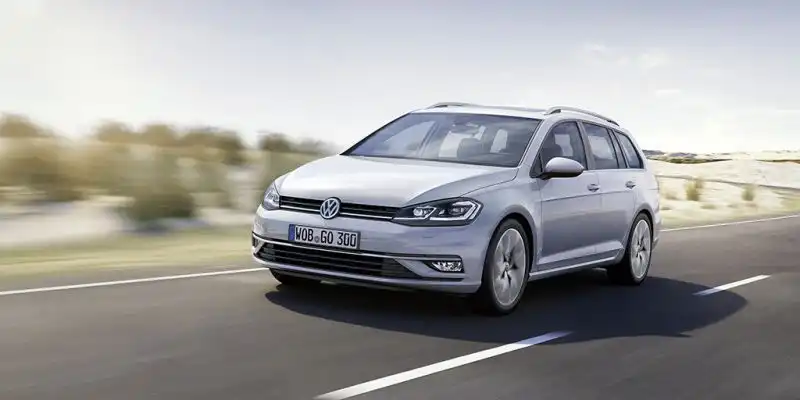
The Volkswagen Golf VII Variant 1.4 TSI DSG, introduced during the 2017 facelift, built upon the success of the Golf VII series, which debuted in 2012. The facelift, denoted by subtle styling revisions and updated technology, aimed to refine an already popular package. The ‘Variant’ designation signifies the station wagon body style, offering 605 liters of boot space (expanding to 1620 liters with the rear seats folded), making it a practical choice for families and those requiring ample cargo room. This particular configuration, pairing the 1.4-liter turbocharged petrol engine with the 7-speed dual-clutch DSG transmission, was designed to provide a balance between fuel efficiency and acceptable performance.
Powertrain & Engine Architecture
At the heart of the Golf VII Variant 1.4 TSI DSG lies the CZDA engine code, a 1.4-liter inline-four cylinder petrol engine. This engine utilizes direct fuel injection and is coupled with a turbocharger and intercooler to boost power and efficiency. The direct injection system precisely meters fuel into the combustion chamber, improving combustion efficiency and reducing emissions. The turbocharger forces more air into the engine, increasing power output. The engine produces 150 horsepower at 5000-6000 rpm and 250 Nm (184 lb-ft) of torque between 1500-3500 rpm. The 7-speed DSG (Direct-Shift Gearbox) is a dual-clutch transmission that offers quick and smooth gear changes. It essentially combines two separate manual gearboxes within one housing, allowing for pre-selection of the next gear, resulting in near-seamless shifts.
Driving Characteristics
The 1.4 TSI DSG variant delivers a comfortable and refined driving experience. While not overtly sporty, the engine provides adequate power for everyday driving and highway cruising. Acceleration from 0-100 km/h (0-62 mph) takes approximately 8.6 seconds. The DSG transmission contributes to smooth acceleration and responsive gear changes. Compared to the more powerful Golf GTI or R models, this variant offers less outright performance, but it excels in fuel economy. The DSG transmission’s gear ratios are tuned for a balance of acceleration and fuel efficiency. Compared to a manual transmission equipped Golf 1.4 TSI, the DSG offers convenience and potentially slightly improved fuel economy, but some enthusiasts may prefer the greater driver engagement of a manual gearbox.
Equipment & Trim Levels
The Golf VII Variant 1.4 TSI DSG typically came equipped with a respectable level of standard features. These included air conditioning, power windows, power mirrors, a touchscreen infotainment system with Bluetooth connectivity, and alloy wheels. Higher trim levels offered additional features such as automatic climate control, a larger touchscreen display, navigation system, parking sensors, and adaptive cruise control. Interior upholstery was typically cloth, with optional leather upgrades available. Dashboard configuration was consistent across the range, featuring a clean and modern design.
Chassis & Braking
The Golf VII Variant 1.4 TSI DSG utilizes a MacPherson strut front suspension and a multi-link rear suspension. This setup provides a good balance of ride comfort and handling. The front brakes are ventilated discs, while the rear brakes are solid discs. ABS (Anti-lock Braking System) is standard. The suspension tuning is geared towards comfort, making it well-suited for everyday driving. Stabilizer bars are fitted to both the front and rear axles to reduce body roll during cornering.
Market Reception & Comparison
The Golf VII Variant 1.4 TSI DSG was generally well-received by automotive critics. It was praised for its practicality, fuel efficiency, and comfortable ride. However, some reviewers noted that the engine could feel slightly underpowered when fully loaded or tackling steep hills. Compared to the 1.6 TDI diesel variant, the 1.4 TSI offered slightly more power but typically lower fuel economy. The 1.4 TSI was also seen as a more refined and quieter option than the diesel. Against competitors like the Ford Focus Estate and Skoda Octavia Estate, the Golf VII Variant offered a premium feel and a well-rounded package.
Legacy
The 1.4 TSI engine, in various iterations, proved to be a reliable powerplant when properly maintained. The DSG transmission, while generally robust, can be susceptible to issues if not serviced according to Volkswagen’s recommended intervals. In the used car market, the Golf VII Variant 1.4 TSI DSG remains a popular choice, offering a good balance of practicality, efficiency, and affordability. Regular maintenance, including oil changes and DSG fluid changes, is crucial to ensure the long-term reliability of this powertrain. Its continued presence in the used car market is a testament to the Golf’s enduring appeal and the overall quality of the seventh-generation model.