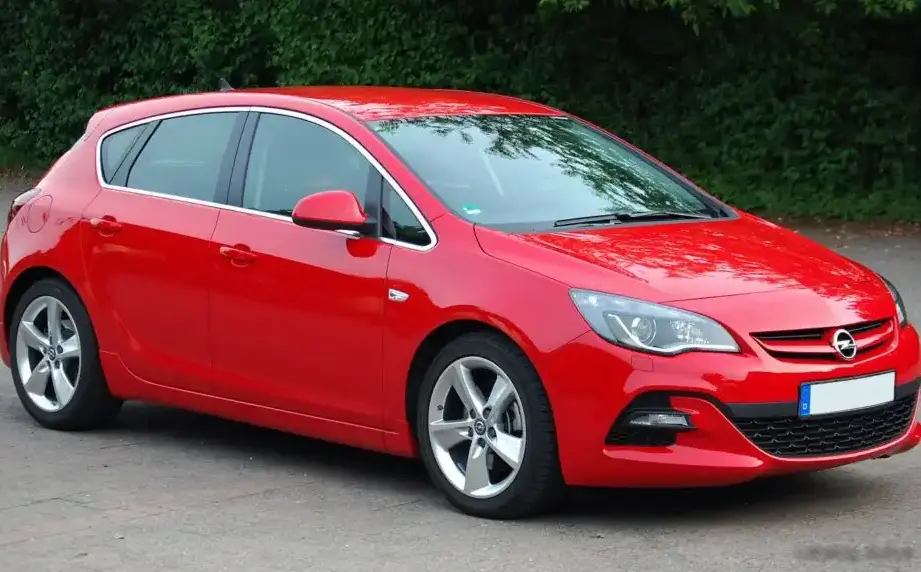
The Opel Astra J (facelift, produced 2012-2015) 1.4 Turbo Ecotec Automatic represents a mid-range offering within the broader Astra J lineup. Introduced as part of the facelifted J series, this variant aimed to balance fuel efficiency with respectable performance, appealing to buyers seeking a comfortable and practical hatchback. It occupied a position between the base 1.4-liter non-turbo models and the more powerful 1.6-liter and 2.0-liter turbocharged options. This model was primarily marketed in Europe, where the Astra J competed with rivals like the Volkswagen Golf, Ford Focus, and Peugeot 308.
Technical Specifications
| Brand | Opel |
| Model | Astra |
| Generation | Astra J (facelift 2012) |
| Type (Engine) | 1.4 (140 Hp) Turbo Ecotec Automatic |
| Start of production | 2012 |
| End of production | 2015 |
| Powertrain Architecture | Internal Combustion engine |
| Body type | Hatchback |
| Seats | 5 |
| Doors | 5 |
| Fuel consumption (urban) | 8.9-9.1 l/100 km (26.4 – 25.8 US mpg) |
| Fuel consumption (extra urban) | 5.2-5.4 l/100 km (45.2 – 43.6 US mpg) |
| Fuel consumption (combined) | 6.6-6.8 l/100 km (35.6 – 34.6 US mpg) |
| CO2 emissions | 154-159 g/km |
| Fuel Type | Petrol (Gasoline) |
| Acceleration 0 – 100 km/h | 10.2 sec |
| Acceleration 0 – 62 mph | 10.2 sec |
| Acceleration 0 – 60 mph | 9.7 sec |
| Maximum speed | 200 km/h (124.27 mph) |
| Emission standard | Euro 5 |
| Weight-to-power ratio | 9.4 kg/Hp |
| Weight-to-torque ratio | 6.6 kg/Nm |
| Power | 140 Hp @ 4900-6000 rpm |
| Torque | 200 Nm @ 1850-4900 rpm (147.51 lb.-ft.) |
| Engine layout | Front, Transverse |
| Engine Model/Code | A14NET |
| Engine displacement | 1364 cm3 (83.24 cu. in.) |
| Number of cylinders | 4 |
| Engine configuration | Inline |
| Cylinder Bore | 72.5 mm (2.85 in.) |
| Piston Stroke | 82.6 mm (3.25 in.) |
| Number of valves per cylinder | 4 |
| Fuel injection system | Multi-port manifold injection |
| Engine aspiration | Turbocharger, Intercooler |
| Engine oil capacity | 4 l (4.23 US qt | 3.52 UK qt) |
| Coolant capacity | 6.2 l (6.55 US qt | 5.46 UK qt) |
| Kerb Weight | 1313 kg (2894.67 lbs.) |
| Max. weight | 1885 kg (4155.71 lbs.) |
| Max load | 572 kg (1261.04 lbs.) |
| Trunk (boot) space – minimum | 370 l (13.07 cu. ft.) |
| Trunk (boot) space – maximum | 1235 l (43.61 cu. ft.) |
| Fuel tank capacity | 56 l (14.79 US gal | 12.32 UK gal) |
| Max. roof load | 75 kg (165.35 lbs.) |
| Permitted trailer load with brakes (12%) | 1400 kg (3086.47 lbs.) |
| Permitted trailer load without brakes | 680 kg (1499.14 lbs.) |
| Length | 4419 mm (173.98 in.) |
| Width | 1814 mm (71.42 in.) |
| Width with mirrors folded | 1831 mm (72.09 in.) |
| Width including mirrors | 2013 mm (79.25 in.) |
| Height | 1510 mm (59.45 in.) |
| Wheelbase | 2685 mm (105.71 in.) |
| Front track | 1541 mm (60.67 in.) |
| Rear (Back) track | 1551 mm (61.06 in.) |
| Minimum turning circle | 11.4 m (37.4 ft.) |
| Drivetrain Architecture | Front wheel drive |
| Number of gears and type of gearbox | 6 gears, automatic transmission |
INTRODUCTION
The Opel Astra J facelift, launched in 2012, represented a significant refresh of the Astra J series, which debuted in 2009. The facelift brought revised styling, improved interior materials, and updated technology. The 1.4 Turbo Ecotec Automatic variant was a key part of this update, offering a blend of efficiency and convenience. Built on the GM Delta II platform (also known as the 1HX0/A3 platform), the Astra J aimed to provide a competitive package in the crowded European C-segment. This particular engine and transmission combination was designed to appeal to drivers prioritizing comfort and ease of use over outright performance.
Powertrain & Engine Architecture
At the heart of the Astra J 1.4 Turbo Ecotec Automatic lies the A14NET engine, a 1.4-liter inline-four cylinder gasoline engine. This engine utilizes a single-scroll turbocharger with an intercooler to boost power and efficiency. The A14NET features multi-point fuel injection and a double overhead camshaft (DOHC) valvetrain with four valves per cylinder. The turbocharger provides increased air intake, allowing for a higher compression ratio and improved combustion. The engine is paired with a six-speed automatic transmission, offering smooth gear changes and a comfortable driving experience. This transmission isn’t a dual-clutch unit, but a traditional torque-converter automatic, prioritizing smoothness over ultimate shift speed. The engine management system carefully controls fuel delivery and ignition timing to optimize performance and minimize emissions, meeting Euro 5 standards.
Driving Characteristics
The 140 horsepower and 200 Nm (147.51 lb-ft) of torque produced by the 1.4 Turbo Ecotec engine provide adequate performance for everyday driving. Acceleration from 0-60 mph takes approximately 9.7 seconds, and the car has a top speed of 200 km/h (124 mph). However, compared to the more powerful Astra J variants, such as those equipped with the 1.6 Turbo or 2.0 Turbo engines, this version feels less responsive. The automatic transmission, while smooth, can sometimes feel hesitant during quick overtaking maneuvers. The gear ratios are tuned for fuel efficiency rather than outright acceleration. The engine delivers its peak torque from 1850-4900 rpm, providing a usable powerband for most driving situations, but it lacks the punch of higher-output engines. The front-wheel-drive configuration provides predictable handling, but it’s not particularly engaging for enthusiastic drivers.
Equipment & Trim Levels
The Astra J 1.4 Turbo Ecotec Automatic typically came equipped with a reasonable level of standard features. These included air conditioning, power windows, power mirrors, a CD/MP3 stereo system, and basic safety equipment like ABS brakes, airbags, and stability control. Higher trim levels, such as Sport or Elegance, added features like alloy wheels, upgraded interior trim, a touchscreen infotainment system, and parking sensors. Optional extras included a sunroof, leather upholstery, and a navigation system. The interior generally featured a functional and modern design, although the materials used were not as premium as those found in some of its competitors.
Chassis & Braking
The Astra J utilized a MacPherson strut front suspension and a torsion beam rear suspension. This setup provided a comfortable ride quality, although it wasn’t particularly sporty. The torsion beam rear suspension is a cost-effective solution, but it doesn’t offer the same level of control as a multi-link setup. Braking duties were typically handled by disc brakes on the front wheels and drum brakes on the rear wheels, although some higher trim levels featured rear disc brakes. The Astra J’s steering was electrically assisted, providing light and easy steering feel. Stabilizer bars were fitted to both the front and rear axles to reduce body roll during cornering.
Market Reception & Comparison
The Astra J 1.4 Turbo Ecotec Automatic received generally positive reviews from automotive critics. It was praised for its fuel efficiency, comfortable ride, and smooth automatic transmission. However, some critics noted that the engine lacked the punch of its rivals and that the interior materials could be improved. Compared to the 1.6-liter turbocharged version, the 1.4 offered better fuel economy but less performance. The 1.9-liter diesel (TDI) models provided even better fuel economy but were more expensive to purchase. The 1.4 Turbo Automatic appealed to buyers who prioritized comfort and economy over sporty handling and rapid acceleration.
Legacy
The A14NET engine, while generally reliable, is known to have some potential issues, including occasional turbocharger failures and oil leaks. The six-speed automatic transmission is also relatively reliable, but regular maintenance, including fluid changes, is crucial to ensure its longevity. Today, used Astra J 1.4 Turbo Ecotec Automatic models are relatively affordable and represent a practical choice for buyers seeking a comfortable and fuel-efficient hatchback. However, potential buyers should be aware of the potential issues mentioned above and ensure that the vehicle has been properly maintained. The Astra J remains a common sight on European roads, and its blend of practicality and affordability has ensured its continued popularity in the used car market.