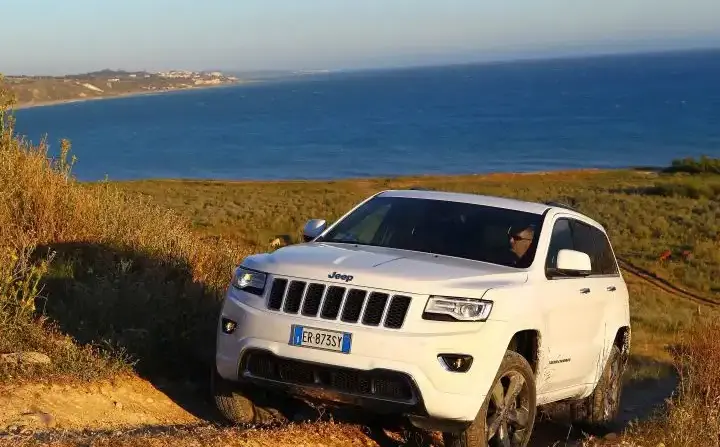
The Jeep Grand Cherokee IV (WK2), specifically the facelifted version produced from 2013 to 2017, represented a significant step forward for the iconic American SUV. This generation, introduced in 2010, moved the Grand Cherokee into a more premium segment, offering a blend of off-road capability, on-road refinement, and modern technology. The 3.0 CRD (250 Hp) 4×4 Automatic variant was a key offering in many European and international markets, providing a diesel-powered option focused on fuel efficiency and torque for towing and all-weather driving. It occupied a mid-range position within the WK2 lineup, slotting below the more powerful 5.7L HEMI V8 and above the base 3.6L Pentastar V6 models.
Technical Specifications
| Brand | Jeep |
| Model | Grand Cherokee |
| Generation | Grand Cherokee IV (WK2, facelift 2013) |
| Type (Engine) | 3.0 CRD (250 Hp) 4×4 Automatic |
| Start of production | 2013 |
| End of production | 2017 |
| Powertrain Architecture | Internal Combustion engine |
| Body type | SUV |
| Seats | 5 |
| Doors | 5 |
| Fuel consumption (urban) | 9.3 l/100 km (25.3 US mpg) |
| Fuel consumption (extra urban) | 6.5 l/100 km (36.2 US mpg) |
| Fuel consumption (combined) | 7.5 l/100 km (31.4 US mpg) |
| CO2 emissions | 198 g/km |
| Fuel Type | Diesel |
| Acceleration 0 – 100 km/h | 8.2 sec |
| Acceleration 0 – 62 mph | 8.2 sec |
| Acceleration 0 – 60 mph | 7.8 sec |
| Maximum speed | 202 km/h (125.52 mph) |
| Emission standard | Euro 5 |
| Weight-to-power ratio | 9.6 kg/Hp |
| Weight-to-torque ratio | 4.2 kg/Nm |
| Power | 250 Hp @ 4000 rpm |
| Torque | 570 Nm @ 2000 rpm (420.41 lb.-ft. @ 2000 rpm) |
| Engine layout | Front, Longitudinal |
| Engine Model/Code | EXN |
| Engine displacement | 2987 cm3 (182.28 cu. in.) |
| Number of cylinders | 6 |
| Engine configuration | V-engine |
| Cylinder Bore | 83 mm (3.27 in.) |
| Piston Stroke | 92 mm (3.62 in.) |
| Compression ratio | 15.5:1 |
| Number of valves per cylinder | 4 |
| Fuel injection system | Diesel Commonrail |
| Engine aspiration | Turbocharger, Intercooler |
| Valvetrain | DOHC |
| Engine oil capacity | 8.4 l (8.88 US qt | 7.39 UK qt) |
| Coolant capacity | 13.2 l (13.95 US qt | 11.61 UK qt) |
| Kerb Weight | 2403-2522 kg (5297.71 – 5560.06 lbs.) |
| Max. weight | 2949 kg (6501.43 lbs.) |
| Max load | 427-546 kg (941.37 – 1203.72 lbs.) |
| Trunk (boot) space – minimum | 457 l (16.14 cu. ft.) |
| Trunk (boot) space – maximum | 1554 l (54.88 cu. ft.) |
| Fuel tank capacity | 93 l (24.57 US gal | 20.46 UK gal) |
| Permitted trailer load with brakes (12%) | 3500 kg (7716.18 lbs.) |
| Length | 4828 mm (190.08 in.) |
| Width | 1943 mm (76.5 in.) |
| Height | 1802 mm (70.94 in.) |
| Wheelbase | 2915 mm (114.76 in.) |
| Front track | 1628 mm (64.09 in.) |
| Rear (Back) track | 1634 mm (64.33 in.) |
| Ride height (ground clearance) | 218 mm (8.58 in.) |
| Drag coefficient (Cd) | 0.37 |
| Minimum turning circle (turning diameter) | 11.3 m (37.07 ft.) |
| Approach angle | 26.3° |
| Departure angle | 26.5° |
| Ramp-over (brakeover) angle | 18.8° |
| Drive wheel | All wheel drive (4×4) |
| Number of gears and type of gearbox | 8 gears, automatic transmission |
| Front suspension | Double wishbone |
| Rear suspension | Independent multi-link suspension |
| Front brakes | Ventilated discs |
| Rear brakes | Ventilated discs |
| Assisting systems | ABS (Anti-lock braking system) |
| Steering type | Steering rack and pinion |
| Tires size | 265/60 R18; 265/50 R20 |
| Wheel rims size | 8J x 18; 8J x 20 |
INTRODUCTION
The 3.0 CRD variant of the WK2 Grand Cherokee was primarily aimed at markets outside of North America, where diesel engines enjoy greater popularity. Introduced with the 2013 facelift, this version combined the robust Jeep platform with a fuel-efficient and torquey diesel engine. The facelift brought subtle styling updates, an upgraded interior, and enhanced technology features, further solidifying the Grand Cherokee’s position as a competitive luxury SUV. This particular configuration, paired with the eight-speed automatic transmission, offered a balance between performance, comfort, and economy, making it a popular choice for families and drivers who frequently tow or travel long distances.
Powertrain & Engine Architecture
The heart of the 3.0 CRD is the EXN engine, a 3.0-liter V6 diesel. This engine utilizes a common rail direct injection system, delivering fuel at extremely high pressure for optimized combustion. The EXN engine features a variable geometry turbocharger (VGT) and an intercooler to maximize power and efficiency. The engine produces 250 horsepower at 4000 rpm and a substantial 570 Nm (420 lb-ft) of torque at just 2000 rpm. This torque output is particularly beneficial for towing and off-road driving. The eight-speed automatic transmission, sourced from Chrysler, provides smooth and efficient gear changes. It’s programmed to prioritize fuel economy while still offering responsive acceleration when needed. The transmission features a wide gear ratio spread, allowing the engine to operate in its optimal power band more frequently.
Driving Characteristics
The 3.0 CRD Grand Cherokee delivers a refined and comfortable driving experience. The abundance of torque makes overtaking effortless, and the eight-speed transmission keeps the engine in its sweet spot. While not as quick as the HEMI V8 models, the diesel offers ample power for everyday driving and towing. The automatic transmission is well-tuned, providing smooth shifts and minimizing hunting for the right gear. Compared to the manual transmission options available in some markets, the automatic prioritizes convenience and ease of use. Fuel economy is a significant advantage of the 3.0 CRD, offering considerably better mileage than the gasoline engines, especially on long highway journeys.
Equipment & Trim Levels
The 3.0 CRD typically came well-equipped, often featuring leather upholstery, dual-zone climate control, a touchscreen infotainment system, and a premium sound system. Standard safety features included multiple airbags, ABS, electronic stability control, and traction control. Optional extras included a panoramic sunroof, navigation system, rear-seat entertainment system, and advanced driver-assistance systems such as adaptive cruise control and blind-spot monitoring. Trim levels varied by market, but generally included options like Limited, Overland, and Summit, with each successive trim adding more luxury features and technology.
Chassis & Braking
The WK2 Grand Cherokee boasts a robust chassis with a fully independent suspension system. The front suspension utilizes a double wishbone design, while the rear features a multi-link setup. This configuration provides a comfortable ride and good handling characteristics. The 3.0 CRD models typically came equipped with ventilated disc brakes on all four wheels, providing ample stopping power. The electronic stability control system helps to maintain control in challenging driving conditions. The weight of the diesel engine and transmission does contribute to a slightly higher curb weight compared to the V6 gasoline models, but the suspension is tuned to compensate for this.
Market Reception & Comparison
The 3.0 CRD Grand Cherokee was generally well-received by automotive critics, who praised its fuel efficiency, torque, and comfortable ride. It was often compared favorably to other luxury diesel SUVs, such as the BMW X5 and Audi Q7. While some critics noted that the diesel engine was not as refined as some of its European competitors, the Grand Cherokee offered a compelling combination of capability, luxury, and value. Fuel economy was a key selling point, and the 3.0 CRD consistently outperformed the gasoline engines in this regard. Reliability was generally good, although diesel engines can be more complex and potentially more expensive to repair than gasoline engines.
Legacy
The 3.0 CRD Grand Cherokee (WK2) has proven to be a relatively reliable and durable SUV. The EXN diesel engine, while not without its potential issues (like diesel particulate filter problems common to many modern diesels), has generally held up well over time. In the used car market, these models remain popular, particularly among buyers seeking a capable and fuel-efficient SUV. Regular maintenance, including timely servicing of the diesel particulate filter and fuel system, is crucial for ensuring long-term reliability. The WK2 Grand Cherokee, in all its variants, helped to elevate the Jeep brand into a more premium segment, and the 3.0 CRD played a significant role in expanding its appeal to international markets.