
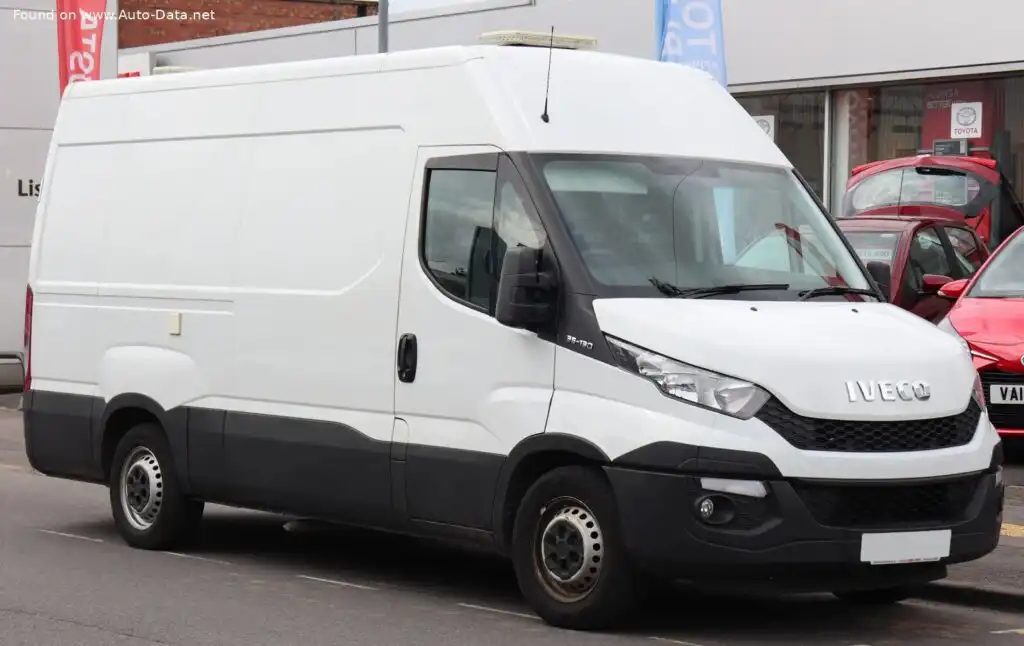
The Iveco Daily III Panel Van 2.3 Multijet (106 Hp) L2H2 represents a specific configuration within the third generation of Iveco’s popular Daily commercial vehicle range. Introduced in April 2014 and continuing through April 2016, this variant was designed to balance practicality, fuel efficiency, and payload capacity for businesses and tradespeople. The “L2H2” designation refers to the vehicle’s body length and roof height – a medium length and high roof configuration – making it a versatile option for a wide range of applications. This particular model served primarily in the European market, where the Daily has long been a dominant force in the light commercial vehicle segment.
Technical Specifications
| Brand | Iveco |
| Model | Daily |
| Generation | Daily III Panel Van |
| Type (Engine) | 2.3 Multijet (106 Hp) L2H2 |
| Start of production | April, 2014 |
| End of production | April, 2016 |
| Powertrain Architecture | Internal Combustion engine |
| Body type | Van |
| Seats | 3 |
| Doors | 4-5 |
| Fuel consumption (economy) – urban (NEDC) | 7.9-8.7 l/100 km (29.8 – 27 US mpg, 35.8 – 32.5 UK mpg, 12.7 – 11.5 km/l) |
| Fuel consumption (economy) – extra urban (NEDC) | 6.8-7.6 l/100 km (34.6 – 30.9 US mpg, 41.5 – 37.2 UK mpg, 14.7 – 13.2 km/l) |
| Fuel consumption (economy) – combined (NEDC) | 7.2-8 l/100 km (32.7 – 29.4 US mpg, 39.2 – 35.3 UK mpg, 13.9 – 12.5 km/l) |
| CO2 emissions (NEDC) | 190-211 g/km |
| Fuel Type | Diesel |
| Emission standard | Euro 5 |
| Weight-to-power ratio | 20.8 kg/Hp, 48.1 Hp/tonne |
| Weight-to-torque ratio | 8.2 kg/Nm, 122.6 Nm/tonne |
| Power | 106 Hp @ 2750-3900 rpm |
| Power per litre | 46.3 Hp/l |
| Torque | 270 Nm @ 1500-2750 rpm (199.14 lb.-ft. @ 1500-2750 rpm) |
| Engine layout | Front, Longitudinal |
| Engine Model/Code | F1AFL411A |
| Engine displacement | 2287 cm3 (139.56 cu. in.) |
| Number of cylinders | 4 |
| Engine configuration | Inline |
| Cylinder Bore | 88 mm (3.46 in.) |
| Piston Stroke | 94 mm (3.7 in.) |
| Number of valves per cylinder | 4 |
| Fuel injection system | Diesel Commonrail |
| Engine aspiration | Turbocharger, Intercooler |
| Valvetrain | DOHC |
| Engine oil capacity | 4.3 l (4.54 US qt | 3.78 UK qt) |
| Coolant | 16 l (16.91 US qt | 14.08 UK qt) |
| Kerb Weight | 2203-2221 kg (4856.78 – 4896.47 lbs.) |
| Max. weight | 3300-3500 kg (7275.25 – 7716.18 lbs.) |
| Max load | 1097-1279 kg (2418.47 – 2819.71 lbs.) |
| Trunk (boot) space – minimum | 10800 l (381.4 cu. ft.) |
| Fuel tank capacity | 70 l (18.49 US gal | 15.4 UK gal) |
| Max. roof load | 150 kg (330.69 lbs.) |
| Permitted trailer load with brakes (12%) | 3300 kg (7275.25 lbs.) |
| Permitted trailer load without brakes | 750 kg (1653.47 lbs.) |
| Permitted towbar download | 132 kg (291.01 lbs.) |
| Length | 5669 mm (223.19 in.) |
| Width | 2010 mm (79.13 in.) |
| Height | 2620 mm (103.15 in.) |
| Wheelbase | 3520 mm (138.58 in.) |
| Front track | 1740 mm (68.5 in.) |
| Rear (Back) track | 1704 mm (67.09 in.) |
| Front overhang | 1008 mm (39.69 in.) |
| Rear overhang | 1141 mm (44.92 in.) |
| Ride height (ground clearance) | 180 mm (7.09 in.) |
| Minimum turning circle (turning diameter) | 12.08 m (39.63 ft.) |
| Drivetrain Architecture | Rear wheel drive |
| Drive wheel | Rear wheel drive |
| Number of gears and type of gearbox | 6 gears, manual transmission |
| Front suspension | Double wishbone, Transverse stabilizer, Leaf spring |
| Rear suspension | Rigid axle suspension, Transverse stabilizer, Leaf spring, Air Suspension – Optional |
| Front brakes | Ventilated discs, 300 mm |
| Rear brakes | Disc, 296 mm |
| Assisting systems | ABS (Anti-lock braking system) |
| Steering type | Steering rack and pinion |
| Power steering | Hydraulic Steering |
| Tires size | 215/65 R16; 225/65 R16; 235/65 R16 |
| Wheel rims size | 6.5J x 16 |
Powertrain & Engine Architecture
The heart of the Daily III 2.3 Multijet is the F1AFL411A engine, a 2.3-liter inline four-cylinder diesel. This engine is part of Iveco’s well-regarded Multijet family, known for its common-rail direct injection system. This system, supplied by Bosch, allows for multiple injections per combustion cycle, optimizing fuel burn, reducing noise, and improving efficiency. The 106 horsepower output is achieved at 2750-3900 rpm, while peak torque of 270 Nm (199.14 lb.-ft.) is delivered between 1500-2750 rpm. The engine features a turbocharger with an intercooler, enhancing power and torque output. The valvetrain utilizes a Double Overhead Camshaft (DOHC) configuration with four valves per cylinder, contributing to improved breathing and overall engine performance. The engine is longitudinally mounted in the chassis, driving the rear wheels. The 6-speed manual transmission was standard for this configuration, offering a balance between fuel economy and usability.
Driving Characteristics
The 106 hp 2.3 Multijet, paired with the 6-speed manual transmission, provided a practical, if not exhilarating, driving experience. While not designed for rapid acceleration, it offered sufficient power for everyday tasks and highway cruising when unladen. The relatively low horsepower meant that the engine needed to be worked harder when carrying a full load or tackling steep inclines. The gear ratios were well-suited to commercial use, prioritizing torque delivery at lower speeds for hauling and maneuverability. Compared to higher-output versions of the 2.3 Multijet, or the larger 3.0-liter engines available in the Daily range, this variant felt less powerful but more economical. The manual transmission allowed for greater driver control and potentially better fuel economy compared to an automatic option, if equipped.
Equipment & Trim Levels
The Daily III Panel Van 2.3 Multijet (106 Hp) L2H2 typically came with a functional, work-oriented interior. Standard features included a driver’s air bag, power steering, and a basic audio system. The cabin was designed for durability and ease of cleaning, with hard-wearing plastics and vinyl upholstery. Trim levels were relatively basic, focusing on functionality rather than luxury. Optional extras included air conditioning, electric windows, a more advanced audio system, and various storage solutions. The L2H2 body style offered a generous cargo volume of 10.8 cubic meters (381.4 cu. ft.), making it suitable for a wide range of commercial applications.
Chassis & Braking
The Daily III utilized a robust ladder-frame chassis, providing a solid foundation for heavy loads. The front suspension consisted of independent double wishbones with a transverse stabilizer and leaf springs, while the rear suspension employed a rigid axle setup with leaf springs and an optional air suspension system for improved ride comfort and load leveling. The braking system featured ventilated discs on the front wheels (300mm) and discs on the rear wheels (296mm), along with ABS (Anti-lock Braking System) as standard. The steering was rack and pinion with hydraulic power assistance.
Market Reception & Comparison
The Iveco Daily III 2.3 Multijet (106 Hp) L2H2 was generally well-received in the commercial vehicle market. Critics praised its fuel efficiency, reliability, and load-carrying capacity. Compared to other light commercial vehicles in its class, such as the Mercedes-Benz Sprinter and the Volkswagen Crafter, the Daily offered a competitive combination of features and price. The 106 hp engine was considered adequate for many applications, but some reviewers noted that it could feel underpowered when fully loaded. Fuel economy figures of 7.2-8 l/100 km (32.7 – 29.4 US mpg) were competitive for its class.
Legacy
The Iveco Daily III 2.3 Multijet (106 Hp) L2H2 remains a common sight on European roads today. The F1AFL411A engine is known for its durability and relatively low maintenance costs, although, like any diesel engine, it can be susceptible to issues with the fuel injection system and turbocharger over time. In the used market, these vans represent a cost-effective option for businesses and tradespeople seeking a reliable and practical workhorse. The Daily’s reputation for robustness and longevity has cemented its position as a leading light commercial vehicle in Europe.
