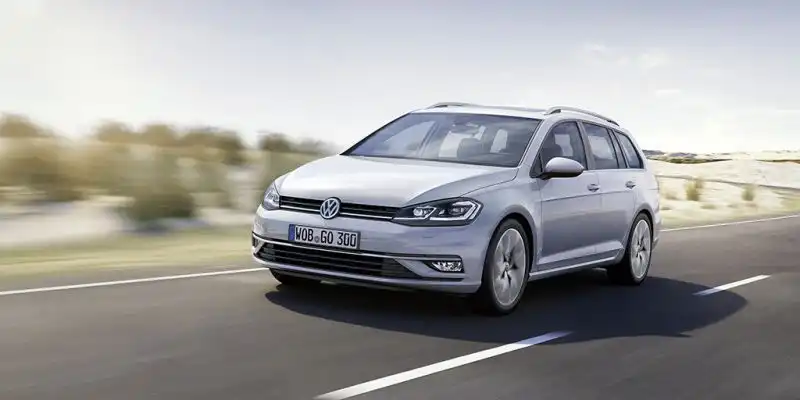
The Volkswagen Golf VII Variant, specifically the 1.5 TSI ACT (150 hp) DSG model produced from March 2017 to 2019, represents a significant iteration within the seventh generation of Volkswagen’s iconic Golf lineup. This variant, a practical station wagon (estate) body style, was positioned as a mid-range offering, balancing fuel efficiency, performance, and modern technology. It formed part of the broader Golf VII facelift (introduced in late 2017), which brought styling updates and revised engine options to the popular hatchback and wagon models. The Golf VII platform (PQ25) was a cornerstone of Volkswagen’s strategy, underpinning numerous models across the Volkswagen Group.
Technical Specifications
| Brand | Volkswagen |
| Model | Golf |
| Generation | Golf VII Variant (facelift 2017) |
| Type (Engine) | 1.5 TSI ACT (150 Hp) DSG |
| Start of production | March, 2017 |
| End of production | 2019 |
| Powertrain Architecture | Internal Combustion engine |
| Body type | Station wagon (estate) |
| Seats | 5 |
| Doors | 5 |
| Fuel consumption (urban) | 6.6-6.9 l/100 km (35.6 – 34.1 US mpg, 42.8 – 40.9 UK mpg, 15.2 – 14.5 km/l) |
| Fuel consumption (extra urban) | 4.3-4.5 l/100 km (54.7 – 52.3 US mpg, 65.7 – 62.8 UK mpg, 23.3 – 22.2 km/l) |
| Fuel consumption (combined) | 5.1-5.2 l/100 km (46.1 – 45.2 US mpg, 55.4 – 54.3 UK mpg, 19.6 – 19.2 km/l) |
| CO2 emissions | 116-118 g/km |
| Fuel Type | Petrol (Gasoline) |
| Acceleration 0 – 100 km/h | 8.7 sec |
| Acceleration 0 – 62 mph | 8.7 sec |
| Acceleration 0 – 60 mph | 8.3 sec |
| Maximum speed | 218 km/h (135.46 mph) |
| Emission standard | Euro 6d-TEMP |
| Weight-to-power ratio | 9.3 kg/Hp, 107.5 Hp/tonne |
| Weight-to-torque ratio | 5.6 kg/Nm, 179.2 Nm/tonne |
| Power | 150 Hp |
| Power per litre | 100.1 Hp/l |
| Torque | 250 Nm @ 1500-3500 rpm (184.39 lb.-ft. @ 1500-3500 rpm) |
| Engine layout | Front, Transverse |
| Engine Model/Code | EA211evo / DADA |
| Engine displacement | 1498 cm3 (91.41 cu. in.) |
| Number of cylinders | 4 |
| Engine configuration | Inline |
| Number of valves per cylinder | 4 |
| Fuel injection system | Direct injection |
| Engine aspiration | Turbocharger, Intercooler |
| Engine oil capacity | 4.3 l (4.54 US qt | 3.78 UK qt) |
| Kerb Weight | 1395 kg (3075.45 lbs.) |
| Max. weight | 1930 kg (4254.92 lbs.) |
| Max load | 535 kg (1179.47 lbs.) |
| Trunk (boot) space – minimum | 605 l (21.37 cu. ft.) |
| Trunk (boot) space – maximum | 1620 l (57.21 cu. ft.) |
| Fuel tank capacity | 50 l (13.21 US gal | 11 UK gal) |
| Max. roof load | 75 kg (165.35 lbs.) |
| Permitted trailer load with brakes (8%) | 1700 kg (3747.86 lbs.) |
| Permitted trailer load with brakes (12%) | 1500 kg (3306.93 lbs.) |
| Permitted trailer load without brakes | 690 kg (1521.19 lbs.) |
| Permitted towbar download | 80 kg (176.37 lbs.) |
| Length | 4567 mm (179.8 in.) |
| Width | 1799 mm (70.83 in.) |
| Width including mirrors | 2027 mm (79.8 in.) |
| Height | 1515 mm (59.65 in.) |
| Wheelbase | 2620 mm (103.15 in.) |
| Front track | 1533-1549 mm (60.35 – 60.98 in.) |
| Rear (Back) track | 1504-1520 mm (59.21 – 59.84 in.) |
| Ride height (ground clearance) | 140 mm (5.51 in.) |
| Minimum turning circle (turning diameter) | 10.9 m (35.76 ft.) |
| Drive wheel | Front wheel drive |
| Number of gears and type of gearbox | 7 gears, automatic transmission DSG |
| Assisting systems | ABS (Anti-lock braking system) |
| Steering type | Steering rack and pinion |
| Power steering | Electric Steering |
| Tires size | 205/50 R17; 225/45 R17 |
| Wheel rims size | 6J x 17; 7J x 17 |
INTRODUCTION
The Golf VII Variant 1.5 TSI ACT DSG, launched in 2017 as part of the facelift, aimed to provide a compelling blend of practicality, efficiency, and performance for European buyers. The “Variant” designation signifies the station wagon body style, offering increased cargo capacity compared to the standard hatchback. The 1.5 TSI ACT engine, a key feature of this variant, represented Volkswagen’s move towards smaller, turbocharged engines with innovative fuel-saving technologies. This model occupied a middle ground in the Golf VII Variant lineup, offering a step up in performance from the base 1.0 TSI engine while remaining more accessible than the higher-powered 1.8 TSI or diesel options.
Powertrain & Engine Architecture
At the heart of the Golf VII Variant 1.5 TSI ACT DSG lies the EA211evo engine family, specifically the DADA engine code. This 1.5-liter inline-four cylinder engine utilizes direct fuel injection and a single turbocharger with an intercooler to deliver 150 horsepower. A defining feature of this engine is its Active Cylinder Technology (ACT), which allows it to deactivate two cylinders under light load conditions to reduce fuel consumption. The engine’s valvetrain employs variable valve timing on both the intake and exhaust sides, optimizing performance and efficiency. The engine is transversely mounted, a common configuration for front-wheel-drive vehicles. Paired with the engine is a seven-speed dual-clutch transmission (DSG), known for its quick and smooth gear changes. This DSG unit is electronically controlled and offers both automatic and manual shift modes.
Driving Characteristics
The 1.5 TSI ACT DSG variant delivers a balanced driving experience. While not as overtly sporty as the Golf GTI or R models, it provides ample power for everyday driving and highway cruising. The 150 hp and 250 Nm (184 lb-ft) of torque are readily available, with peak torque sustained between 1500 and 3500 rpm. The DSG transmission contributes to brisk acceleration, achieving 0-100 km/h (0-62 mph) in approximately 8.7 seconds. The ACT system is largely seamless in operation, and while cylinder deactivation can be subtly felt, it doesn’t detract significantly from the driving experience. Compared to the 1.0 TSI engine, the 1.5 TSI offers noticeably more power and responsiveness. However, it doesn’t match the outright performance of the 1.8 TSI, which provides a more engaging and powerful driving experience. The DSG transmission’s gear ratios are tuned for a balance of acceleration and fuel economy.
Equipment & Trim Levels
The Golf VII Variant 1.5 TSI ACT DSG typically came equipped with a respectable level of standard features. These included air conditioning, a touchscreen infotainment system with Bluetooth connectivity, alloy wheels, and a suite of safety features such as ABS, electronic stability control, and multiple airbags. Higher trim levels, such as Comfortline and Highline, added features like automatic climate control, parking sensors, adaptive cruise control, and upgraded interior upholstery. Optional extras included a panoramic sunroof, navigation system, and premium sound system. Interior upholstery was typically cloth on lower trims, with leather options available on higher-spec models. The dashboard layout was consistent across the Golf VII range, featuring a clean and functional design.
Chassis & Braking
The Golf VII Variant 1.5 TSI ACT DSG utilizes a MacPherson strut front suspension and a multi-link rear suspension, providing a comfortable and controlled ride. The suspension setup is tuned to balance handling and ride quality, making it suitable for both city driving and longer journeys. Braking systems varied depending on trim level, with lower trims typically featuring disc brakes on the front and drum brakes on the rear. Higher trims often included disc brakes on all four wheels. Anti-lock braking system (ABS) and electronic stability control (ESC) were standard features, enhancing safety and control. Stabilizer bars were fitted to both the front and rear axles to reduce body roll during cornering.
Market Reception & Comparison
The Golf VII Variant 1.5 TSI ACT DSG was generally well-received by automotive critics. It was praised for its fuel efficiency, comfortable ride, and practical interior space. The ACT technology was seen as a clever innovation, contributing to reduced fuel consumption without significantly compromising performance. Compared to the 1.0 TSI variant, the 1.5 TSI offered a noticeable improvement in performance, making it a more appealing option for drivers who frequently travel on highways or carry passengers and luggage. Against the 1.8 TSI, the 1.5 TSI offered a more economical option, albeit with slightly less power. Fuel economy figures of around 5.1-5.2 l/100 km (46.1-45.2 US mpg) were competitive within its class.
Legacy
The EA211evo engine family, including the 1.5 TSI variant, has proven to be relatively reliable, although some owners have reported issues with the turbocharger and direct injection system. Regular maintenance, including oil changes and timely replacement of wear items, is crucial for ensuring long-term reliability. In the used car market, the Golf VII Variant 1.5 TSI ACT DSG remains a popular choice, offering a good balance of practicality, efficiency, and affordability. Its reputation for build quality and reliability, combined with the Golf’s enduring appeal, ensures continued demand for this variant.