Technical Specifications
| Brand | Ford |
| Model | Fiesta |
| Generation | Fiesta VIII (Mk8, facelift 2022) |
| Type (Engine) | 1.0 EcoBoost (125 Hp) Hybrid |
| Start of production | November, 2021 |
| End of production | July, 2023 |
| Powertrain Architecture | MHEV (Mild Hybrid Electric Vehicle) |
| Body type | Hatchback |
| Seats | 5 |
| Doors | 3 |
| Fuel consumption at Low speed (WLTP) | 6.3-7.3 l/100 km (37.3 – 32.2 US mpg) |
| Fuel consumption at Medium speed (WLTP) | 4.6-5.5 l/100 km (51.1 – 42.8 US mpg) |
| Fuel consumption at high speed (WLTP) | 4.3-5.3 l/100 km (54.7 – 44.4 US mpg) |
| Fuel consumption at very high speed (WLTP) | 5.4-6.6 l/100 km (43.6 – 35.6 US mpg) |
| Combined fuel consumption (WLTP) | 5-6 l/100 km (47 – 39.2 US mpg) |
| CO2 emissions (WLTP) | 113-136 g/km |
| Fuel Type | Petrol (Gasoline) |
| Acceleration 0 – 100 km/h | 9.4 sec |
| Acceleration 0 – 62 mph | 9.4 sec |
| Acceleration 0 – 60 mph | 8.9 sec |
| Maximum speed | 200 km/h (124.27 mph) |
| Emission standard | Euro 6d-ISC-FCM |
| Weight-to-power ratio | 9 kg/Hp |
| Weight-to-torque ratio | 5.3 kg/Nm |
| Power | 125 Hp @ 6000 rpm |
| Torque | 210 Nm @ 1750 rpm (154.89 lb.-ft. @ 1750 rpm) |
| Engine layout | Front, Transverse |
| Engine Model/Code | B7JB |
| Engine displacement | 999 cm3 (60.96 cu. in.) |
| Number of cylinders | 3 |
| Engine configuration | Inline |
| Cylinder Bore | 71.9 mm (2.83 in.) |
| Piston Stroke | 82 mm (3.23 in.) |
| Compression ratio | 10.5:1 |
| Number of valves per cylinder | 4 |
| Fuel injection system | Direct injection |
| Engine aspiration | Turbocharger, Intercooler |
| Valvetrain | DOHC |
| Engine oil capacity | 4.52 l (4.78 US qt | 3.98 UK qt) |
| Coolant | 5.6 l (5.92 US qt | 4.93 UK qt) |
| Kerb Weight | 1121 kg (2471.38 lbs.) |
| Max. weight | 1675 kg (3692.74 lbs.) |
| Max load | 554 kg (1221.36 lbs.) |
| Trunk (boot) space – minimum | 292 l (10.31 cu. ft.) |
| Trunk (boot) space – maximum | 1093 l (38.6 cu. ft.) |
| Fuel tank capacity | 42 l (11.1 US gal | 9.24 UK gal) |
| Max. roof load | 50 kg (110.23 lbs.) |
| Permitted trailer load with brakes (12%) | 1000 kg (2204.62 lbs.) |
| Permitted trailer load without brakes | 595 kg (1311.75 lbs.) |
| Permitted towbar download | 65 kg (143.3 lbs.) |
| Length | 4048-4069 mm (159.37 – 160.2 in.) |
| Width | 1735 mm (68.31 in.) |
| Width with mirrors folded | 1783 mm (70.2 in.) |
| Width including mirrors | 1941 mm (76.42 in.) |
| Height | 1484-1490 mm (58.43 – 58.66 in.) |
| Wheelbase | 2493 mm (98.15 in.) |
| Front overhang | 846-847 mm (33.31 – 33.35 in.) |
| Rear overhang | 708-730 mm (27.87 – 28.74 in.) |
| Ride height (ground clearance) | 122-130 mm (4.8 – 5.12 in.) |
| Minimum turning circle | 9.8-10.0 m (32.15 – 32.81 ft.) |
| Drivetrain Architecture | ICE and electric motor, Front wheel drive |
| Number of gears and type of gearbox | 6 gears, manual transmission |
| Front suspension | Independent, McPherson with coil spring and anti-roll bar |
| Rear suspension | Torsion |
| Front brakes | Ventilated discs, 262×23 mm |
| Rear brakes | Drum, 202.8 mm |
| Assisting systems | ABS (Anti-lock braking system) |
| Steering type | Steering rack and pinion |
| Power steering | Electric |
| Tires size | 195/60 R15; 205/45 R17 |
| Wheel rims size | 6J x 15; 7.5J x 17 |
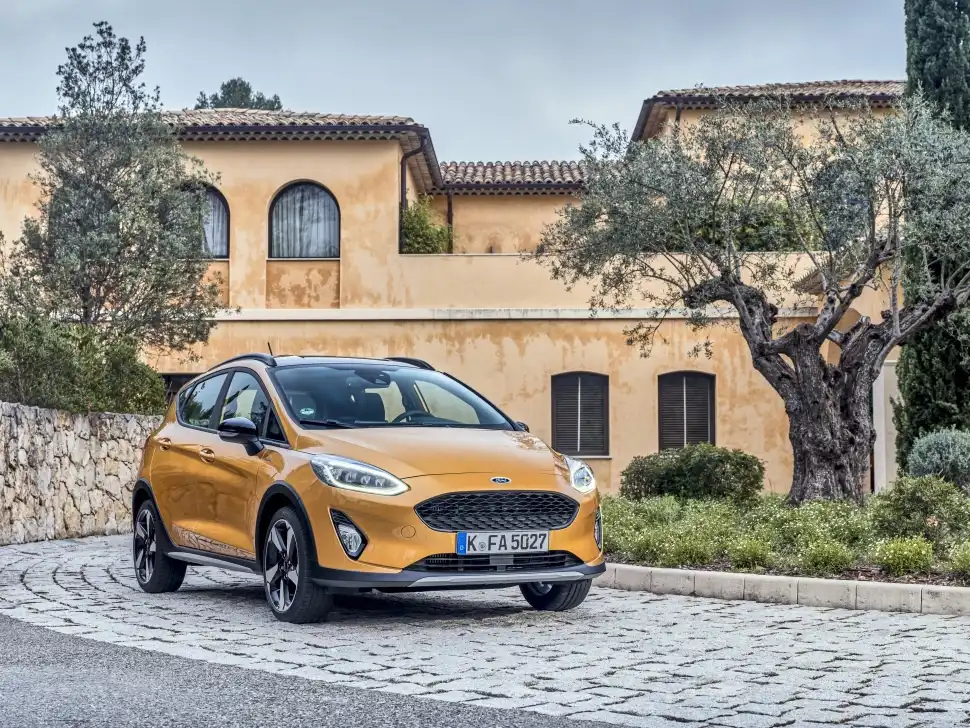
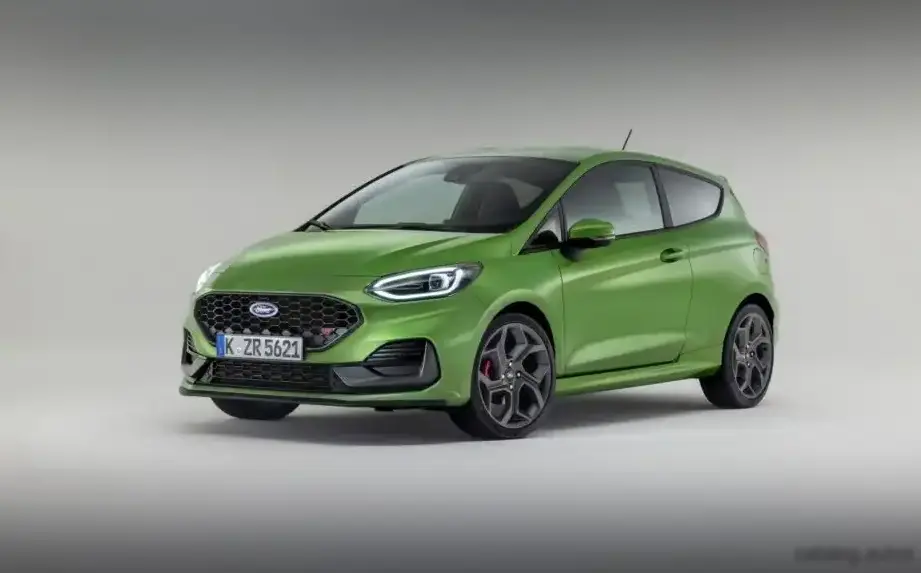
The Ford Fiesta Mk8 facelift, launched in 2021, brought with it a refreshed design and updated technology, including the introduction of mild-hybrid powertrains. The three-door 1.0 EcoBoost 125 hp Hybrid model was a key offering, positioned as a more efficient and refined alternative to the non-hybrid versions. Built on the global B-platform, the Mk8 Fiesta aimed to compete with rivals like the Volkswagen Polo, Renault Clio, and Peugeot 208. The three-door body style, while becoming less common, catered to buyers prioritizing a sportier aesthetic and easier parking in urban environments.
Powertrain & Engine Architecture
At the heart of this Fiesta variant lies the 1.0 EcoBoost B7JB engine, a three-cylinder turbocharged gasoline engine. This engine is coupled with a 48-volt mild-hybrid system. The engine utilizes direct fuel injection and a twin-independent variable camshaft timing (Ti-VCT) system to optimize combustion efficiency and performance. The turbocharger, coupled with an intercooler, provides a boost in power and torque. The mild-hybrid system incorporates a belt-driven integrated starter generator (BiSG) which assists the engine during acceleration and enables start-stop functionality for improved fuel economy. The BiSG also recovers energy during deceleration, storing it in a small 48V lithium-ion battery. The transmission is a six-speed manual gearbox, chosen for its efficiency and driver engagement. The engine produces 125 horsepower at 6000 rpm and 210 Nm (154.89 lb-ft) of torque at 1750 rpm.
Driving Characteristics
The 1.0 EcoBoost 125 hp Hybrid Fiesta offers a surprisingly lively driving experience. While not as overtly powerful as some of its rivals, the combination of the turbocharged engine and the mild-hybrid assistance provides adequate acceleration, achieving 0-60 mph in approximately 8.9 seconds. The six-speed manual transmission allows for precise gear changes, and the engine is responsive throughout the rev range. The mild-hybrid system provides a subtle but noticeable boost during acceleration, smoothing out power delivery. Compared to the lower-powered 1.0 EcoBoost variants, this version feels more capable on the open road, while still maintaining excellent fuel economy. The three-door configuration contributes to a slightly more agile feel, although it does compromise rear passenger access.
Equipment & Trim Levels
The 1.0 EcoBoost 125 hp Hybrid Fiesta typically came equipped with a reasonable level of standard equipment. This included air conditioning, a touchscreen infotainment system with Apple CarPlay and Android Auto compatibility, Bluetooth connectivity, and a suite of safety features such as lane-keeping assist and automatic emergency braking. Higher trim levels, such as Titanium and ST-Line, added features like alloy wheels, a larger touchscreen, a rear-view camera, and upgraded interior trim. Optional extras included a panoramic sunroof, heated seats, and a premium sound system.
Chassis & Braking
The Fiesta Mk8 utilizes a McPherson strut front suspension and a torsion beam rear suspension. This setup provides a good balance between ride comfort and handling. The steering is precise and well-weighted, offering a connected feel to the driver. The front brakes are ventilated discs, while the rear brakes are drums. This configuration is typical for vehicles in this weight class. The Fiesta’s relatively lightweight construction contributes to its agility and braking performance. Electronic stability control (ESC) and anti-lock braking system (ABS) are standard features.
Market Reception & Comparison
The 1.0 EcoBoost 125 hp Hybrid Fiesta was generally well-received by automotive critics. It was praised for its fuel efficiency, responsive engine, and engaging driving dynamics. However, some reviewers noted that the three-cylinder engine could be slightly noisy under heavy acceleration. Compared to the non-hybrid 1.0 EcoBoost variants, the hybrid model offered improved fuel economy and a smoother driving experience. Against rivals like the Volkswagen Polo and Renault Clio, the Fiesta was often seen as offering a more enjoyable driving experience, but potentially lacking some of the interior refinement of its competitors.
Legacy
The Ford Fiesta Mk8 1.0 EcoBoost 125 hp Hybrid represents a significant step forward in terms of fuel efficiency and technology for the Fiesta model line. The 1.0 EcoBoost engine, despite its small displacement, proved to be a reliable and capable powerplant. The mild-hybrid system further enhanced its efficiency without significantly compromising performance. On the used car market, these models are generally sought after for their low running costs and modern features. While the Fiesta itself has been discontinued, the Mk8 generation, and particularly the hybrid variants, are likely to remain popular choices for buyers seeking an affordable and economical supermini.