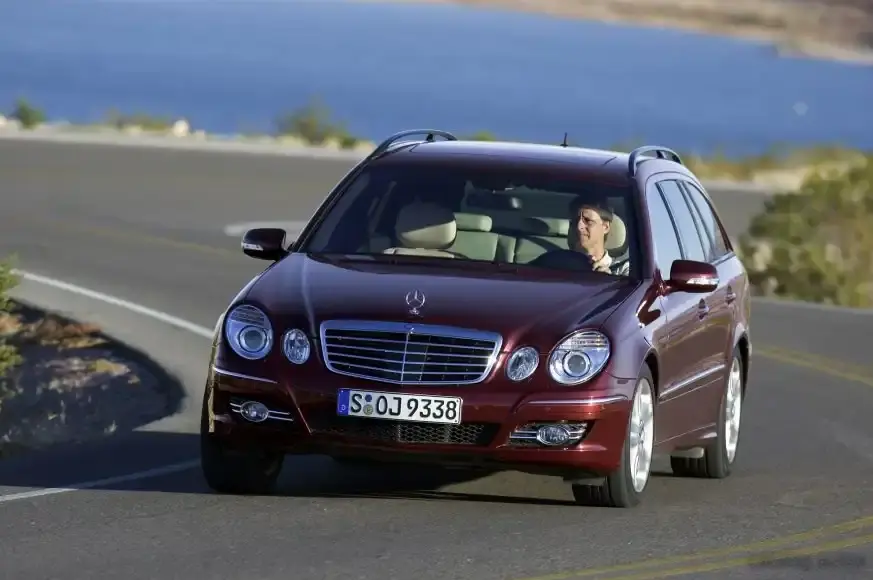
The Mercedes-Benz E-Class T-modell (S211) facelift, specifically the E 230 V6 variant produced from 2007 to 2009, represents a refined iteration of the popular estate car. Positioned as a mid-range offering within the S211 lineup, it bridged the gap between the more economical four-cylinder models and the higher-performance V8 options. This variant aimed to provide a balance of practicality, comfort, and respectable performance for buyers seeking a versatile luxury wagon. The S211 generation, introduced in 2003, was a significant model for Mercedes-Benz, solidifying their presence in the premium estate segment, and the 2006 facelift brought updated styling and improved technology.
Technical Specifications
| Brand | Mercedes-Benz |
| Model | E-Class |
| Generation | E-Class T-modell (S211, facelift 2006) |
| Type (Engine) | E 230 V6 (204 Hp) |
| Start of production | 2007 |
| End of production | 2009 |
| Powertrain Architecture | Internal Combustion engine |
| Body type | Station wagon (estate) |
| Seats | 5 |
| Doors | 5 |
| Fuel consumption (urban) | 13.8-13.9 l/100 km (17 – 16.9 US mpg, 20.5 – 20.3 UK mpg, 7.2 – 7.2 km/l) |
| Fuel consumption (extra urban) | 7.1-7.4 l/100 km (33.1 – 31.8 US mpg, 39.8 – 38.2 UK mpg, 14.1 – 13.5 km/l) |
| Fuel consumption (combined) | 9.6-9.8 l/100 km (24.5 – 24 US mpg, 29.4 – 28.8 UK mpg, 10.4 – 10.2 km/l) |
| CO2 emissions | 229-233 g/km |
| Fuel Type | Petrol (Gasoline) |
| Acceleration 0 – 100 km/h | 9.9 sec |
| Acceleration 0 – 62 mph | 9.9 sec |
| Acceleration 0 – 60 mph | 9.4 sec |
| Maximum speed | 233 km/h (144.78 mph) |
| Emission standard | Euro 4 |
| Weight-to-power ratio | 8.4 kg/Hp, 119.6 Hp/tonne |
| Weight-to-torque ratio | 7 kg/Nm, 143.7 Nm/tonne |
| Power | 204 Hp @ 6100 rpm |
| Torque | 245 Nm @ 2900-5500 rpm (180.7 lb.-ft. @ 2900-5500 rpm) |
| Engine layout | Front, Longitudinal |
| Engine Model/Code | M 272.922 |
| Engine displacement | 2496 cm3 (152.32 cu. in.) |
| Number of cylinders | 6 |
| Engine configuration | V-engine |
| Cylinder Bore | 88 mm (3.46 in.) |
| Piston Stroke | 68.4 mm (2.69 in.) |
| Compression ratio | 11.2:1 |
| Number of valves per cylinder | 4 |
| Fuel injection system | Multi-port manifold injection |
| Engine aspiration | Naturally aspirated engine |
| Valvetrain | DOHC |
| Engine oil capacity | 8 l (8.45 US qt | 7.04 UK qt) |
| Coolant | 10 l (10.57 US qt | 8.8 UK qt) |
| Kerb Weight | 1705 kg (3758.88 lbs.) |
| Max. weight | 2355 kg (5191.89 lbs.) |
| Max load | 650 kg (1433 lbs.) |
| Trunk (boot) space – minimum | 690 l (24.37 cu. ft.) |
| Trunk (boot) space – maximum | 1950 l (68.86 cu. ft.) |
| Fuel tank capacity | 70 l (18.49 US gal | 15.4 UK gal) |
| Max. roof load | 100 kg (220.46 lbs.) |
| Permitted trailer load with brakes (12%) | 1900 kg (4188.78 lbs.) |
| Permitted trailer load without brakes | 750 kg (1653.47 lbs.) |
| Length | 4888 mm (192.44 in.) |
| Width | 1822 mm (71.73 in.) |
| Width including mirrors | 2063 mm (81.22 in.) |
| Height | 1506 mm (59.29 in.) |
| Wheelbase | 2854 mm (112.36 in.) |
| Front track | 1559 mm (61.38 in.) |
| Rear (Back) track | 1552 mm (61.1 in.) |
| Front overhang | 869 mm (34.21 in.) |
| Rear overhang | 1165 mm (45.87 in.) |
| Drag coefficient (Cd) | 0.31 |
| Minimum turning circle (turning diameter) | 11.4 m (37.4 ft.) |
| Drivetrain Architecture | The Internal combustion engine (ICE) drives the rear wheels of the vehicle. |
| Drive wheel | Rear wheel drive |
| Number of gears and type of gearbox | 6 gears, manual transmission |
| Front suspension | Double wishbone, Transverse stabilizer |
| Rear suspension | Independent multi-link suspension, Air suspension, Transverse stabilizer |
| Front brakes | Ventilated discs |
| Rear brakes | Ventilated discs |
| Assisting systems | ABS (Anti-lock braking system) |
| Steering type | Steering rack and pinion |
| Power steering | Hydraulic Steering |
| Tires size | 225/55 R16 |
| Wheel rims size | 7.5J x 16 |
Powertrain & Engine Architecture
The E 230 V6 was powered by the M272.922 engine, a 2.5-liter naturally aspirated V6. This engine, a cornerstone of Mercedes-Benz’s mid-size offerings during this period, featured a 60-degree V-angle and a four-valve-per-cylinder DOHC valvetrain. The M272 engine family was known for its smooth operation and relatively high specific output. Fuel delivery was handled by a multi-port fuel injection system, optimizing combustion efficiency. The engine produced 204 horsepower at 6100 rpm and 245 Nm (180.7 lb-ft) of torque between 2900 and 5500 rpm. The engine’s longitudinal mounting and rear-wheel-drive configuration were typical for Mercedes-Benz vehicles of this era. The standard transmission was a 6-speed manual, although a 5-speed automatic transmission was also available, impacting acceleration and fuel economy slightly.
Driving Characteristics
The E 230 V6 with the manual transmission offered a reasonably engaging driving experience. Acceleration to 60 mph took approximately 9.4 seconds, and top speed was limited to 144.78 mph. While not a sports car, the engine provided sufficient power for comfortable highway cruising and overtaking. The automatic transmission, while offering convenience, resulted in slightly slower acceleration times. The V6 engine delivered a smooth and linear power delivery, making it easy to modulate throttle response. The S211’s suspension, tuned for comfort, absorbed road imperfections well, providing a refined ride quality. However, the estate’s weight and dimensions were noticeable in cornering, with some body roll present.
Equipment & Trim Levels
The E 230 V6 T-modell typically came standard with features such as automatic climate control, power windows and mirrors, a multi-function steering wheel, and a basic audio system. Upholstery was usually a cloth or leatherette combination, with full leather options available as an upgrade. Optional extras included a premium sound system, navigation system, sunroof, heated seats, and parking sensors. The facelifted S211 models also benefited from revised interior trim and updated infotainment systems. Trim levels varied by market, but generally, the E 230 V6 sat in the middle of the range, offering a good balance of features and price.
Chassis & Braking
The S211 E-Class featured a double wishbone front suspension and an independent multi-link rear suspension. Many models, including the E 230 V6, were equipped with air suspension on the rear axle, providing adjustable ride height and improved comfort. Braking duties were handled by ventilated disc brakes on all four wheels, coupled with an ABS (Anti-lock Braking System) for enhanced safety. The steering was a hydraulic power-assisted rack and pinion system, offering precise and responsive control. The chassis was designed to provide a stable and comfortable ride, prioritizing passenger comfort over outright sportiness.
Market Reception & Comparison
The E 230 V6 T-modell was generally well-received by automotive critics. It was praised for its spacious interior, comfortable ride, and refined engine. However, some reviewers noted that the engine lacked the outright punch of the larger V8 models. Compared to the E 320 CDI (diesel) variant, the E 230 V6 offered less torque but a more responsive engine character. Fuel economy was respectable for a gasoline-powered estate car, but the diesel models offered significantly better mileage. The E 230 V6 appealed to buyers who prioritized a smooth and refined driving experience over outright performance.
Legacy
The M272 engine family, including the 2.5-liter V6 found in the E 230 V6, has proven to be relatively reliable, although regular maintenance is crucial. Common issues include oil leaks and occasional problems with the balance shaft. Today, the S211 E-Class T-modell, including the E 230 V6 variant, is a popular choice in the used car market, particularly among those seeking a practical and comfortable luxury estate. Its combination of space, comfort, and reliability makes it a compelling alternative to more modern vehicles. Well-maintained examples continue to command reasonable prices, reflecting the enduring appeal of the Mercedes-Benz E-Class.