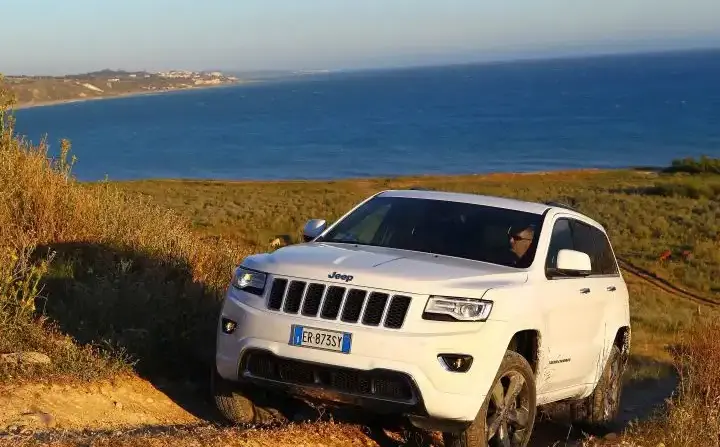
The Jeep Grand Cherokee IV (WK2), specifically the facelifted version produced from 2016 to 2017, offered a 3.6-liter V6 engine producing 299 horsepower paired with an eight-speed automatic transmission and a four-wheel-drive system. This configuration represented a core offering within the WK2 lineup, balancing capability with a more accessible price point compared to the higher-trim models featuring the 5.7L Hemi V8 or the diesel engine options. The facelift brought updated styling, improved interior materials, and enhanced technology features to the already successful WK2 platform.
Technical Specifications
| Brand | Jeep |
| Model | Grand Cherokee |
| Generation | Grand Cherokee IV (WK2, facelift 2013) |
| Type (Engine) | 3.6 V6 (299 Hp) 4×4 Automatic |
| Start of production | 2016 |
| End of production | 2017 |
| Powertrain Architecture | Internal Combustion engine |
| Body type | SUV |
| Seats | 5 |
| Doors | 5 |
| Fuel consumption (urban) | 13.1 l/100 km (18 US mpg, 21.6 UK mpg, 7.6 km/l) |
| Fuel consumption (extra urban) | 9.4 l/100 km (25 US mpg, 30.1 UK mpg, 10.6 km/l) |
| Fuel consumption (combined) | 11.2 l/100 km (21 US mpg, 25.2 UK mpg, 8.9 km/l) |
| Fuel Type | Petrol (Gasoline) |
| Weight-to-power ratio | 7.1 kg/Hp, 141 Hp/tonne |
| Weight-to-torque ratio | 6 kg/Nm, 166.4 Nm/tonne |
| Power | 299 Hp @ 6400 rpm |
| Power per litre | 83 Hp/l |
| Torque | 353 Nm @ 4800 rpm (260.36 lb.-ft. @ 4800 rpm) |
| Engine layout | Front, Longitudinal |
| Engine Model/Code | ERB |
| Engine displacement | 3604 cm3 (219.93 cu. in.) |
| Number of cylinders | 6 |
| Engine configuration | V-engine |
| Cylinder Bore | 96 mm (3.78 in.) |
| Piston Stroke | 83 mm (3.27 in.) |
| Compression ratio | 10.2:1 |
| Number of valves per cylinder | 4 |
| Fuel injection system | Multi-port manifold injection |
| Engine aspiration | Naturally aspirated engine |
| Valvetrain | DOHC |
| Engine oil capacity | 5.7 l (6.02 US qt | 5.02 UK qt) |
| Coolant capacity | 9.9 l (10.46 US qt | 8.71 UK qt) |
| Kerb Weight | 2121 kg (4676 lbs.) |
| Max. weight | 2948 kg (6499.23 lbs.) |
| Max load | 827 kg (1823.22 lbs.) |
| Fuel tank capacity | 93 l (24.57 US gal | 20.46 UK gal) |
| Permitted trailer load with brakes (12%) | 2812 kg (6199.4 lbs.) |
| Length | 4822 mm (189.84 in.) |
| Width | 1943 mm (76.5 in.) |
| Height | 1761 mm (69.33 in.) |
| Wheelbase | 2915 mm (114.76 in.) |
| Front track | 1623 mm (63.9 in.) |
| Rear track | 1627 mm (64.06 in.) |
| Ride height (ground clearance) | 218 mm (8.58 in.) |
| Drag coefficient (Cd) | 0.37 |
| Minimum turning circle | 11.3 m (37.07 ft.) |
| Approach angle | 26.3° |
| Departure angle | 26.5° |
| Ramp-over angle | 18.8° |
| Drive wheel | All wheel drive (4×4) |
| Number of gears | 8 |
| Gearbox type | Automatic transmission |
| Front brakes | Ventilated discs |
| Rear brakes | Disc |
| Assisting systems | ABS (Anti-lock braking system) |
| Steering type | Steering rack and pinion |
| Power steering | Electric Steering |
| Tires size | 245/70 R17 |
| Wheel rims size | 17 |
INTRODUCTION
The 2016-2017 Jeep Grand Cherokee 3.6L V6 4×4 Automatic represents a significant evolution of Jeep’s flagship SUV. Built on the WK2 platform, which debuted in 2011, this facelifted version aimed to refine the Grand Cherokee’s blend of luxury, capability, and technology. The 3.6-liter Pentastar V6 engine, paired with the ZF-sourced eight-speed automatic transmission, was positioned as the entry-level powertrain option, offering a balance between fuel efficiency and adequate performance for most drivers. It served as a stepping stone to the more powerful 5.7L Hemi V8 and the EcoDiesel variants, appealing to buyers prioritizing value and everyday usability.
Powertrain & Engine Architecture
The heart of this Grand Cherokee variant is the 3.6-liter Pentastar V6 engine, designated as the ERB code. This engine is a naturally aspirated, 60-degree V6 featuring a lightweight aluminum block and cylinder heads. It utilizes multi-port fuel injection and a double overhead camshaft (DOHC) valvetrain with four valves per cylinder. The Pentastar engine is known for its smooth operation and relatively high output for its displacement. The eight-speed automatic transmission (845RE) is a crucial component, providing a wide gear ratio spread for improved fuel economy and acceleration. This transmission features a torque converter lock-up clutch for enhanced efficiency during cruising. The 4×4 system employs Jeep’s Quadra-Trac I or Quadra-Trac II, depending on the trim level, offering full-time four-wheel drive with various terrain modes.
Driving Characteristics
The 3.6L V6 and eight-speed automatic combination delivers a comfortable and capable driving experience. While not as exhilarating as the V8 models, the 299 horsepower and 260 lb-ft of torque provide sufficient power for daily commuting and highway cruising. The eight-speed transmission keeps the engine in its optimal power band, resulting in responsive acceleration. The gear ratios are tuned for a balance between fuel economy and performance. Compared to the manual transmission option (available in some markets), the automatic offers smoother shifts and greater convenience, but at the expense of some driver engagement. The 4×4 system provides confident traction in various conditions, making it suitable for light off-road adventures.
Equipment & Trim Levels
The 3.6L V6 Automatic was available across several trim levels, including Laredo, Limited, and Altitude. Standard equipment on the Laredo typically included features like air conditioning, a touchscreen infotainment system, and basic safety features. Higher trims, such as the Limited, added luxury features like leather upholstery, heated seats, a premium sound system, and advanced driver-assistance systems. Optional extras included a panoramic sunroof, navigation system, and various appearance packages. Interior upholstery ranged from cloth on the base models to leather on the higher trims. Dashboard configurations were consistent across the range, with a focus on user-friendly controls and a modern design.
Chassis & Braking
The WK2 Grand Cherokee utilizes an independent front suspension with coil springs and stabilizer bar, and a multi-link independent rear suspension. The suspension tuning is geared towards providing a comfortable ride while maintaining good handling characteristics. The braking system consists of ventilated discs at the front and solid discs at the rear. Anti-lock brakes (ABS) are standard, along with electronic stability control and traction control. The stabilizer bar thickness varies depending on the trim level, with higher trims often featuring thicker bars for improved handling. The overall chassis design prioritizes a balance between on-road comfort and off-road capability.
Market Reception & Comparison
The 3.6L V6 Grand Cherokee received generally positive reviews from automotive critics. It was praised for its comfortable ride, spacious interior, and user-friendly technology. However, some critics noted that the V6 engine could feel strained when towing or accelerating aggressively. Compared to the 5.7L Hemi V8, the V6 offered significantly better fuel economy but lacked the V8’s raw power. The EcoDiesel variant provided even better fuel economy but came with a higher price tag. In terms of reliability, the Pentastar V6 engine has proven to be relatively robust, although some owners have reported issues with the eight-speed automatic transmission.
Legacy
The 2016-2017 Jeep Grand Cherokee 3.6L V6 4×4 Automatic remains a popular choice in the used car market. Its combination of affordability, capability, and comfort makes it an attractive option for buyers seeking a versatile SUV. The Pentastar V6 engine and eight-speed automatic transmission have proven to be generally reliable, although regular maintenance is essential. While the transmission has had some reported issues, many owners have experienced years of trouble-free operation. The WK2 Grand Cherokee, in general, has established a reputation as a well-rounded and capable SUV, and the 3.6L V6 variant continues to offer a compelling value proposition.