
Technical Specifications
| Brand | Iveco |
| Model | Daily |
| Generation | Daily III Panel Van |
| Type (Engine) | 2.3 Multijet (106 Hp) L4H3 |
| Start of production | April, 2014 |
| End of production | April, 2016 |
| Powertrain Architecture | Internal Combustion engine |
| Body type | Van |
| Seats | 3 |
| Doors | 4-5 |
| Fuel consumption (economy) – urban (NEDC) | 7.9-8.7 l/100 km (29.8 – 27 US mpg, 35.8 – 32.5 UK mpg, 12.7 – 11.5 km/l) |
| Fuel consumption (economy) – extra urban (NEDC) | 6.8-7.6 l/100 km (34.6 – 30.9 US mpg, 41.5 – 37.2 UK mpg, 14.7 – 13.2 km/l) |
| Fuel consumption (economy) – combined (NEDC) | 7.2-8 l/100 km (32.7 – 29.4 US mpg, 39.2 – 35.3 UK mpg, 13.9 – 12.5 km/l) |
| CO2 emissions (NEDC) | 190-211 g/km |
| Fuel Type | Diesel |
| Emission standard | Euro 5 |
| Weight-to-power ratio | 22.8 kg/Hp, 43.8 Hp/tonne |
| Weight-to-torque ratio | 9 kg/Nm, 111.5 Nm/tonne |
| Power | 106 Hp @ 2750-3900 rpm |
| Power per litre | 46.3 Hp/l |
| Torque | 270 Nm @ 1500-2750 rpm (199.14 lb.-ft. @ 1500-2750 rpm) |
| Engine layout | Front, Longitudinal |
| Engine Model/Code | F1AFL411A |
| Engine displacement | 2287 cm3 (139.56 cu. in.) |
| Number of cylinders | 4 |
| Engine configuration | Inline |
| Cylinder Bore | 88 mm (3.46 in.) |
| Piston Stroke | 94 mm (3.7 in.) |
| Number of valves per cylinder | 4 |
| Fuel injection system | Diesel Commonrail |
| Engine aspiration | Turbocharger, Intercooler |
| Valvetrain | DOHC |
| Engine oil capacity | 4.3 l (4.54 US qt | 3.78 UK qt) |
| Coolant | 16 l (16.91 US qt | 14.08 UK qt) |
| Kerb Weight | 2422-2431 kg (5339.6 – 5359.44 lbs.) |
| Max. weight | 3500 kg (7716.18 lbs.) |
| Max load | 1069-1078 kg (2356.74 – 2376.58 lbs.) |
| Trunk (boot) space – minimum | 18000 l (635.66 cu. ft.) |
| Fuel tank capacity | 70 l (18.49 US gal | 15.4 UK gal) |
| Permitted trailer load with brakes (12%) | 3500 kg (7716.18 lbs.) |
| Permitted trailer load without brakes | 750 kg (1653.47 lbs.) |
| Permitted towbar download | 140 kg (308.65 lbs.) |
| Length | 7234 mm (284.8 in.) |
| Width | 2010 mm (79.13 in.) |
| Height | 2780 mm (109.45 in.) |
| Wheelbase | 4100 mm (161.42 in.) |
| Front track | 1740 mm (68.5 in.) |
| Rear (Back) track | 1704 mm (67.09 in.) |
| Front overhang | 1008 mm (39.69 in.) |
| Rear overhang | 2126 mm (83.7 in.) |
| Ride height (ground clearance) | 180 mm (7.09 in.) |
| Minimum turning circle (turning diameter) | 13.8 m (45.28 ft.) |
| Drivetrain Architecture | The Internal combustion engine (ICE) drives the rear wheels of the vehicle. |
| Drive wheel | Rear wheel drive |
| Number of gears and type of gearbox | 6 gears, manual transmission |
| Front suspension | Double wishbone, Transverse stabilizer, Leaf spring |
| Rear suspension | Rigid axle suspension, Transverse stabilizer, Leaf spring, Air Suspension – Optional |
| Front brakes | Ventilated discs, 300 mm |
| Rear brakes | Disc, 296 mm |
| Assisting systems | ABS (Anti-lock braking system) |
| Steering type | Steering rack and pinion |
| Power steering | Hydraulic Steering |
| Tires size | 225/65 R16; 235/65 R16 |
| Wheel rims size | 6.5J x 16 |
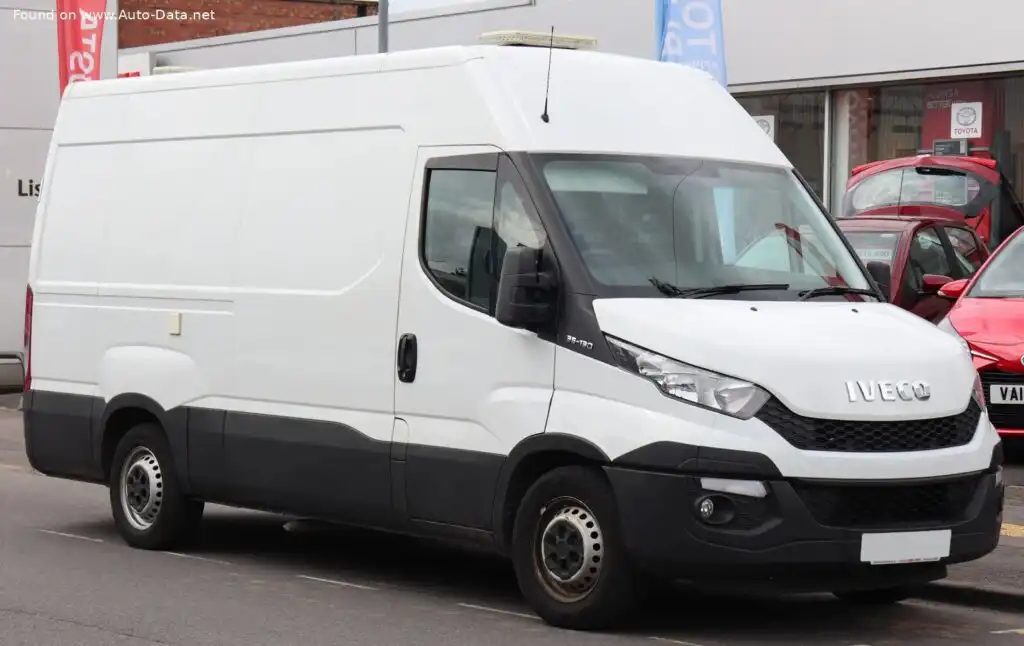
The Iveco Daily III, launched in 2006, represented a significant evolution in the brand’s light commercial vehicle range. The 2.3 Multijet (106 Hp) L4H3 variant, introduced in 2014, was positioned as an entry-level to mid-range option within the Daily III lineup. It catered to businesses requiring a versatile and economical van with a substantial cargo capacity. The L4H3 configuration, denoting a long wheelbase and high roof, made it particularly suitable for delivery services, mobile workshops, and trades requiring the transport of bulky items. This model was primarily sold in Europe and other markets where Iveco had a strong presence, competing with vehicles like the Mercedes-Benz Sprinter, Ford Transit, and Volkswagen Crafter.
Powertrain & Engine Architecture
At the heart of the Daily III 2.3 Multijet (106 Hp) L4H3 lies the F1AFL411A engine, a 2.3-liter inline-four cylinder diesel. This engine is part of Iveco’s Multijet family, utilizing common-rail direct injection technology for improved fuel efficiency and reduced emissions. The 106 horsepower output is achieved at 2750-3900 rpm, with a torque figure of 270 Nm (199.14 lb.-ft.) available between 1500-2750 rpm. The engine features a turbocharger with an intercooler to enhance power and efficiency. The valvetrain employs a Double Overhead Camshaft (DOHC) configuration with four valves per cylinder. This specific variant was typically paired with a six-speed manual transmission, although an automated manual transmission (AMT) was sometimes offered as an option. The engine is longitudinally mounted at the front of the vehicle, driving the rear wheels.
Driving Characteristics
The 106 hp output and six-speed manual transmission of the Daily III 2.3 Multijet L4H3 provided adequate, though not exhilarating, performance. Acceleration was geared towards practicality rather than speed, with a focus on maintaining momentum on inclines and providing sufficient power for everyday delivery tasks. The gear ratios were optimized for fuel economy and load-carrying capability. Compared to higher-powered Daily variants, such as those equipped with the 3.0-liter engine, this version felt less responsive, particularly when fully loaded. However, the lower power output also contributed to improved fuel efficiency. The rear-wheel-drive configuration provided good traction, especially when combined with a reasonable load in the cargo area. The steering, while hydraulic, lacked the precision of some competitors, but offered sufficient control for maneuvering in urban environments.
Equipment & Trim Levels
The Iveco Daily III 2.3 Multijet (106 Hp) L4H3 typically came with a functional, rather than luxurious, interior. Standard equipment included a driver’s air bag, power steering, and a basic audio system. The cabin featured durable plastic trim and cloth upholstery. The dashboard layout was straightforward and focused on practicality, with easily accessible controls. Optional extras included air conditioning, electric windows, a passenger airbag, and a more advanced audio system with Bluetooth connectivity. Trim levels were relatively basic, with the emphasis on providing a robust and reliable work vehicle. Features like cruise control and advanced infotainment systems were generally reserved for higher-spec Daily models.
Chassis & Braking
The Daily III chassis is built around a ladder-frame construction, providing a robust and durable platform for heavy-duty applications. The front suspension utilizes a double wishbone setup with a transverse stabilizer and leaf springs, while the rear suspension employs a rigid axle with leaf springs and an optional air suspension system. The braking system consists of ventilated discs at the front (300mm) and discs at the rear (296mm), equipped with an Anti-lock Braking System (ABS) as standard. The suspension was tuned to prioritize load-carrying capacity and stability, rather than ride comfort. The rear suspension, in particular, was designed to handle significant weight without compromising handling.
Market Reception & Comparison
The Iveco Daily III 2.3 Multijet (106 Hp) L4H3 was generally well-received by commercial vehicle operators for its reliability, fuel efficiency, and cargo capacity. Critics noted that the 106 hp engine could feel underpowered when fully loaded, particularly on hilly terrain. However, its lower running costs and robust construction made it a popular choice for businesses operating on tight budgets. Compared to the more powerful Daily variants, this version offered a more affordable entry point into the range, but at the expense of performance. Against competitors like the Mercedes-Benz Sprinter and Ford Transit, the Daily III offered a competitive package, particularly in terms of payload capacity and durability.
Legacy
The Iveco Daily III 2.3 Multijet (106 Hp) L4H3 has proven to be a durable and reliable workhorse in the used commercial vehicle market. The F1AFL411A engine, while not known for being particularly refined, is generally considered to be robust and relatively easy to maintain. Common issues include wear and tear on the turbocharger and potential problems with the fuel injection system, but these are typically manageable with regular maintenance. Today, these vans can be found in service across Europe, often with high mileage, testament to their inherent durability. They remain a popular choice for small businesses and tradespeople seeking a cost-effective and practical commercial vehicle.
