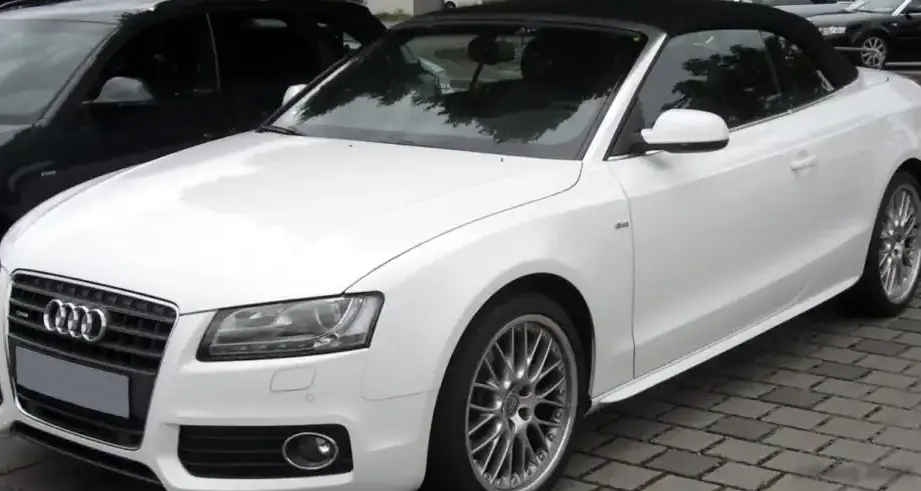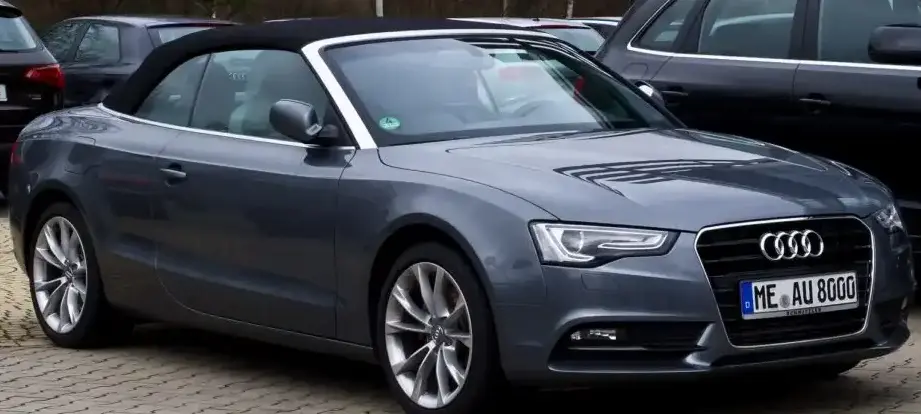
The Audi A5 Cabriolet 2.0 TDI (163 hp) Multitronic, produced from 2011 to 2014, represents a compelling blend of open-air motoring and diesel efficiency within the broader A5 (8F7) facelift range. Positioned as a mid-range offering, this variant aimed to provide a more economical alternative to the higher-powered gasoline engines while still delivering a refined driving experience. It occupied a space between the entry-level 1.8 TFSI models and the more performance-oriented 2.0 TFSI quattro versions. This model was primarily marketed in Europe, where diesel engines held a significant market share, and offered a balance of fuel economy, reasonable performance, and Audi’s characteristic luxury.
Technical Specifications
| Brand | Audi |
| Model | A5 |
| Generation | A5 Cabriolet (8F7, facelift 2011) |
| Type (Engine) | 2.0 TDI (163 Hp) Multitronic |
| Start of production | 2011 |
| End of production | 2014 |
| Powertrain Architecture | Internal Combustion engine |
| Body type | Cabriolet |
| Seats | 4 |
| Doors | 2 |
| Fuel consumption (urban) | 5.8 l/100 km (40.6 US mpg, 48.7 UK mpg, 17.2 km/l) |
| Fuel consumption (extra urban) | 4.6 l/100 km (51.1 US mpg, 61.4 UK mpg, 21.7 km/l) |
| Fuel consumption (combined) | 5 l/100 km (47 US mpg, 56.5 UK mpg, 20 km/l) |
| CO2 emissions | 132 g/km |
| Fuel Type | Diesel |
| Acceleration 0 – 100 km/h | 8 sec |
| Acceleration 0 – 62 mph | 8 sec |
| Acceleration 0 – 60 mph | 7.6 sec |
| Maximum speed | 213 km/h (132.35 mph) |
| Emission standard | Euro 5 |
| Weight-to-power ratio | 10.3 kg/Hp, 97 Hp/tonne |
| Weight-to-torque ratio | 5.3 kg/Nm, 190.5 Nm/tonne |
| Power | 163 Hp @ 4200 rpm |
| Power per litre | 82.8 Hp/l |
| Torque | 320 Nm @ 1750-2500 rpm (236.02 lb.-ft. @ 1750-2500 rpm) |
| Engine layout | Front, Longitudinal |
| Engine Model/Code | CGLD, CNHC |
| Engine displacement | 1968 cm3 (120.09 cu. in.) |
| Number of cylinders | 4 |
| Engine configuration | Inline |
| Cylinder Bore | 81 mm (3.19 in.) |
| Piston Stroke | 95.5 mm (3.76 in.) |
| Compression ratio | 16.5:1 |
| Number of valves per cylinder | 4 |
| Fuel injection system | Diesel Commonrail |
| Engine aspiration | Turbocharger, Intercooler |
| Valvetrain | DOHC |
| Engine oil capacity | 4.7 l (4.97 US qt | 4.14 UK qt) |
| Kerb Weight | 1680 kg (3703.77 lbs.) |
| Max. weight | 2180 kg (4806.08 lbs.) |
| Max load | 500 kg (1102.31 lbs.) |
| Trunk (boot) space – minimum | 320 l (11.3 cu. ft.) |
| Trunk (boot) space – maximum | 750 l (26.49 cu. ft.) |
| Fuel tank capacity | 63 l (16.64 US gal | 13.86 UK gal) |
| Permitted trailer load with brakes (8%) | 1900 kg (4188.78 lbs.) |
| Permitted trailer load without brakes | 750 kg (1653.47 lbs.) |
| Permitted towbar download | 80 kg (176.37 lbs.) |
| Length | 4626 mm (182.13 in.) |
| Width | 1854 mm (72.99 in.) |
| Width including mirrors | 2020 mm (79.53 in.) |
| Height | 1383 mm (54.45 in.) |
| Wheelbase | 2751 mm (108.31 in.) |
| Front track | 1590 mm (62.6 in.) |
| Rear (Back) track | 1577 mm (62.09 in.) |
| Front overhang | 861 mm (33.9 in.) |
| Rear overhang | 1014 mm (39.92 in.) |
| Drag coefficient (Cd) | 0.31 |
| Minimum turning circle (turning diameter) | 11.4 m (37.4 ft.) |
| Drivetrain Architecture | The Internal combustion engine (ICE) drives the front wheels of the vehicle. |
| Drive wheel | Front wheel drive |
| Number of gears and type of gearbox | automatic transmission Multitronic |
| Front suspension | Independent multi-link suspension |
| Rear suspension | Independent on trapezoidal lever |
| Front brakes | Ventilated discs |
| Rear brakes | Disc |
| Assisting systems | ABS (Anti-lock braking system) |
| Steering type | Steering rack and pinion |
| Power steering | Electric Steering |
| Tires size | 225/50 R17 |
| Wheel rims size | 7.5J x 17 |
Powertrain & Engine Architecture
The heart of this A5 Cabriolet is the 2.0-liter four-cylinder diesel engine, identified by engine codes CGLD or CNHC. This engine is a member of the Volkswagen Group’s modular engine family, known for its compact dimensions and efficiency. It features common rail direct injection, delivering fuel at extremely high pressure for optimized combustion. The engine utilizes a turbocharger with an intercooler to boost power output and improve torque across a wide rev range. The valvetrain employs a dual overhead camshaft (DOHC) configuration with four valves per cylinder, enhancing breathing and contributing to the engine’s overall performance. The Multitronic transmission is a continuously variable transmission (CVT) offering smooth, stepless gear changes. It utilizes a chain-driven belt to vary the gear ratio, providing optimal engine efficiency and responsiveness.
Driving Characteristics
The 163 hp and 320 Nm (236 lb-ft) of torque delivered by the 2.0 TDI engine, coupled with the Multitronic transmission, resulted in a comfortable and refined driving experience. Acceleration from 0-62 mph took approximately 8 seconds, which was adequate for everyday driving but noticeably slower than the more powerful gasoline variants. The Multitronic transmission prioritized fuel efficiency, keeping engine speeds low during cruising. While this contributed to excellent fuel economy (around 47 US mpg combined), it sometimes resulted in a slightly less engaging driving experience compared to a traditional automatic or manual transmission. The engine provided strong low-end torque, making it easy to navigate city streets and overtake slower vehicles. However, the engine lacked the outright punch of the higher-output 2.0 TFSI models.
Equipment & Trim Levels
The 2.0 TDI Multitronic Cabriolet typically came equipped with a respectable level of standard features. These included automatic climate control, a multi-function steering wheel, an Audi Concert audio system, and alloy wheels. Interior upholstery was generally cloth, with leather options available as an upgrade. Common optional extras included navigation systems, parking sensors, heated seats, and upgraded audio systems. The trim level often influenced the availability of certain features, with higher trims offering more luxurious appointments and advanced technology.
Chassis & Braking
The A5 Cabriolet’s chassis featured an independent multi-link suspension at the front and an independent trapezoidal lever suspension at the rear, providing a comfortable ride and good handling characteristics. The front brakes were ventilated discs, while the rear brakes were solid discs. Anti-lock Braking System (ABS) was standard. The suspension was tuned to prioritize comfort, but still offered a reasonably controlled driving experience. Stabilizer bars were fitted to both the front and rear axles to reduce body roll during cornering.
Market Reception & Comparison
The Audi A5 Cabriolet 2.0 TDI Multitronic was generally well-received by automotive critics. It was praised for its fuel efficiency, comfortable ride, and refined interior. However, some reviewers noted that the engine lacked the excitement of the gasoline variants and that the Multitronic transmission could feel somewhat detached. Compared to the 1.8 TFSI models, the 2.0 TDI offered better fuel economy and more torque, but at a slightly higher price point. Compared to the 2.0 TFSI quattro, it sacrificed performance for efficiency and cost.
Legacy
The 2.0 TDI engine, in various iterations, proved to be a reliable and durable powertrain. The Multitronic transmission, however, has a more mixed reputation. While generally smooth and efficient, it can be prone to issues if not properly maintained, particularly regarding fluid changes. Today, well-maintained examples of the A5 Cabriolet 2.0 TDI Multitronic represent a good value on the used car market, offering a stylish and economical open-top driving experience. Regular servicing and adherence to the manufacturer’s recommended maintenance schedule are crucial for ensuring the long-term reliability of this powertrain.