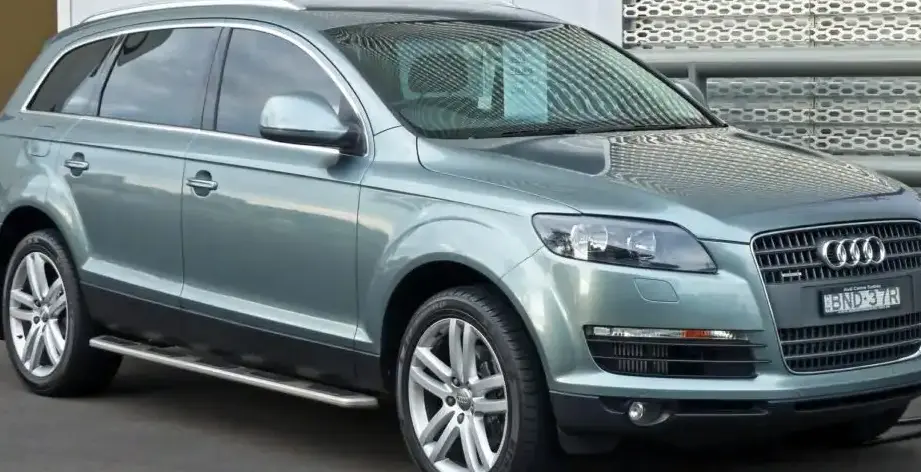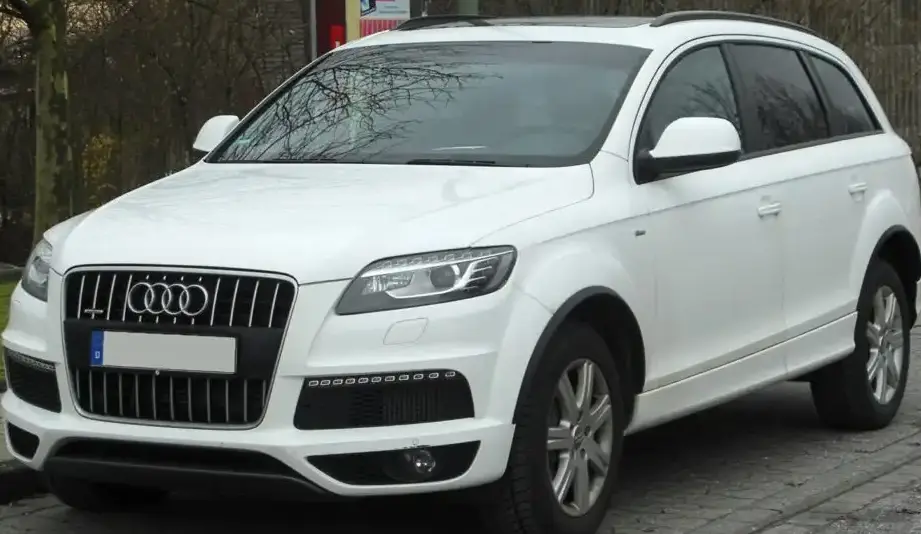
The Audi Q7 3.0 TDI, specifically the facelifted version produced from 2009 to 2015 (Typ 4L), represented a significant offering in the luxury SUV segment. This variant, powered by a 3.0-liter V6 turbodiesel engine producing 240 horsepower and paired with an 8-speed Tiptronic automatic transmission and Audi’s quattro all-wheel drive system, was introduced in May 2010 and continued through April 2011. It occupied a middle ground within the Q7 lineup, offering a balance between performance, fuel efficiency, and luxury features, appealing to buyers seeking a capable and refined SUV for family use and long-distance travel. The “clean diesel” designation highlighted Audi’s efforts to meet increasingly stringent emissions standards.
Technical Specifications
| Brand | Audi |
| Model | Q7 |
| Generation | Q7 (Typ 4L, facelift 2009) |
| Type (Engine) | 3.0 TDI V6 clean diesel (240 Hp) quattro 8 tiptronic 6-7 Seat |
| Start of production | May, 2010 |
| End of production | April, 2011 |
| Powertrain Architecture | Internal Combustion engine |
| Body type | SUV |
| Seats | 6-7 |
| Doors | 5 |
| Fuel consumption (urban) | 10.9 l/100 km (21.6 US mpg, 25.9 UK mpg, 9.2 km/l) |
| Fuel consumption (extra urban) | 6.9 l/100 km (34.1 US mpg, 40.9 UK mpg, 14.5 km/l) |
| Fuel consumption (combined) | 8.4 l/100 km (28 US mpg, 33.6 UK mpg, 11.9 km/l) |
| CO2 emissions | 219 g/km |
| Fuel Type | Diesel |
| Acceleration 0 – 100 km/h | 8.1 sec |
| Acceleration 0 – 62 mph | 8.1 sec |
| Acceleration 0 – 60 mph | 7.7 sec |
| Maximum speed | 215 km/h (133.59 mph) |
| Emission standard | Euro 5 |
| Weight-to-power ratio | 9.9 kg/Hp, 101.5 Hp/tonne |
| Weight-to-torque ratio | 4.3 kg/Nm, 232.6 Nm/tonne |
| Power | 240 Hp @ 4000-4400 rpm |
| Power per litre | 80.9 Hp/l |
| Torque | 550 Nm @ 2000-3000 rpm (405.66 lb.-ft. @ 2000-3000 rpm) |
| Engine layout | Front, Longitudinal |
| Engine Model/Code | EA896 evo / CCMA, CJGA |
| Engine displacement | 2967 cm3 (181.06 cu. in.) |
| Number of cylinders | 6 |
| Engine configuration | V-engine |
| Cylinder Bore | 83 mm (3.27 in.) |
| Piston Stroke | 91.4 mm (3.6 in.) |
| Compression ratio | 16.8:1 |
| Number of valves per cylinder | 4 |
| Fuel injection system | Diesel Commonrail |
| Engine aspiration | Turbocharger, Intercooler |
| Valvetrain | DOHC |
| Engine oil capacity | 8.2 l (8.66 US qt | 7.21 UK qt) |
| Coolant | 18 l (19.02 US qt | 15.84 UK qt) |
| Kerb Weight | 2365 kg (5213.93 lbs.) |
| Max. weight | 3190 kg (7032.75 lbs.) |
| Max load | 825 kg (1818.81 lbs.) |
| Trunk (boot) space – minimum | 330 l (11.65 cu. ft.) |
| Trunk (boot) space – maximum | 2035 l (71.87 cu. ft.) |
| Fuel tank capacity | 100 l (26.42 US gal | 22 UK gal) |
| AdBlue tank | 12 l (3.17 US gal | 2.64 UK gal) |
| Max. roof load | 100 kg (220.46 lbs.) |
| Permitted trailer load with brakes (8%) | 3200 kg (7054.79 lbs.) |
| Permitted trailer load with brakes (12%) | 3200 kg (7054.79 lbs.) |
| Permitted trailer load without brakes | 750 kg (1653.47 lbs.) |
| Permitted towbar download | 130 kg (286.6 lbs.) |
| Length | 5089 mm (200.35 in.) |
| Width | 1983 mm (78.07 in.) |
| Width including mirrors | 2177 mm (85.71 in.) |
| Height | 1737 mm (68.39 in.) |
| Wheelbase | 3002 mm (118.19 in.) |
| Front track | 1651 mm (65 in.) |
| Rear (Back) track | 1681 mm (66.18 in.) |
| Front overhang | 962 mm (37.87 in.) |
| Rear overhang | 1125 mm (44.29 in.) |
| Ride height (ground clearance) | 205 mm (8.07 in.) |
| Drag coefficient (Cd) | 0.37 |
| Minimum turning circle (turning diameter) | 12 m (39.37 ft.) |
| Approach angle | 21° |
| Departure angle | 23.4° |
| Ramp-over (brakeover) angle | 21.1° |
| Climb angle | 31° |
| Wading depth | 500 mm (19.69 in.) |
| Drivetrain Architecture | The Internal combustion engine (ICE) drives permanently the four wheels of the vehicle. |
| Drive wheel | All wheel drive (4×4) |
| Number of gears and type of gearbox | 8 gears, automatic transmission tiptronic |
| Front suspension | Coil spring, Double wishbone, Transverse stabilizer, Air Suspension – Optional |
| Rear suspension | Double wishbone, Transverse stabilizer, Coil spring, Air Suspension – Optional |
| Front brakes | Ventilated discs |
| Rear brakes | Ventilated discs |
| Assisting systems | ABS (Anti-lock braking system) |
| Steering type | Steering rack and pinion |
| Power steering | Hydraulic Steering |
| Tires size | 235/60 R18; 255/55 R18; 265/50 R19; 275/45 R20; 295/40 R20; 295/35 R21 |
| Wheel rims size | 7.5J x 18; 8J x 18; 8.5J x 19; 9J x 20; 10J x 20; 10J x 21 |
INTRODUCTION
The Audi Q7 3.0 TDI, as part of the Typ 4L facelift released in 2009, built upon the foundation of the original Q7 launched in 2006. This update brought revised styling, improved interior materials, and enhanced technology. The 3.0 TDI variant, with its 240 horsepower output and eight-speed Tiptronic transmission, was a popular choice in European markets, where diesel engines held a significant market share. In the US, the Q7 was primarily offered with gasoline engines, making this diesel version a relatively rare sight. This configuration aimed to provide a blend of luxury, space, and reasonable fuel economy for families and those needing a versatile SUV.
Powertrain & Engine Architecture
At the heart of the Q7 3.0 TDI lies the EA896 evo engine family, specifically the CCMA or CJGA engine code depending on the exact production date and market. This 3.0-liter V6 diesel engine utilizes a common rail direct injection system, delivering fuel at extremely high pressure for optimized combustion. The engine features a single turbocharger with an intercooler to increase air density and boost power. The double overhead camshaft (DOHC) valvetrain, with four valves per cylinder, contributes to efficient gas exchange. The 8-speed Tiptronic automatic transmission, a ZF-sourced unit, provides smooth and responsive gear changes. It offers a manual shift mode for greater driver control. The transmission’s wide gear ratio spread helps to optimize both fuel economy and performance. The engine also incorporated a particulate filter and, in some markets, a Start & Stop system to further reduce emissions.
Driving Characteristics
The 240 hp and 405 lb-ft of torque delivered by the 3.0 TDI engine provided the Q7 with respectable performance. Acceleration from 0-60 mph took around 7.7 to 8.1 seconds, making it adequately quick for everyday driving and highway merging. The Tiptronic transmission, while smooth, wasn’t as sporty as some dual-clutch transmissions. However, it offered a comfortable and refined driving experience. The quattro all-wheel-drive system provided excellent traction in various weather conditions. The Q7’s substantial weight (around 5,214 lbs) was noticeable, particularly during spirited driving. Compared to the higher-output 3.6L gasoline V6 or the performance-oriented 4.2L V8, the 3.0 TDI prioritized fuel efficiency and torque over outright speed. The torque delivery was strong and consistent throughout the rev range, making it well-suited for towing and hauling.
Equipment & Trim Levels
The Q7 3.0 TDI typically came well-equipped, even in base trim. Standard features included leather upholstery, tri-zone automatic climate control, a premium audio system, and power-adjustable front seats. Optional extras included a panoramic sunroof, adaptive air suspension, navigation system, and advanced driver-assistance systems like adaptive cruise control and lane departure warning. Interior trim options varied, with choices in wood or aluminum accents. The Q7 offered seating for up to seven passengers, with a third-row seat that could be folded flat to increase cargo space. The interior design was typically understated and elegant, reflecting Audi’s commitment to quality and refinement.
Chassis & Braking
The Q7’s chassis featured a double-wishbone suspension setup at both the front and rear. Coil springs were standard, but an optional air suspension system was available, providing adjustable ride height and improved comfort. Stabilizer bars were fitted front and rear to reduce body roll during cornering. The braking system consisted of ventilated discs on all four wheels, providing ample stopping power. Anti-lock brakes (ABS) and electronic stability control (ESC) were standard safety features. The Q7’s steering was hydraulic, offering a direct and responsive feel.
Market Reception & Comparison
The Audi Q7 3.0 TDI was generally well-received by automotive critics. It was praised for its comfortable ride, spacious interior, and fuel-efficient engine. However, some critics noted its substantial weight and relatively high price. Compared to other trims in the Q7 lineup, the 3.0 TDI offered a compelling balance between performance and economy. The gasoline-powered Q7 models provided more horsepower but consumed significantly more fuel. The 4.2L V8 offered even greater performance but came at a substantial price premium. In terms of reliability, the 3.0 TDI engine proved to be generally robust, although diesel particulate filter issues could occur with infrequent long-distance driving.
Legacy
The Audi Q7 3.0 TDI (Typ 4L) has established a reputation as a reliable and capable luxury SUV. On the used car market, these models remain desirable, particularly those with well-maintained service histories. The 3.0 TDI engine is known for its longevity, although preventative maintenance, such as regular oil changes and diesel particulate filter cleaning, is crucial. The Q7’s spacious interior and comfortable ride continue to appeal to buyers seeking a versatile and refined SUV. While newer Q7 generations have since been introduced, the Typ 4L remains a popular choice for those seeking a well-built and capable luxury SUV at a more affordable price point.