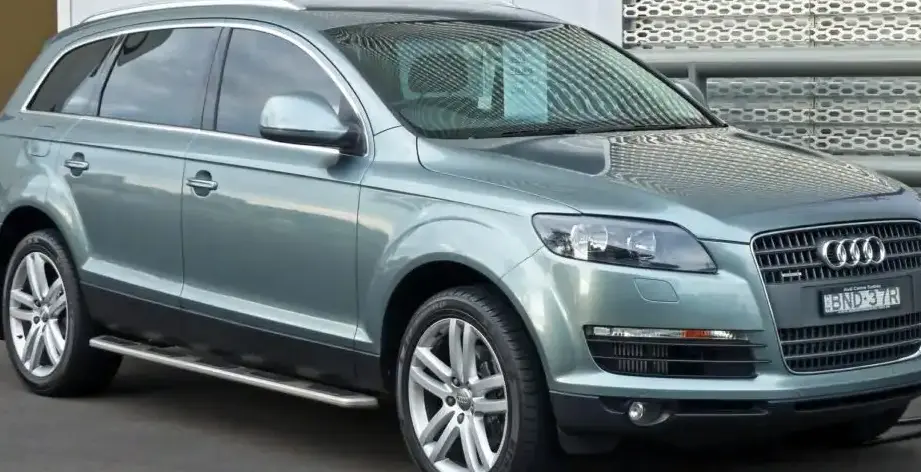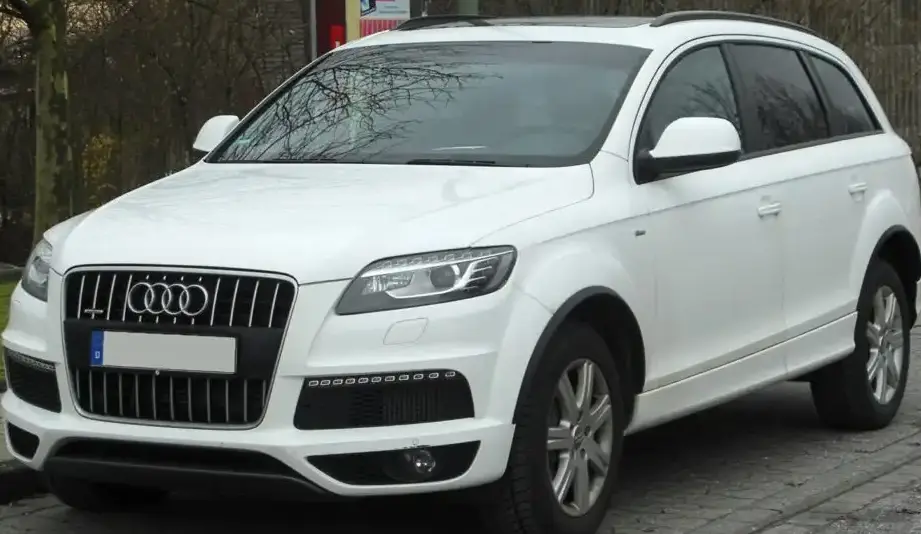
The Audi Q7 (Typ 4L, facelift 2009) 3.0 TDI V6 clean diesel, producing 245 horsepower, coupled with the quattro all-wheel drive system and a tiptronic transmission, represents a significant iteration of Audi’s luxury SUV. Production of this specific configuration ran from May 2011 to August 2015. This variant occupied a middle-ground position within the Q7 lineup, offering a balance between performance, fuel efficiency, and luxury features, appealing to buyers seeking a capable and refined SUV for both daily driving and long-distance travel. It built upon the foundation of the Typ 4L Q7, which debuted in 2006, and benefited from the mid-cycle facelift that brought updated styling and improved technology.
Technical Specifications
| Brand | Audi |
| Model | Q7 |
| Generation | Q7 (Typ 4L, facelift 2009) |
| Type (Engine) | 3.0 TDI V6 clean diesel (245 Hp) quattro tiptronic |
| Start of production | May, 2011 |
| End of production | August, 2015 |
| Powertrain Architecture | Internal Combustion engine |
| Body type | SUV |
| Seats | 5 |
| Doors | 5 |
| Fuel consumption (urban) | 8.8 l/100 km (26.7 US mpg, 32.1 UK mpg, 11.4 km/l) |
| Fuel consumption (extra urban) | 6.6 l/100 km (35.6 US mpg, 42.8 UK mpg, 15.2 km/l) |
| Fuel consumption (combined) | 7.4 l/100 km (31.8 US mpg, 38.2 UK mpg, 13.5 km/l) |
| CO2 emissions | 195 g/km |
| Fuel Type | Diesel |
| Acceleration 0 – 100 km/h | 8 sec |
| Acceleration 0 – 62 mph | 8 sec |
| Acceleration 0 – 60 mph | 7.6 sec |
| Maximum speed | 216 km/h (134.22 mph) |
| Emission standard | Euro 6 |
| Weight-to-power ratio | 9.5 kg/Hp, 105.6 Hp/tonne |
| Weight-to-torque ratio | 4.2 kg/Nm, 237.1 Nm/tonne |
| Power | 245 Hp @ 4000-4400 rpm |
| Power per litre | 82.6 Hp/l |
| Torque | 550 Nm @ 1750-2750 rpm (405.66 lb.-ft. @ 1750-2750 rpm) |
| Engine layout | Front, Longitudinal |
| Engine Model/Code | CJGD, CLZB, CRCA |
| Engine displacement | 2967 cm3 (181.06 cu. in.) |
| Number of cylinders | 6 |
| Engine configuration | V-engine |
| Cylinder Bore | 83 mm (3.27 in.) |
| Piston Stroke | 91.4 mm (3.6 in.) |
| Compression ratio | 16.8:1 |
| Number of valves per cylinder | 4 |
| Fuel injection system | Diesel Commonrail |
| Engine aspiration | Turbocharger, Intercooler |
| Valvetrain | DOHC |
| Engine oil capacity | 8.2 l (8.66 US qt | 7.21 UK qt) |
| Kerb Weight | 2320 kg (5114.72 lbs.) |
| Max. weight | 3045 kg (6713.08 lbs.) |
| Max load | 725 kg (1598.35 lbs.) |
| Trunk (boot) space – minimum | 775 l (27.37 cu. ft.) |
| Trunk (boot) space – maximum | 2035 l (71.87 cu. ft.) |
| Fuel tank capacity | 100 l (26.42 US gal | 22 UK gal) |
| Max. roof load | 100 kg (220.46 lbs.) |
| Permitted trailer load with brakes (8%) | 3500 kg (7716.18 lbs.) |
| Permitted trailer load without brakes | 750 kg (1653.47 lbs.) |
| Permitted towbar download | 130 kg (286.6 lbs.) |
| Length | 5089 mm (200.35 in.) |
| Width | 1983 mm (78.07 in.) |
| Width including mirrors | 2177 mm (85.71 in.) |
| Height | 1737 mm (68.39 in.) |
| Wheelbase | 3002 mm (118.19 in.) |
| Front track | 1651 mm (65 in.) |
| Rear (Back) track | 1681 mm (66.18 in.) |
| Front overhang | 962 mm (37.87 in.) |
| Rear overhang | 1125 mm (44.29 in.) |
| Ride height (ground clearance) | 205 mm (8.07 in.) |
| Drag coefficient (Cd) | 0.37 |
| Minimum turning circle (turning diameter) | 12 m (39.37 ft.) |
| Drive wheel | All wheel drive (4×4) |
| Number of gears and type of gearbox | 8 gears, automatic transmission Tiptronic |
| Front suspension | Independent multi-link suspension |
| Rear suspension | Double wishbone |
| Front brakes | Ventilated discs |
| Rear brakes | Ventilated discs |
| Assisting systems | ABS (Anti-lock braking system) |
| Steering type | Steering rack and pinion |
| Power steering | Electric Steering |
| Tires size | 235/60 R18 |
| Wheel rims size | 7.5J x 18 |
Powertrain & Engine Architecture
At the heart of this Q7 variant lies the 3.0-liter TDI V6 diesel engine, identified by engine codes CJGD, CLZB, or CRCA depending on the specific production year and market. This engine is a longitudinally mounted, turbocharged common rail diesel, representing a significant advancement in diesel technology. The common rail direct injection system, operating at extremely high pressures, ensures precise fuel delivery and optimized combustion. The engine utilizes a double overhead camshaft (DOHC) valvetrain with four valves per cylinder, enhancing volumetric efficiency and contributing to its power output. The turbocharger, coupled with an intercooler, forces more air into the cylinders, boosting power and torque. The ‘clean diesel’ designation refers to the inclusion of a diesel particulate filter (DPF) to reduce harmful emissions, meeting stringent Euro 6 standards. The eight-speed tiptronic automatic transmission is a crucial component, offering smooth and efficient gear changes. This transmission allows for both fully automatic operation and manual gear selection via steering wheel-mounted paddles or the gear selector, providing the driver with greater control.
Driving Characteristics
The 245 horsepower and 405.66 lb.-ft. of torque delivered by the 3.0 TDI engine, combined with the quattro all-wheel drive system, provide the Q7 with confident and capable performance. While not the quickest Q7 variant, the 0-60 mph time of around 7.6 seconds is respectable for a large SUV. The tiptronic transmission is well-tuned for everyday driving, offering smooth upshifts and downshifts. The eight-speed configuration helps to keep the engine in its optimal power band, maximizing efficiency and responsiveness. Compared to the more powerful 3.0 TDI variants (often exceeding 270 hp), this version prioritizes fuel economy and a more relaxed driving experience. The quattro system ensures excellent traction in all weather conditions, making it a safe and stable vehicle. The gear ratios are optimized for both highway cruising and accelerating from a standstill, providing a versatile driving experience.
Equipment & Trim Levels
The 3.0 TDI quattro tiptronic Q7 typically came well-equipped, reflecting Audi’s commitment to luxury and technology. Standard features often included leather upholstery, tri-zone automatic climate control, a premium sound system, and a multi-function steering wheel. Infotainment systems included a color display screen with navigation, Bluetooth connectivity, and Audi’s MMI (Multi Media Interface) controller. Optional extras could include features like adaptive cruise control, a panoramic sunroof, heated seats, and advanced driver assistance systems. Trim levels varied by market, but generally, this engine/transmission combination was positioned as a mid-range offering, bridging the gap between the entry-level 2.0 TDI and the higher-performance 3.0 TDI variants.
Chassis & Braking
The Q7’s chassis features an independent multi-link suspension at the front and a double wishbone suspension at the rear, providing a comfortable and controlled ride. The suspension is tuned to balance ride comfort with handling performance. Ventilated disc brakes are fitted on all four wheels, providing ample stopping power. Anti-lock braking system (ABS) is standard, enhancing safety and stability during emergency braking. The Q7’s relatively high weight necessitates a robust braking system, and the ventilated discs effectively dissipate heat, preventing brake fade. Stabilizer bars are used front and rear to reduce body roll during cornering.
Market Reception & Comparison
The Audi Q7 3.0 TDI quattro tiptronic was generally well-received by automotive critics. It was praised for its refined driving experience, spacious interior, and advanced technology. Fuel economy was a strong point, with combined figures around 31.8 US mpg being competitive for a vehicle of its size and capability. Compared to the more powerful Q7 variants, this version offered a more affordable price point and lower running costs. The tiptronic transmission was generally considered smooth and responsive, although some reviewers preferred the engagement of a manual gearbox. Against competitors like the BMW X5 and Mercedes-Benz GL-Class, the Q7 offered a compelling combination of luxury, performance, and practicality.
Legacy
The 3.0 TDI engine, in various iterations, has proven to be a reliable and durable powertrain. While diesel engines, in general, have faced increased scrutiny regarding emissions, the Q7’s 3.0 TDI, particularly those equipped with a DPF, have demonstrated good long-term reliability. On the used car market, these Q7s remain popular choices, offering a blend of luxury, space, and capability at a relatively affordable price. Regular maintenance, including timely DPF regeneration and oil changes, is crucial for ensuring the longevity of this powertrain. The Typ 4L Q7, and this variant specifically, established Audi as a major player in the luxury SUV segment, paving the way for the successful second-generation Q7.