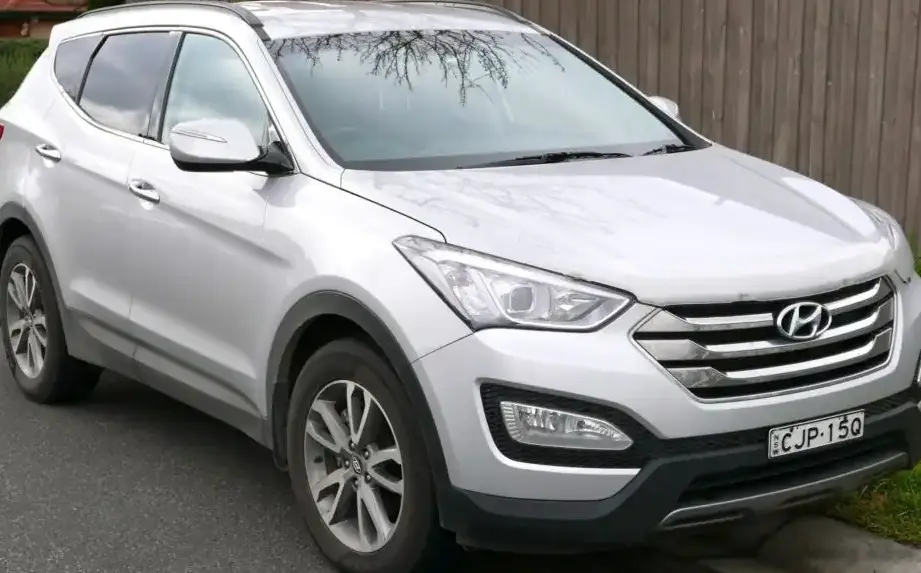
The Hyundai Santa Fe III (DM) 2.0 CRDi, producing 150 horsepower, was a key variant in Hyundai’s lineup from 2013 to 2015. Positioned as a mid-range offering within the third-generation Santa Fe (DM) series, it aimed to balance fuel efficiency with practicality for families. This model was primarily sold in the European and Asian markets, where diesel engines were favored for their economy, and represented Hyundai’s growing ambition to compete with established brands in the SUV segment. The DM generation Santa Fe was notable for offering both five and seven-seat configurations, catering to a wider range of customer needs.
Technical Specifications
| Brand | Hyundai |
| Model | Santa Fe |
| Generation | Santa Fe III (DM) |
| Type (Engine) | 2.0 CRDi (150 Hp) |
| Start of production | 2013 |
| End of production | 2015 |
| Powertrain Architecture | Internal Combustion engine |
| Body type | SUV |
| Seats | 7 |
| Doors | 5 |
| Fuel consumption (urban) | 8.1 l/100 km (29 US mpg, 34.9 UK mpg, 12.3 km/l) |
| Fuel consumption (extra urban) | 4.9 l/100 km (48 US mpg, 57.6 UK mpg, 20.4 km/l) |
| Fuel consumption (combined) | 6.1 l/100 km (38.6 US mpg, 46.3 UK mpg, 16.4 km/l) |
| Fuel Type | Diesel |
| Acceleration 0 – 100 km/h | 11 sec |
| Acceleration 0 – 62 mph | 11 sec |
| Acceleration 0 – 60 mph | 10.5 sec |
| Maximum speed | 187 km/h (116.2 mph) |
| Emission standard | Euro 6 |
| Weight-to-power ratio | 11.3 kg/Hp, 88.1 Hp/tonne |
| Weight-to-torque ratio | 4.4 kg/Nm, 225 Nm/tonne |
| Power | 150 Hp @ 4000 rpm |
| Power per litre | 75.2 Hp/l |
| Torque | 383 Nm @ 1800-2500 rpm (282.49 lb.-ft. @ 1800-2500 rpm) |
| Engine layout | Front, Transverse |
| Engine Model/Code | R II / D4HA |
| Engine displacement | 1995 cm3 (121.74 cu. in.) |
| Number of cylinders | 4 |
| Engine configuration | Inline |
| Cylinder Bore | 84 mm (3.31 in.) |
| Piston Stroke | 90 mm (3.54 in.) |
| Compression ratio | 16.5:1 |
| Number of valves per cylinder | 4 |
| Fuel injection system | Diesel Commonrail |
| Engine aspiration | Turbocharger, Intercooler |
| Valvetrain | DOHC |
| Engine oil capacity | 6.7 l (7.08 US qt | 5.9 UK qt) |
| Coolant | 9.1 l (9.62 US qt | 8.01 UK qt) |
| Kerb Weight | 1702 kg (3752.27 lbs.) |
| Max. weight | 2510 kg (5533.6 lbs.) |
| Max load | 808 kg (1781.34 lbs.) |
| Trunk (boot) space – minimum | 585 l (20.66 cu. ft.) |
| Trunk (boot) space – maximum | 1570 l (55.44 cu. ft.) |
| Fuel tank capacity | 64 l (16.91 US gal | 14.08 UK gal) |
| Length | 4690 mm (184.65 in.) |
| Width | 1880 mm (74.02 in.) |
| Height | 1680 mm (66.14 in.) |
| Wheelbase | 2700 mm (106.3 in.) |
| Front track | 1633 mm (64.29 in.) |
| Rear (Back) track | 1644 mm (64.72 in.) |
| Minimum turning circle | 10.9 m (35.76 ft.) |
| Drivetrain Architecture | ICE, Front wheel drive |
| Drive wheel | Front wheel drive |
| Number of gears | 6 gears, manual transmission |
| Front suspension | Independent type McPherson |
| Rear suspension | Independent coil spring |
| Front brakes | Ventilated discs |
| Rear brakes | Disc |
| Assisting systems | ABS (Anti-lock braking system) |
| Steering type | Steering rack and pinion |
| Power steering | Electric Steering |
| Tires size | 235/65 R17; 235/60 R18; 235/55 R19 |
| Wheel rims size | 7.0J x 17; 7.5J x 18; 7.5J x 19 |
INTRODUCTION
The Hyundai Santa Fe III (DM) 2.0 CRDi 150 hp, produced between 2013 and 2015, was a significant model for Hyundai, representing a step up in quality and refinement. Built on the 1HX0 platform (shared with the Kia Sorento), the DM Santa Fe aimed to provide a compelling alternative to established competitors like the Toyota RAV4 and Honda CR-V. The 2.0 CRDi engine, paired with a six-speed manual transmission, was positioned as a practical and economical choice for buyers prioritizing fuel efficiency and reasonable performance. It offered a balance between the lower-powered petrol options and the more expensive, higher-output diesel variants.
Powertrain & Engine Architecture
The heart of this Santa Fe variant is the Hyundai R-series 2.0-liter CRDi diesel engine, specifically the D4HA code. This engine utilizes a common-rail direct injection system, delivering fuel at extremely high pressure for improved combustion efficiency and reduced emissions. The engine features a turbocharger with an intercooler, boosting power output. The valvetrain employs a Double Overhead Camshaft (DOHC) configuration with four valves per cylinder, optimizing airflow for enhanced performance. The 150 horsepower output is achieved at 4,000 rpm, while the peak torque of 383 Nm (282.49 lb-ft) is available between 1800 and 2500 rpm, providing good low-end grunt for everyday driving. The six-speed manual transmission was the standard offering, providing a direct connection between the engine and the front wheels. The gear ratios were tuned for a balance of fuel economy and drivability, with a relatively tall final drive to aid in highway cruising.
Driving Characteristics
The 2.0 CRDi 150 hp Santa Fe offered a comfortable and composed driving experience. While not particularly sporty, the engine provided sufficient power for most driving situations. Acceleration from 0 to 100 km/h (0-62 mph) took around 11 seconds, which was adequate but not exhilarating. The readily available torque made overtaking at highway speeds relatively easy. Compared to the more powerful 2.2 CRDi variants, this engine felt less strained during acceleration and offered better fuel economy. The manual transmission allowed for greater driver control, but the shift quality was generally smooth and precise. The suspension, tuned for comfort, absorbed bumps and imperfections in the road well, providing a stable and predictable ride.
Equipment & Trim Levels
The 2.0 CRDi 150 hp Santa Fe typically came with a respectable level of standard equipment. This included air conditioning, power windows, central locking, and a basic audio system with USB connectivity. Higher trim levels added features such as alloy wheels, a touchscreen infotainment system with navigation, rear parking sensors, and a panoramic sunroof. Interior upholstery was typically cloth, with leather options available on higher-spec models. Safety features included ABS, Electronic Stability Control (ESC), and multiple airbags. The Santa Fe DM offered a spacious interior, with ample room for passengers and luggage. The seven-seat configuration provided flexibility for larger families, although the third-row seats were best suited for children.
Chassis & Braking
The Santa Fe DM utilized an independent McPherson strut suspension setup at the front, providing good handling and ride comfort. The rear suspension employed an independent coil spring arrangement, further enhancing ride quality. The braking system consisted of ventilated discs at the front and solid discs at the rear, providing adequate stopping power for the vehicle’s weight. ABS (Anti-lock Braking System) was standard, enhancing safety during emergency braking situations. The steering was a rack and pinion system with electric power assistance, offering a light and responsive feel.
Market Reception & Comparison
The Hyundai Santa Fe III (DM) 2.0 CRDi 150 hp was generally well-received by automotive critics. It was praised for its spacious interior, comfortable ride, and competitive fuel economy. However, some reviewers noted that the engine could feel underpowered when fully loaded or driving uphill. Compared to the higher-output diesel variants, the 2.0 CRDi offered a more affordable entry point into the Santa Fe range. It also provided better fuel economy than the petrol engines. Reliability reports have generally been positive, with few major issues reported with the engine or transmission.
Legacy
The Hyundai Santa Fe III (DM) 2.0 CRDi 150 hp remains a popular choice in the used car market. Its combination of practicality, fuel efficiency, and affordability makes it an attractive option for families and budget-conscious buyers. The R-series diesel engine has proven to be relatively durable, although regular maintenance is essential to ensure long-term reliability. Common issues include diesel particulate filter (DPF) clogging, particularly on vehicles that are primarily used for short journeys. Overall, the 2.0 CRDi 150 hp Santa Fe represents a solid and dependable SUV that continues to offer good value for money.