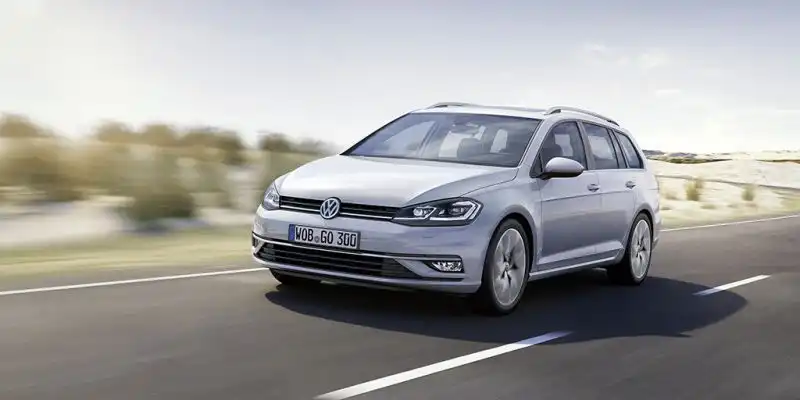
The Volkswagen Golf VII Variant GTD 2.0 TDI (184 hp) represents a compelling blend of practicality, efficiency, and performance within the seventh generation Golf lineup. Produced from 2017 to 2019 as part of the facelifted Golf VII range (internally designated as the 5G model), this variant occupied a sweet spot for buyers seeking a diesel-powered wagon with genuine driving appeal. It built upon the success of previous Golf GTD models, offering a more refined and technologically advanced package compared to its predecessors. The “Variant” designation signifies the station wagon (estate) body style, providing increased cargo capacity and versatility compared to the standard hatchback.
Technical Specifications
| Brand | Volkswagen |
| Model | Golf |
| Generation | Golf VII Variant (facelift 2017) |
| Type (Engine) | GTD 2.0 TDI (184 Hp) |
| Start of production | 2017 |
| End of production | 2019 |
| Powertrain Architecture | Internal Combustion engine |
| Body type | Station wagon (estate) |
| Seats | 5 |
| Doors | 5 |
| Fuel consumption (urban) | 5.5 l/100 km (42.8 US mpg, 51.4 UK mpg, 18.2 km/l) |
| Fuel consumption (extra urban) | 4.3 l/100 km (54.7 US mpg, 65.7 UK mpg, 23.3 km/l) |
| Fuel consumption (combined) | 4.7 l/100 km (50 US mpg, 60.1 UK mpg, 21.3 km/l) |
| CO2 emissions | 124 g/km |
| Fuel Type | Diesel |
| Acceleration 0 – 100 km/h | 7.9 sec |
| Acceleration 0 – 62 mph | 7.9 sec |
| Acceleration 0 – 60 mph | 7.5 sec |
| Maximum speed | 231 km/h (143.54 mph) |
| Emission standard | Euro 6 |
| Weight-to-power ratio | 7.6 kg/Hp, 132.3 Hp/tonne |
| Weight-to-torque ratio | 3.7 kg/Nm, 273.2 Nm/tonne |
| Power | 184 Hp @ 3500-4000 rpm |
| Power per litre | 93.5 Hp/l |
| Torque | 380 Nm @ 1750-3250 rpm (280.27 lb.-ft. @ 1750-3250 rpm) |
| Engine layout | Front, Transverse |
| Engine Model/Code | CUNA, DGCA |
| Engine displacement | 1968 cm3 (120.09 cu. in.) |
| Number of cylinders | 4 |
| Engine configuration | Inline |
| Number of valves per cylinder | 4 |
| Fuel injection system | Diesel Commonrail |
| Engine aspiration | Turbocharger, Intercooler |
| Engine oil capacity | 4.7 l (4.97 US qt | 4.14 UK qt) |
| Kerb Weight | 1391 kg (3066.63 lbs.) |
| Max. weight | 1990 kg (4387.2 lbs.) |
| Max load | 599 kg (1320.57 lbs.) |
| Trunk (boot) space – minimum | 605 l (21.37 cu. ft.) |
| Trunk (boot) space – maximum | 1620 l (57.21 cu. ft.) |
| Fuel tank capacity | 50 l (13.21 US gal | 11 UK gal) |
| Max. roof load | 75 kg (165.35 lbs.) |
| Permitted trailer load with brakes (8%) | 1800 kg (3968.32 lbs.) |
| Permitted trailer load with brakes (12%) | 1600 kg (3527.4 lbs.) |
| Permitted trailer load without brakes | 730 kg (1609.37 lbs.) |
| Permitted towbar download | 80 kg (176.37 lbs.) |
| Length | 4567 mm (179.8 in.) |
| Width | 1799 mm (70.83 in.) |
| Width including mirrors | 2027 mm (79.8 in.) |
| Height | 1515 mm (59.65 in.) |
| Wheelbase | 2620 mm (103.15 in.) |
| Front track | 1533-1549 mm (60.35 – 60.98 in.) |
| Rear (Back) track | 1504-1520 mm (59.21 – 59.84 in.) |
| Ride height (ground clearance) | 131 mm (5.16 in.) |
| Minimum turning circle (turning diameter) | 10.9 m (35.76 ft.) |
| Drive wheel | Front wheel drive |
| Number of gears and type of gearbox | 6 gears, manual transmission |
| Front brakes | Ventilated discs |
| Rear brakes | Disc |
| Assisting systems | ABS (Anti-lock braking system) |
| Steering type | Steering rack and pinion |
| Power steering | Electric Steering |
| Tires size | 205/55 R16; 225/40 R18; 225/35 R19 |
| Wheel rims size | 6J x 16; 7.5J x 18; 7.5J x 19 |
Powertrain & Engine Architecture
At the heart of the Golf VII Variant GTD lies the 2.0-liter four-cylinder diesel engine, specifically the CUNA or DGCA engine codes depending on the exact production date and market. This engine is a member of the Volkswagen Group’s modular engine family, known for its robust construction and efficiency. It utilizes a common rail direct injection system, delivering fuel directly into the combustion chamber at extremely high pressure for optimized combustion. The engine also features a turbocharger with an intercooler, boosting power output and improving throttle response. The valvetrain employs four valves per cylinder, enhancing breathing and contributing to the engine’s overall performance. The 184 horsepower and 380 Nm (280 lb-ft) of torque are delivered across a broad rev range, making it a flexible and usable powerplant. The engine is transversely mounted in the front of the vehicle, driving the front wheels. The six-speed manual transmission was standard, providing precise gear changes and a direct connection to the engine.
Driving Characteristics
The 184 hp GTD variant offered a noticeably more engaging driving experience than lower-powered Golf VII Variants. While not as overtly sporty as the GTI, the GTD provided ample power for everyday driving and confident overtaking maneuvers. The turbocharger provides a surge of torque from relatively low engine speeds, resulting in strong acceleration. The six-speed manual transmission allows the driver to fully exploit the engine’s powerband. Compared to the 1.6 TDI models, the 2.0 TDI GTD felt significantly more refined and responsive. The gear ratios were well-chosen, providing a balance between acceleration and fuel economy. The suspension, while tuned for comfort, offered a reasonable level of body control, making the Golf Variant GTD a pleasant car to drive on both city streets and winding country roads.
Equipment & Trim Levels
The GTD trim level was positioned as the mid-range performance offering in the Golf VII Variant lineup, sitting below the GTI but above the more economy-focused trims. Standard equipment typically included sport seats upholstered in a unique fabric pattern, a leather-wrapped multi-function steering wheel, and distinctive GTD badging both inside and out. Infotainment systems varied depending on the year and market, but generally included a touchscreen display with Bluetooth connectivity and USB ports. Optional extras included features such as a panoramic sunroof, adaptive cruise control, and a premium sound system. The interior generally featured a dark color scheme with subtle red accents, reinforcing the GTD’s sporty character.
Chassis & Braking
The Golf VII Variant GTD utilized a MacPherson strut front suspension and a multi-link rear suspension, providing a comfortable yet controlled ride. The braking system consisted of ventilated disc brakes at the front and solid disc brakes at the rear. ABS (Anti-lock Braking System) was standard, enhancing safety and stability during emergency braking. The steering was an electric power steering system, offering precise control and a variable steering ratio. Stabilizer bars were fitted to both the front and rear axles, reducing body roll during cornering.
Market Reception & Comparison
The Golf VII Variant GTD was generally well-received by automotive critics, who praised its blend of performance, efficiency, and practicality. It was often lauded as a more sensible alternative to the GTI, offering a similar level of driving enjoyment with significantly better fuel economy. Compared to other diesel wagons in its class, the Golf GTD stood out for its refined engine, comfortable ride, and high-quality interior. Fuel economy figures consistently exceeded those of its gasoline-powered counterparts, making it an attractive option for drivers who covered long distances. Reliability was generally good, although some owners reported issues with the diesel particulate filter (DPF) system, a common concern with modern diesel engines.
Legacy
The Golf VII Variant GTD 2.0 TDI (184 hp) remains a popular choice in the used car market today. Its reputation for reliability, fuel efficiency, and driving enjoyment has ensured strong demand. The 2.0 TDI engine, while subject to some scrutiny regarding emissions in the wake of the “Dieselgate” scandal, has proven to be a durable and long-lasting powerplant when properly maintained. The availability of spare parts and a large network of Volkswagen service centers further contribute to its appeal. The Golf VII Variant GTD represents a high point in the development of the diesel-powered wagon, offering a compelling combination of practicality, performance, and efficiency.