Technical Specifications
| Brand | Opel |
| Model | Astra |
| Generation | Astra J (facelift 2012) |
| Type (Engine) | 1.7 CDTI (130 Hp) Ecotec |
| Start of production | 2012 |
| End of production | 2014 |
| Powertrain Architecture | Internal Combustion engine |
| Body type | Hatchback |
| Seats | 5 |
| Doors | 5 |
| Fuel consumption (urban) | 5.4 l/100 km (43.6 US mpg, 52.3 UK mpg, 18.5 km/l) |
| Fuel consumption (extra urban) | 4 l/100 km (58.8 US mpg, 70.6 UK mpg, 25 km/l) |
| Fuel consumption (combined) | 4.5 l/100 km (52.3 US mpg, 62.8 UK mpg, 22.2 km/l) |
| CO2 emissions | 119 g/km |
| Fuel Type | Diesel |
| Acceleration 0 – 100 km/h | 10.6 sec |
| Acceleration 0 – 62 mph | 10.6 sec |
| Acceleration 0 – 60 mph | 10.1 sec |
| Maximum speed | 198 km/h (123.03 mph) |
| Emission standard | Euro 5 |
| Weight-to-power ratio | 10.5 kg/Hp, 94.9 Hp/tonne |
| Weight-to-torque ratio | 4.6 kg/Nm, 219 Nm/tonne |
| Power | 130 Hp @ 4000 rpm |
| Power per litre | 77.1 Hp/l |
| Torque | 300 Nm @ 2000-2700 rpm (221.27 lb.-ft. @ 2000-2700 rpm) |
| Engine layout | Front, Transverse |
| Engine Model/Code | A17DTS |
| Engine displacement | 1686 cm3 (102.89 cu. in.) |
| Number of cylinders | 4 |
| Engine configuration | Inline |
| Cylinder Bore | 79 mm (3.11 in.) |
| Piston Stroke | 86 mm (3.39 in.) |
| Number of valves per cylinder | 4 |
| Fuel injection system | Diesel Commonrail |
| Engine aspiration | Turbocharger, Intercooler |
| Engine oil capacity | 5.4 l (5.71 US qt | 4.75 UK qt) |
| Coolant capacity | 7.1 l (7.5 US qt | 6.25 UK qt) |
| Kerb Weight | 1370 kg (3020.33 lbs.) |
| Max. weight | 1940 kg (4276.97 lbs.) |
| Max load | 570 kg (1256.63 lbs.) |
| Trunk (boot) space – minimum | 370 l (13.07 cu. ft.) |
| Trunk (boot) space – maximum | 1235 l (43.61 cu. ft.) |
| Fuel tank capacity | 56 l (14.79 US gal | 12.32 UK gal) |
| Max. roof load | 75 kg (165.35 lbs.) |
| Length | 4419 mm (173.98 in.) |
| Width | 1814 mm (71.42 in.) |
| Width with mirrors folded | 1831 mm (72.09 in.) |
| Width including mirrors | 2013 mm (79.25 in.) |
| Height | 1510 mm (59.45 in.) |
| Wheelbase | 2685 mm (105.71 in.) |
| Front track | 1541 mm (60.67 in.) |
| Rear (Back) track | 1551 mm (61.06 in.) |
| Minimum turning circle | 11.4 m (37.4 ft.) |
| Drivetrain Architecture | Front wheel drive |
| Number of gears and type of gearbox | 6 gears, manual transmission |
| Front brakes | Ventilated discs |
| Assisting systems | ABS (Anti-lock braking system) |
| Steering type | Steering rack and pinion |
| Power steering | Electric Steering |
| Tires size | 205/60 R16 |
| Wheel rims size | 16 |
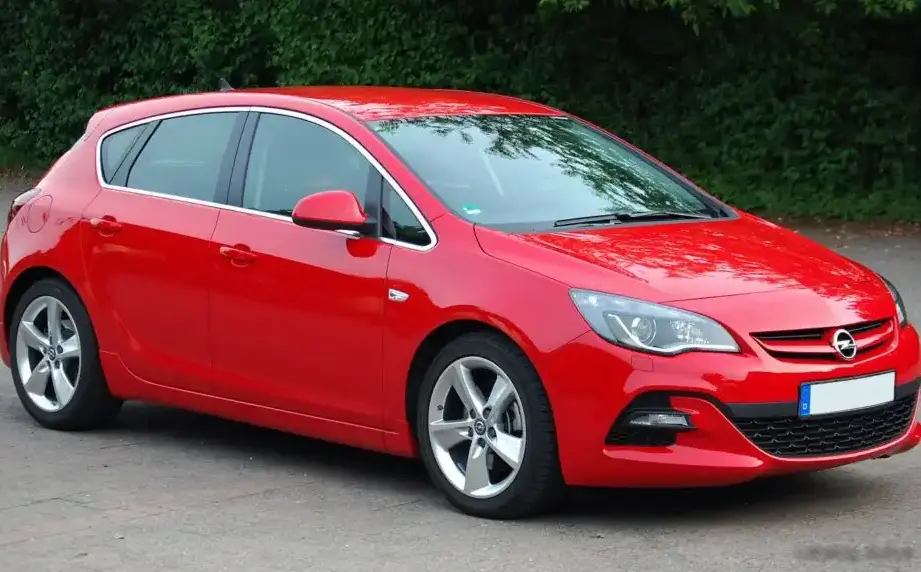
The Opel Astra J (facelift, introduced in 2012) 1.7 CDTI Ecotec, producing 130 horsepower, was a significant offering within the compact car segment in Europe. Positioned as a fuel-efficient and practical option, this variant aimed to balance performance with economy, appealing to a broad range of buyers. Production of this specific configuration ran from 2012 to 2014, falling within the broader J-series Astra lifespan (2009-2015). The facelift brought styling updates and refinements to the Astra J, enhancing its appeal in a competitive market. This model was primarily sold in Europe, where diesel engines held a substantial market share due to favorable taxation and fuel costs.
Powertrain & Engine Architecture
The heart of this Astra variant is the A17DTS engine, a 1.7-liter inline-four cylinder diesel. This engine belongs to Opel/Vauxhall’s ‘Ecotec’ family, known for its focus on efficiency and reduced emissions. The A17DTS utilizes a common rail direct injection system, delivering fuel at extremely high pressure for optimized combustion. A turbocharger with an intercooler is employed to boost power output, providing 130 horsepower at 4000 rpm and a substantial 300 Nm (221 lb-ft) of torque between 2000 and 2700 rpm. This torque curve is characteristic of diesel engines, offering strong pulling power at lower engine speeds. The engine features four valves per cylinder and a timing belt. The 6-speed manual transmission was the standard offering, chosen for its efficiency and driver engagement. While an automatic transmission was available on other Astra J models, it wasn’t typically paired with this specific 1.7 CDTI engine.
Driving Characteristics
The 1.7 CDTI with the manual gearbox provided a practical and economical driving experience. Acceleration to 62 mph (100 km/h) took around 10.6 seconds, which was adequate for everyday driving but not particularly sporty. The strength of this powertrain lay in its mid-range torque, making it easy to overtake and maintain speed on highways. The gear ratios were well-matched to the engine’s characteristics, allowing for relaxed cruising at motorway speeds. Compared to the more powerful 1.4 Turbo petrol or the 2.0 CDTI diesel variants, the 1.7 CDTI felt less refined and offered less outright performance. However, it significantly outperformed those options in terms of fuel economy, achieving combined figures of around 4.5 l/100 km (52.3 US mpg).
Equipment & Trim Levels
The 1.7 CDTI typically came in lower to mid-range trim levels, such as ‘Essentia’ or ‘Sport’. Standard equipment generally included air conditioning, electric front windows, a CD/radio system, and ABS brakes. Higher trim levels added features like alloy wheels, cruise control, a multi-function steering wheel, and upgraded interior trim. Interior upholstery was typically cloth, with options for more premium materials on higher-spec models. The dashboard layout was functional and straightforward, prioritizing usability over luxury.
Chassis & Braking
The Astra J utilized a MacPherson strut front suspension and a torsion beam rear suspension. This setup provided a good balance between ride comfort and handling. The front brakes were ventilated discs, while the rear brakes were typically solid discs on higher trims, but drums on base models. Electric power steering was standard, offering light and precise steering feel. The chassis was tuned for comfort, but the Astra J still offered decent handling characteristics, particularly in the corners.
Market Reception & Comparison
The Opel Astra J 1.7 CDTI was well-received by critics for its fuel efficiency and practicality. It was often praised as a sensible choice for drivers who prioritized economy over performance. Compared to the petrol-powered Astra J models, the 1.7 CDTI offered significantly better fuel economy and lower running costs. However, it was generally considered less refined and less engaging to drive than the more powerful petrol and diesel variants. Against competitors like the Ford Focus, Volkswagen Golf, and Peugeot 308, the Astra J 1.7 CDTI held its own in terms of value for money and fuel efficiency.
Legacy
The A17DTS engine, while not known for being exceptionally durable, proved to be reasonably reliable with regular maintenance. Common issues included turbocharger wear, injector problems, and occasional issues with the diesel particulate filter (DPF). On the used car market, the Astra J 1.7 CDTI remains a popular choice for budget-conscious buyers. Its fuel efficiency and practicality continue to appeal to those seeking a reliable and economical compact car. However, potential buyers should be aware of the potential maintenance costs associated with diesel engines, particularly the DPF and turbocharger.