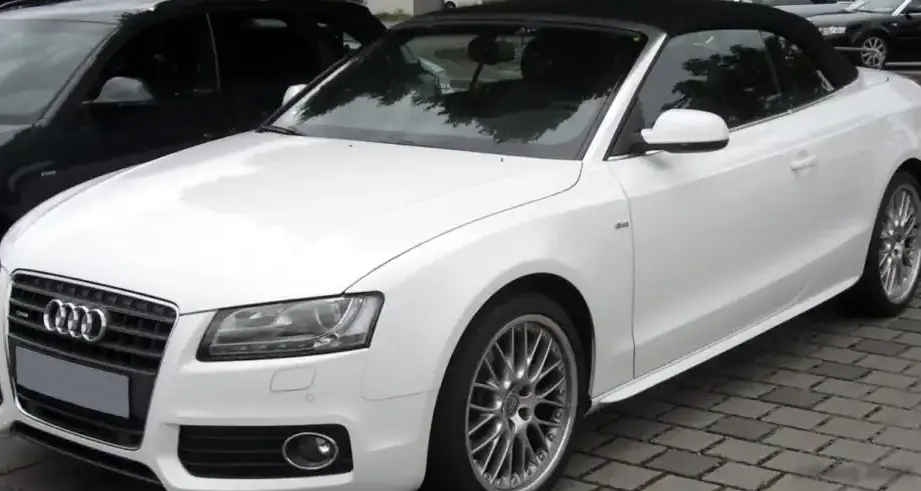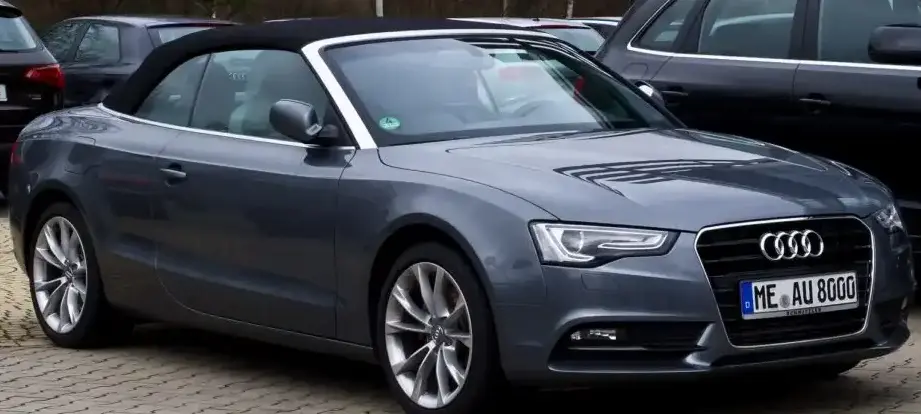
The Audi A5 Cabriolet, specifically the 8F7 facelift model produced from 2011 to 2013, represented Audi’s entry into the premium mid-size convertible market. This iteration of the A5 Cabriolet built upon the success of the original A5, offering a refreshed design, improved technology, and a range of engine options. The 2.0 TFSI variant, producing 211 horsepower, occupied a central position in the A5 Cabriolet lineup, balancing performance, fuel efficiency, and price. It was positioned above the base 1.8 TFSI models and below the more potent S5 Cabriolet.
Technical Specifications
| Brand | Audi |
| Model | A5 |
| Generation | A5 Cabriolet (8F7, facelift 2011) |
| Type (Engine) | 2.0 TFSI (211 Hp) |
| Start of production | 2011 |
| End of production | 2013 |
| Powertrain Architecture | Internal Combustion engine |
| Body type | Cabriolet |
| Seats | 4 |
| Doors | 2 |
| Fuel consumption (urban) | 8.6 l/100 km (27.4 US mpg, 32.8 UK mpg, 11.6 km/l) |
| Fuel consumption (extra urban) | 5.4 l/100 km (43.6 US mpg, 52.3 UK mpg, 18.5 km/l) |
| Fuel consumption (combined) | 6.6 l/100 km (35.6 US mpg, 42.8 UK mpg, 15.2 km/l) |
| CO2 emissions | 154 g/km |
| Fuel Type | Petrol (Gasoline) |
| Acceleration 0 – 100 km/h | 7.5 sec |
| Acceleration 0 – 62 mph | 7.5 sec |
| Acceleration 0 – 60 mph | 7.1 sec |
| Maximum speed | 241 km/h (149.75 mph) |
| Emission standard | Euro 6 |
| Weight-to-power ratio | 7.7 kg/Hp, 129.4 Hp/tonne |
| Weight-to-torque ratio | 4.7 kg/Nm, 214.7 Nm/tonne |
| Power | 211 Hp @ 4300-6000 rpm |
| Power per litre | 106.4 Hp/l |
| Torque | 350 Nm @ 1500-4200 rpm (258.15 lb.-ft. @ 1500-4200 rpm) |
| Engine layout | Front, Longitudinal |
| Engine Model/Code | CDNC |
| Engine displacement | 1984 cm3 (121.07 cu. in.) |
| Number of cylinders | 4 |
| Engine configuration | Inline |
| Cylinder Bore | 82.5 mm (3.25 in.) |
| Piston Stroke | 92.8 mm (3.65 in.) |
| Compression ratio | 9.6:1 |
| Number of valves per cylinder | 4 |
| Fuel injection system | Direct injection |
| Engine aspiration | Turbocharger, Intercooler |
| Valvetrain | DOHC |
| Engine oil capacity | 4.6 l (4.86 US qt | 4.05 UK qt) |
| Kerb Weight | 1630 kg (3593.53 lbs.) |
| Max. weight | 2130 kg (4695.85 lbs.) |
| Max load | 500 kg (1102.31 lbs.) |
| Trunk (boot) space – minimum | 320 l (11.3 cu. ft.) |
| Trunk (boot) space – maximum | 750 l (26.49 cu. ft.) |
| Fuel tank capacity | 63 l (16.64 US gal | 13.86 UK gal) |
| Permitted trailer load with brakes (8%) | 1700 kg (3747.86 lbs.) |
| Permitted trailer load without brakes | 750 kg (1653.47 lbs.) |
| Permitted towbar download | 80 kg (176.37 lbs.) |
| Length | 4626 mm (182.13 in.) |
| Width | 1854 mm (72.99 in.) |
| Width including mirrors | 2020 mm (79.53 in.) |
| Height | 1383 mm (54.45 in.) |
| Wheelbase | 2751 mm (108.31 in.) |
| Front track | 1590 mm (62.6 in.) |
| Rear (Back) track | 1577 mm (62.09 in.) |
| Front overhang | 861 mm (33.9 in.) |
| Rear overhang | 1014 mm (39.92 in.) |
| Drag coefficient (Cd) | 0.31 |
| Minimum turning circle (turning diameter) | 11.4 m (37.4 ft.) |
| Drivetrain Architecture | The Internal combustion engine (ICE) drives the front wheels of the vehicle. |
| Drive wheel | Front wheel drive |
| Number of gears and type of gearbox | 6 gears, manual transmission |
| Front suspension | Independent multi-link suspension |
| Rear suspension | Independent on trapezoidal lever |
| Front brakes | Ventilated discs |
| Rear brakes | Disc |
| Assisting systems | ABS (Anti-lock braking system) |
| Steering type | Steering rack and pinion |
| Power steering | Electric Steering |
| Tires size | 225/50 R17 |
| Wheel rims size | 7.5J x 17 |
Powertrain & Engine Architecture
The heart of the A5 Cabriolet 2.0 TFSI was the CDNC engine, a 1.984-liter inline-four cylinder gasoline engine. This engine was part of Audi’s EA888 family, known for its robust design and tuning potential. The CDNC featured direct fuel injection (FSI) and a single turbocharger with an intercooler, allowing for a good balance of power and efficiency. The engine utilized a dual overhead camshaft (DOHC) valvetrain with four valves per cylinder. The 211 horsepower output was achieved through careful calibration of the engine management system and turbocharger boost. The engine’s torque peak of 350 Nm (258 lb-ft) was available across a broad rev range, from 1500 to 4200 rpm, providing strong mid-range acceleration. The engine was paired with a six-speed manual transmission as standard, offering precise gear changes and driver engagement.
Driving Characteristics
The 2.0 TFSI-equipped A5 Cabriolet offered a refined and enjoyable driving experience. While not as overtly sporty as the S5, the 211 hp engine provided ample power for both city driving and highway cruising. Acceleration from 0 to 60 mph took approximately 7.1 seconds. The broad torque curve meant that overtaking maneuvers were executed with ease. The six-speed manual transmission allowed drivers to fully exploit the engine’s powerband. Compared to the 1.8 TFSI models, the 2.0 TFSI offered a noticeable performance upgrade, while remaining more fuel-efficient than the higher-output S5. The A5 Cabriolet’s chassis was well-tuned, providing a comfortable ride without sacrificing handling precision. The convertible top, a fabric soft top, offered good insulation from wind and road noise when raised.
Equipment & Trim Levels
The A5 Cabriolet 2.0 TFSI typically came well-equipped as standard. Features included leather upholstery, automatic climate control, a multi-function steering wheel, and an Audi Concert audio system. Optional extras included Audi’s MMI navigation system, Bang & Olufsen sound system, heated seats, and parking sensors. Trim levels varied depending on the market, but generally offered progressively more luxurious features and styling enhancements. Common options included sport seats, different wheel designs, and various interior trim packages.
Chassis & Braking
The A5 Cabriolet featured a sophisticated chassis design. The front suspension utilized independent multi-link suspension, while the rear suspension employed an independent trapezoidal link setup. This configuration provided a good balance of ride comfort and handling precision. The braking system consisted of ventilated discs at the front and solid discs at the rear, providing adequate stopping power. Anti-lock braking system (ABS) was standard. The A5 Cabriolet’s steering was precise and well-weighted, offering good feedback to the driver.
Market Reception & Comparison
The Audi A5 Cabriolet 2.0 TFSI was generally well-received by automotive critics. It was praised for its stylish design, refined interior, and enjoyable driving experience. The 2.0 TFSI engine was considered a good compromise between performance and fuel efficiency. Compared to rivals such as the BMW 3 Series Convertible and Mercedes-Benz C-Class Cabriolet, the A5 Cabriolet offered a compelling package. Fuel economy was competitive, averaging around 35.6 US mpg in combined driving. Reliability was generally good, although some owners reported minor issues with the turbocharger and fuel injectors.
Legacy
The Audi A5 Cabriolet 2.0 TFSI (8F7) has proven to be a relatively reliable and durable vehicle. The EA888 engine, while not without its potential issues, is generally considered robust when properly maintained. Today, these cars are readily available on the used car market at reasonable prices. They remain a popular choice for buyers seeking a stylish and well-equipped convertible. Regular maintenance, including oil changes and timing belt replacements, is crucial for ensuring the long-term reliability of the 2.0 TFSI engine. The A5 Cabriolet’s timeless design and enjoyable driving experience continue to make it a desirable option for enthusiasts.